
Anu
Father of the gods — the Mesopotamian sky, whose written sign meant "god" itself; the source of all authority, and almost never the one who uses it.
Ziggurat of the Anu district and the White Temple, Uruk (Warka), Iraq, c. 3500-3000 BCE · CC BY-SA 2.0 · source
The Sign That Means "God"
Anu, Sumerian An, is the sky. The word is the ordinary Sumerian noun for heaven, and the cuneiform sign that writes it — an eight-pointed star — is also the determinative placed before the name of every deity in the writing system, the silent marker that says the following is a god 7. No other Mesopotamian divinity is embedded in the script that way, and it is the clearest indication of how the tradition ranked him 7.
He heads the great triad of An, Enlil, and Enki, dividing the cosmos into heaven, the atmosphere and earth, and the waters beneath 7. In the oldest cosmogonies the sky and the earth were joined and had to be pulled apart; An takes heaven upward and Enlil keeps what is left 6,7. The gods collectively are the Anunnaki, a name usually understood as "offspring of An," which makes his fatherhood a matter of definition rather than of story 7.
Authority Without Action
Anu is the source of anutu, "Anu-ship," the abstract quality of sovereign rank that can be conferred on another god 6,7. Kingship, in Mesopotamian thought, descends from heaven, and it is his to grant. He presides over the divine assembly, and the formula for a legitimate decision is that An and Enlil have decreed it 6.
What he does not do is intervene. Jacobsen described him as authority in its most abstract form — the power that commands assent rather than the power that acts — and noted that in practice the executive work belongs to Enlil, the cunning to Enki, and the fighting to a champion 6. Anu is invoked constantly in oaths, curses, and royal titles, and appears in remarkably few narratives as an agent. When theology later transfers supreme kingship to Marduk, the poem takes care to have Anu among the gods who hand it over, because a transfer he did not sanction would not count 1,6.
Uruk and the Eanna
Anu's chief cult centre was Uruk, where the temple Eanna, "House of Heaven," was shared with — and eventually dominated by — Inanna 7. The arrangement is a good picture of his career: the older, higher god slowly ceding the daily life of his own sanctuary to a more vivid neighbour 7.
That is not the end of the story. In the Seleucid period, over a thousand years later, Uruk saw a deliberate revival of Anu's cult, with a new temple complex, the Bit Resh, built for him and his consort Antu, and a body of ritual texts prescribing their processions and offerings in extraordinary detail 7. Late Babylonian scholarship reorganised its own pantheon around the sky father, at the very end of cuneiform civilisation 7.
The Bull of Heaven
Anu's best-known appearance in narrative is as a father being argued with. In Tablet VI of the Epic of Gilgamesh, Ishtar — Inanna under her Akkadian name — is publicly refused by Gilgamesh and goes up to heaven weeping to demand the Bull of Heaven so she can destroy him 2. Anu's first answer is a reproach: she provoked the insult herself, and the Bull's release will bring seven years of famine to Uruk, so has she laid up grain 2?
She has, she says, and then threatens to smash the doors of the underworld and let the dead out to eat the living if he refuses 2. He gives her the rope 2. The scene shows exactly how his authority works in practice: unquestioned in principle, and negotiable by anyone prepared to make a scene 2,6.
Adapa and the Bread of Life
The story of Adapa turns on the same distance. Adapa, a sage of Eridu and a servant of Ea, breaks the wing of the South Wind when it capsizes his fishing boat, and is summoned to heaven to answer for it 3,8. Ea coaches him: be humble, win over the gatekeepers, and refuse the food and water Anu offers, because they will be the bread and water of death 3.
Anu, mollified, offers instead the bread and water of life, and Adapa — obedient to his own god — refuses them and forfeits immortality for himself and for humankind 3,8. Whether Ea deceived him deliberately is left open, and the text does not resolve it 8. Anu, in the story, is simply the place where the offer is made and cannot be made again 3.
Symbols, Family, and Heirs
Anu's emblem is the horned crown set on a shrine or pedestal, the same headgear that marks divinity generally in Mesopotamian art 7. His consort is Antu in Akkadian tradition and Uraš or Ki, the earth, in Sumerian 7. His children are the pantheon: Enlil in the standard scheme, Adad the storm, the fire god Gibil, and the demons and diseases besides, since destructive powers are also traced to him 7.
He also does what fathers in myth do, which is set limits and then be argued out of them. In Atrahasis, the gods draw lots and heaven falls to him while Enlil takes earth and the human problem 5. In the Epic of Anzu, it is Anu's assembly that must find someone willing to face the thief of the Tablet of Destinies, and two gods refuse before Ninurta accepts 4,8. The pattern is consistent across a thousand years of literature: the highest god convenes, and someone else goes 6.
Continue Exploring
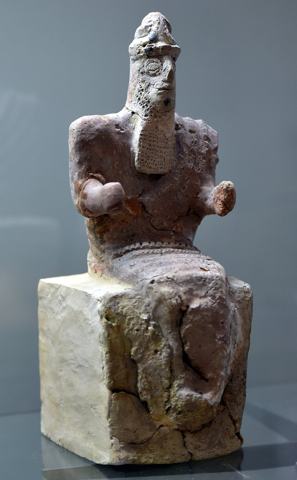
Lord of the moving air — the Sumerian executive of the gods, whose word carried out destinies, who split heaven from earth and sent the Flood.
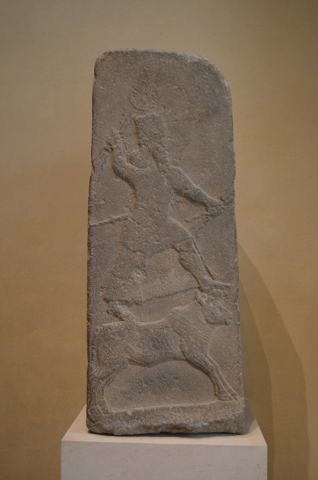
The Mesopotamian storm god who could drown the land in flood or bless it with rain, worshipped as Ishkur in Sumer and Adad across Babylonia and Assyria.
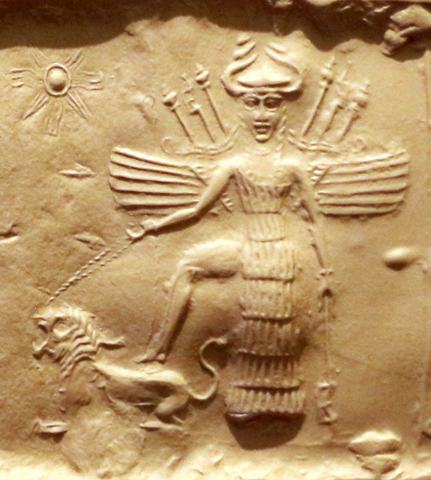
Queen of Heaven — Sumerian goddess of love, war, and the planet Venus, who walked into the land of the dead and was the only one to walk back out.
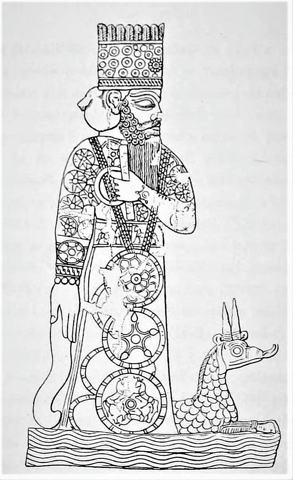
Champion of the gods — Babylon's patron, who killed the sea-dragon Tiamat, built heaven and earth out of her body, and was crowned king over all the gods.
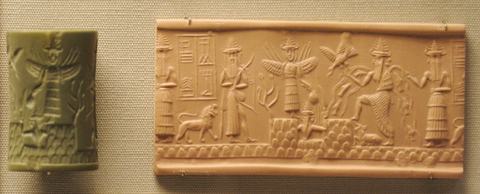
God of wisdom and the sweet water under the ground — the craftsman-trickster who made humankind, taught the crafts, and warned one man about the Flood.
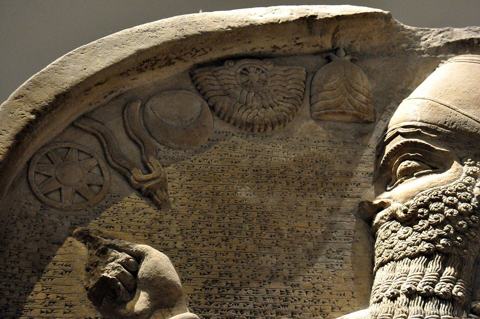
Son and champion of Enlil, who slew the demon Asag and the bird Anzu, and whose plow shaped the rivers and fields of Mesopotamia.
Also mentioned inGilgameshLamashtuNanna (Sin)NinhursagTiamat
Sources & Further Reading
- 1.Enuma Elish (the Babylonian Epic of Creation), Standard Babylonian recension.
- 2.The Epic of Gilgamesh, Standard Babylonian version, Tablet VI.
- 3.Adapa and the South Wind (Akkadian, Amarna and Nineveh fragments).
- 4.The Epic of Anzu, Standard Babylonian version.
- 5.Atrahasis (Old Babylonian Flood epic, c. 1700 BCE).
- 6.Jacobsen, Thorkild. The Treasures of Darkness: A History of Mesopotamian Religion. Yale University Press, 1976.
- 7.Black, Jeremy & Anthony Green. Gods, Demons and Symbols of Ancient Mesopotamia: An Illustrated Dictionary. British Museum Press, 1992.
- 8.Dalley, Stephanie. Myths from Mesopotamia. Oxford University Press, revised edition 2000.
Spot an error or have a source to suggest? Write to info@viseterna.com. We cite primary sources and modern scholarship, and we correct fast.