
Shamash (Utu)
Sumerian Utu, Akkadian Shamash — the sun god who sees everything, judge of heaven and earth, patron of law, oaths, travellers and the diviner's art.
Tablet of Shamash, Sippar, reign of Nabu-apla-iddina, 9th century BCE (British Museum) · CC BY-SA 4.0 · source
The God Who Sees Everything
Utu in Sumerian, Shamash in Akkadian, is the sun and, because the sun sees everything, the god of justice 6. The two functions are one idea in Mesopotamian thought: light exposes, and a god who crosses the whole sky every day is the only reliable witness to what people do when they think no one is watching 2,6. He is invoked to find thieves, to validate oaths, to guard travellers on the road, and to release the wrongly afflicted 2,7.
Unlike the sun deities of Anatolia and later Arabia, the Mesopotamian sun is male, and his name is the ordinary word for the sun itself, cognate with West Semitic shamsh 6. He belongs to a triad of visible sky gods with the moon god Nanna-Sin and the Venus goddess Inanna-Ishtar 6.
Family and Cult Cities
Standard tradition makes him the son of the moon god Nanna-Sin and Ningal, and the brother — in many texts the twin brother — of Inanna 6. His wife is Aya (Sumerian Sherida), goddess of dawn and of marital love; his vizier is Bunene, who drives his chariot; and his children include Kittum, "truth", and Misharum, "equity", personified abstractions that make his legal role explicit in the family tree 6.
He had two great cult cities, one in the south and one in the north: Larsa in Sumer and Sippar in Akkad 6. In both, his temple carried the same Sumerian name, Ebabbar, "the shining white house", and both sanctuaries were rebuilt and endowed repeatedly across two millennia, down to Nabonidus in the sixth century BCE 4,6.
Judge of Heaven and Earth
Mesopotamian law does not present itself as human invention. The stele of Hammurabi names Shamash as the god who gives the land its judgements, and the epilogue calls on him to curse any future king who defaces the laws; the relief on top of the stele shows the king standing before a seated deity who holds the rod and ring of authority, usually identified as Shamash, though the identification rests on iconography rather than a caption 1,6.
The Great Hymn to Shamash is the fullest statement of the ethic attached to him. Across roughly two hundred lines it praises the god for lighting the darkness, watching the caravan and the boat, and hearing the case of the powerless — and it turns to concrete commercial morality, promising long life and a prosperous heir to the merchant who uses honest weights, and destitution to the one who tampers with the scales 2,5. Lambert edited it as a central text of Babylonian wisdom literature, and Foster's translation notes how directly it links divine surveillance to everyday fair dealing 5,7.
Divination and the Diviner's Craft
Shamash is also, with the storm god Adad, the patron of extispicy — reading the future in the entrails of a sacrificed sheep 6,7. The diviner, the baru, addressed his query to the pair at night or at dawn, and the god was understood to write the answer into the animal's liver 6. Prayers used in that ritual survive in numbers, and they address Shamash as bel dini, "lord of the verdict", which is the same title he carries in a lawcourt 6,7.
The overlap is the point. Divination in Mesopotamia was a judicial procedure conducted with a god, not a fortune-telling art, and the god who presided over human courts naturally presided over that one too 6,7.
Iconography and the Sun God Tablet
In art Shamash is shown with rays rising from his shoulders, often holding a saw-toothed blade with which he cuts his way through the eastern mountains at dawn; his emblem is the four-pointed solar disc with wavy rays between the points 6. Cylinder seals of the Akkadian period show him stepping up between two peaks while gatekeepers hold the doors of the sky 6.
The finest surviving object connected with him is the Sun God Tablet from Sippar, made for King Nabu-apla-iddina in the ninth century BCE and found in antiquity-conscious circumstances: buried in a clay box with clay impressions of the relief itself 4,6. Its carved scene shows the god enthroned inside his shrine, with an enormous solar disc resting on an altar before him, drawn forward by ropes held by attendants; the accompanying text records that the old cult statue had been lost in an enemy raid and describes how a clay model was found and the image remade 4,6.
Where the Sun Goes at Night
The gates of heaven are a fixed part of the picture — an eastern door he leaves by and a western door he enters — but what happens between the two is genuinely disputed 8. An older scholarly consensus held that Shamash crossed the underworld at night, judging the dead as he went, which fits his epithet as judge of the shades and certain incantations 6,8.
Heimpel challenged this on the evidence of the texts themselves, arguing that the Babylonian sources rather describe the sun resting in an interior chamber of heaven with Aya between sunset and sunrise, and that the underworld journey is an inference imported from Egyptian religion 8. The debate is not fully closed, and both readings still appear in the literature; what is clear is that his jurisdiction extended below in some form, since prayers ask him to carry messages to the dead 6,8.
The Sun in the Epic
Gilgamesh gives the best narrative picture of him as a partisan. He is Gilgamesh's patron: Ninsun reproaches him for giving her son a restless heart, and when the heroes reach the Cedar Forest he pins Humbaba in place with thirteen winds so that the killing can be done 3. Later, when the gods condemn Enkidu, Shamash alone argues against the sentence and is shouted down by Enlil 3.
He appears once more as geography. When the grieving Gilgamesh crosses the twin-peaked mountain Mashu, he travels the sun's own night-road in absolute darkness, racing the sunrise for twelve double-hours — the one point in the epic where the god's daily route becomes a place a mortal can walk 3.
Continue Exploring
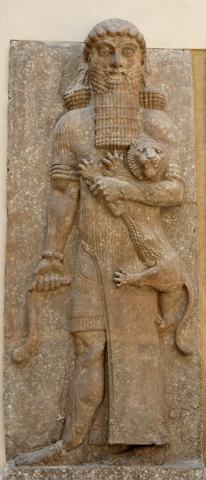
King of Uruk, two-thirds god and one-third man — the hero of the world's oldest surviving epic, who went to the ends of the earth to escape death.
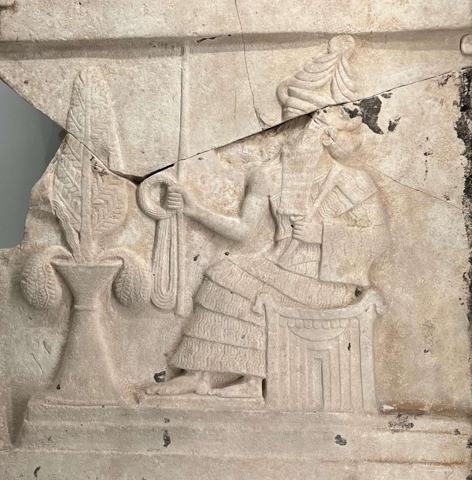
The Mesopotamian moon god of Ur's great ziggurat, father of the sun and Venus in most tellings, served by history's first named author, Enheduanna.
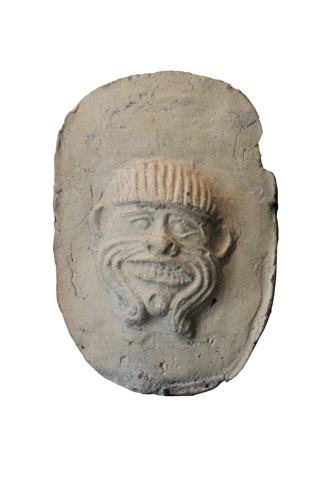
Guardian of the Cedar Forest, killed by Gilgamesh and Enkidu -- and, since a 2015 tablet turned up, a monster who kept court to a chorus of monkeys.
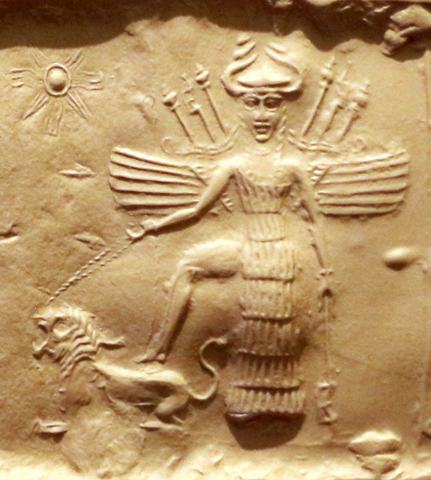
Queen of Heaven — Sumerian goddess of love, war, and the planet Venus, who walked into the land of the dead and was the only one to walk back out.
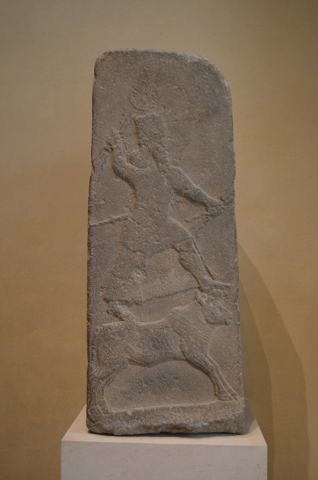
The Mesopotamian storm god who could drown the land in flood or bless it with rain, worshipped as Ishkur in Sumer and Adad across Babylonia and Assyria.
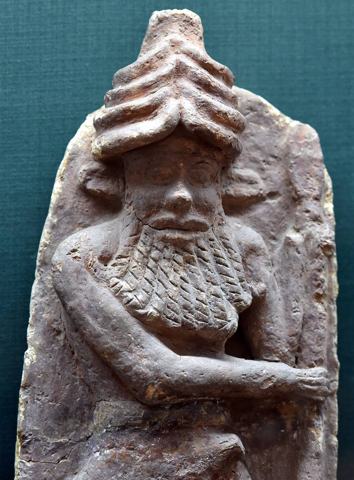
The wild man tamed by Shamhat and bound to Gilgamesh by friendship -- until the gods condemned him to die for the Cedar Forest and the Bull of Heaven.
Also mentioned inDumuzi (Tammuz)
Sources & Further Reading
- 1.The Laws of Hammurabi, prologue and epilogue (c. 1750 BCE, Louvre stele Sb 8).
- 2.The Great Hymn to Shamash (Babylonian, c. 200 lines), in W.G. Lambert, Babylonian Wisdom Literature.
- 3.The Epic of Gilgamesh, Standard Babylonian version, Tablets III-V and IX-X.
- 4.The Sun God Tablet of Nabu-apla-iddina, Sippar, 9th century BCE (British Museum, BM 91000).
- 5.Lambert, W.G. Babylonian Wisdom Literature. Oxford, 1960; repr. Eisenbrauns, 1996.
- 6.Black, Jeremy & Anthony Green. Gods, Demons and Symbols of Ancient Mesopotamia: An Illustrated Dictionary. British Museum Press, 1992.
- 7.Foster, Benjamin R. Before the Muses: An Anthology of Akkadian Literature. 3rd ed., CDL Press, 2005.
- 8.Heimpel, Wolfgang. 'The Sun at Night and the Doors of Heaven in Babylonian Texts.' Journal of Cuneiform Studies 38 (1986), 127-151.
Spot an error or have a source to suggest? Write to info@viseterna.com. We cite primary sources and modern scholarship, and we correct fast.