
The Tablet of Destinies
The cuneiform tablet that fixes the fates of gods and things — fought over by Marduk and Tiamat, stolen by the bird-demon Anzu, always worth a war.
Imdugud (Anzu) relief, Al-Ubaid, Early Dynastic period, c. 2500 BCE (British Museum) · CC0 · source
A Document, Not a Weapon
Mesopotamian myth imagines supreme power taking an unglamorous physical form: not a crown, not a throne, but a small inscribed clay tablet, the Tuppi Shimati, "Tablet of Destinies" 1,7. Whoever holds it can fix the fates of gods, decree the future, and issue proclamations that cannot be undone, an idea that only makes sense in a civilization organized around scribes, seals, and written administrative decree, where the ultimate expression of authority is a document properly sealed rather than a blow struck in battle 4,7. It appears, worn or fastened to the chest of its holder, in at least two major surviving narratives, and the two stories put it to opposite use 1,2.
Worn on Qingu's Chest
In Enuma Elish, Tiamat raises an army against the younger gods and gives command of it to Qingu, her chosen consort; as part of investing him with authority, she fastens the Tablet of Destinies to his chest, transferring to him the power to fix what will happen 1. That single act is what makes the crisis of the poem absolute: the war stops being a fight over territory and becomes a fight over who gets to write the future, and it is why the price Marduk demands before he will fight is that his own decree outrank every other god's, permanently, once he wins 1,4. After the duel he strips the tablet from Qingu's corpse and seals it with his own seal, a moment the poem treats as his true coronation, more so than the killing of Tiamat itself 1,4.
Stolen by a Bird
The second story is older in outline and gives the tablet a very different plot. In the Epic of Anzu, the god Enlil keeps the Tablet of Destinies in his sanctuary, guarded by the monstrous bird Anzu, part eagle and part lion; left alone one day while Enlil bathes, Anzu simply takes it and flies off to a mountain, and the moment it leaves the sanctuary the normal working of the world stops, since no valid decree can be issued without it 2,3. The gods convene in alarm, and hero after hero declines the job of getting it back before the young war god Ninurta finally accepts, hunts Anzu down, and kills him, restoring the tablet to its rightful owner 2,5. Unlike Marduk's story, nothing here changes hands permanently: the point of the Anzu myth is theft and lawful recovery, not conquest and succession 3,5.
Same Prop, Two Different Plots
Read side by side, the two myths use one object to make two different arguments about political change. The Anzu story is conservative: order is briefly interrupted by an outsider and then fully restored, with Enlil exactly where he started 2,5. The Enuma Elish story is not: the tablet moves permanently to a new holder, and the old order does not return, because the whole poem exists to explain why Marduk, rather than Enlil or Anu, now runs the cosmos 1,4. Mesopotamian scribes evidently found the same object useful for telling both a story about restoring the status quo and a story about ending it for good.
No Agreed Picture
Unlike many Mesopotamian objects on this Codex, the Tablet of Destinies has no securely identified depiction in surviving art. Cylinder seals and reliefs show gods in combat, gods enthroned, and monsters like Anzu himself in recognizable form, but nothing labeled or reliably interpreted as the tablet appears among them; it functions in the texts as an idea made physical rather than as an object Mesopotamian artists were in the habit of drawing 7. What does survive is evidence that real kings found the idea useful for their own claims. Andrew George's study of Assyrian royal inscriptions traces how King Sennacherib invoked language associated with the Tablet of Destinies to bolster his own city god Ashur's standing against Marduk's Babylon, borrowing the myth's vocabulary of legitimate, decree-fixing kingship for a very real seventh-century political argument 6.
A Fiction That Kept Working
The tablet's basic logic, that legitimate rule depends on possessing the right sealed document rather than merely on force, outlived the specific myths that dramatized it, turning up in the language Mesopotamian royal inscriptions used for centuries to describe conquest and succession 6,7. Two different divine dynasties, Enlil's and Marduk's, are each shown using or losing exactly the same kind of object to explain exactly the same kind of claim, which says something about how thoroughly Mesopotamian political imagination ran through the model of the archive rather than the battlefield 4,5.
Continue Exploring
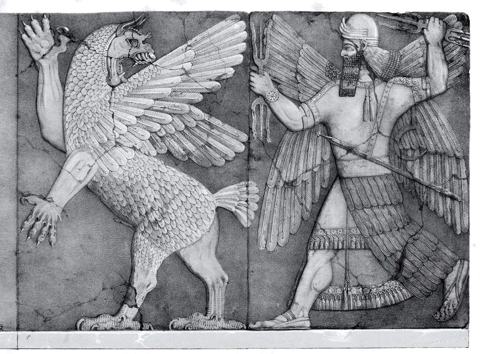
The primordial salt sea — the first mother of the gods, who turned on her children and whose split body became the sky and the earth above us.
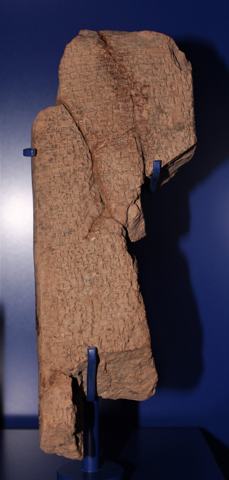
The Babylonian creation epic — seven tablets recited each New Year, telling how Marduk defeated Tiamat and became king of the gods.
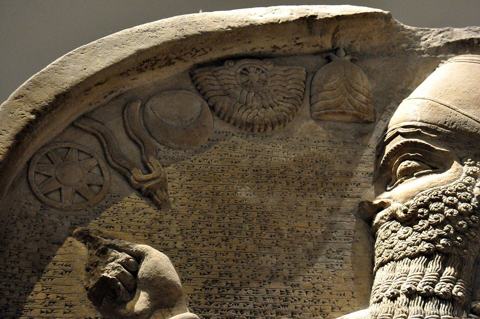
Son and champion of Enlil, who slew the demon Asag and the bird Anzu, and whose plow shaped the rivers and fields of Mesopotamia.
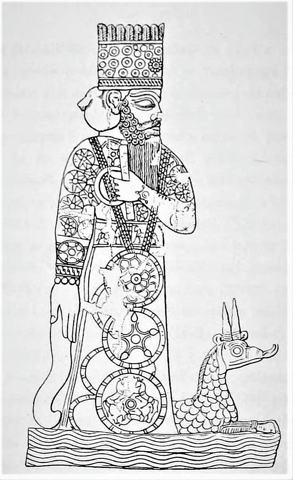
Champion of the gods — Babylon's patron, who killed the sea-dragon Tiamat, built heaven and earth out of her body, and was crowned king over all the gods.
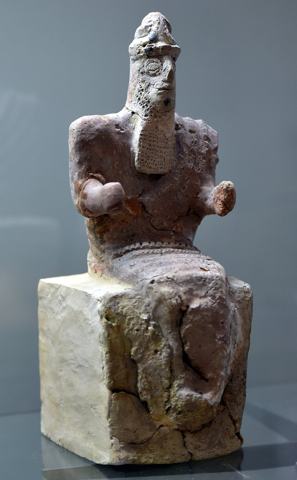
Lord of the moving air — the Sumerian executive of the gods, whose word carried out destinies, who split heaven from earth and sent the Flood.
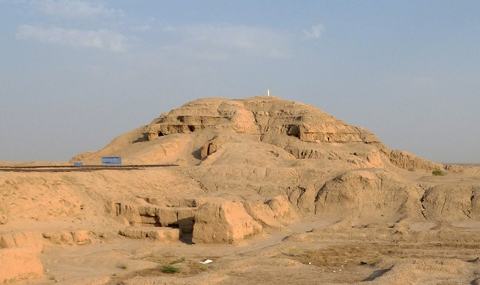
Father of the gods — the Mesopotamian sky, whose written sign meant "god" itself; the source of all authority, and almost never the one who uses it.
Also mentioned inAnzu (the Lion-Headed Eagle)
Sources & Further Reading
- 1.Enuma Elish (the Babylonian Epic of Creation), Standard Babylonian recension, Tablets I-IV.
- 2.The Epic of Anzu, Old Babylonian and Standard Babylonian versions.
- 3.Dalley, Stephanie. Myths from Mesopotamia: Creation, the Flood, Gilgamesh and Others. Rev. ed., Oxford University Press, 2000.
- 4.Lambert, W.G. Babylonian Creation Myths. Mesopotamian Civilizations 16. Eisenbrauns, 2013.
- 5.Annus, Amar. The God Ninurta in the Mythology and Royal Ideology of Ancient Mesopotamia. State Archives of Assyria Studies XIV. Neo-Assyrian Text Corpus Project, 2002.
- 6.George, A.R. 'Sennacherib and the Tablet of Destinies.' Iraq 48 (1986), 133-146.
- 7.Black, Jeremy & Anthony Green. Gods, Demons and Symbols of Ancient Mesopotamia: An Illustrated Dictionary. British Museum Press, 1992.
Spot an error or have a source to suggest? Write to info@viseterna.com. We cite primary sources and modern scholarship, and we correct fast.