
Pazuzu
King of the lilu wind demons, invoked as a monstrous protector against the worse demon Lamashtu -- and, since 1973, the face of The Exorcist.
Statuette of the demon Pazuzu, bronze, 1st millennium BCE (Musee du Louvre, AO 6692) · CC BY-SA 4.0 · source
King of the Wind Demons
Pazuzu rules the lilu, the wind demons of Mesopotamian belief, and personifies in particular the southwest wind that carries the hot season's dust, locusts and fever up from the desert into Mesopotamia each year 3,5. Several surviving bronze statuettes speak in his own voice, carrying a short first-person inscription: "I am Pazuzu, son of Hanbu, king of the evil lilu-demons," followed by a boast that he came raging against the high mountains and climbed them 1,3.
He is the son of Hanbi, himself a minor demon of the same wind-blown category, and his kingship over the lilu is treated as an established fact rather than something won in a myth that survives — there is no Pazuzu epic, only spells, amulets, and inscribed images that assume the audience already knows who he is 3,5. Where Enlil is the numinous power in wind and storm at a cosmic scale, Pazuzu is what the same meteorology looks like reduced to a single malevolent household nuisance — never worshipped as a god, but useful precisely because he already belongs to the same violent weather 3,5.
A Face Assembled From Parts
His standard form combines pieces of several animals rather than exaggerating any one: a doglike or leonine muzzle with bulging eyes and bared teeth, curling horns, a scaled rather than furred body, the taloned feet of a bird of prey, two pairs of wings, and a scorpion's tail 3,5. Black and Green read the accumulation as deliberate — no single beast in the Mesopotamian repertoire was considered frightening enough on its own, so Pazuzu is built from the worst features of several, mounted on a mostly human frame 5.
Full-length statuettes typically stand with one hand raised, and many carry a ring at the top of the head so the object could be hung on a wall or worn as a pendant, which is also how his severed head alone circulates as an amulet, stripped of the rest of the composite body 3,5.
Protector Against Lamashtu
Pazuzu's use is almost entirely defensive, and his most important enemy is Lamashtu, the demoness who attacked pregnant women and infants 2,4. Bronze plaques made to repel her typically carry Pazuzu's head projecting from the top edge, looking down on a scene of Lamashtu herself being marched back across the river to the underworld — the logic being that a demon frightening enough to menace mountains was also the one creature Lamashtu could be made to fear 2,4.
Amulets combining the two, Pazuzu on one register and Lamashtu banished on another, were hung over beds and worn by pregnant women through the first millennium BCE, and Farber's edition of the Lamashtu incantation series collects the spells recited alongside them 4. The arrangement is a working theology in miniature: nothing in the tradition suggests Pazuzu was ever prayed to as a benevolent power, only that he was reliably worse than what he was being asked to keep away 3,4.
Domestic Magic
Pazuzu amulets are among the most common surviving objects of Mesopotamian popular religion — thousands of examples in bronze, stone, and clay have been recovered from sites across the Near East, from simple pendants to elaborate statuettes 3,5. Exorcism texts occasionally invoke him by name to drive out other demons from a sick person's body, extending his function from guarding infants specifically to a more general household defence against invisible attackers 3. Unlike the lamassu standing at a palace gate, whose authority is calm and monumental, Pazuzu's protection works by being more alarming than what it repels 3,5.
His late arrival in the roster of Mesopotamian demons is itself notable. Wiggermann's philological survey places the earliest secure evidence for Pazuzu in the early first millennium BCE, centuries after Lamashtu and the other major demonic figures are already well attested, which makes him one of the last significant additions to a very old system rather than an ancient figure in his own right 3.
After Mesopotamia
Pazuzu's afterlife has run almost entirely through one work. William Peter Blatty's 1971 novel The Exorcist and William Friedkin's 1973 film adaptation open with an archaeologist discovering a Pazuzu amulet and a monumental statue of him on a dig in northern Iraq, before the demon crosses the world to possess a child in Washington, D.C. 5. The image has stuck hard enough that Pazuzu is now better known from a horror franchise than from the thousands of ancient amulets that carried his face for two thousand years before anyone had heard of Georgetown 5.
Continue Exploring
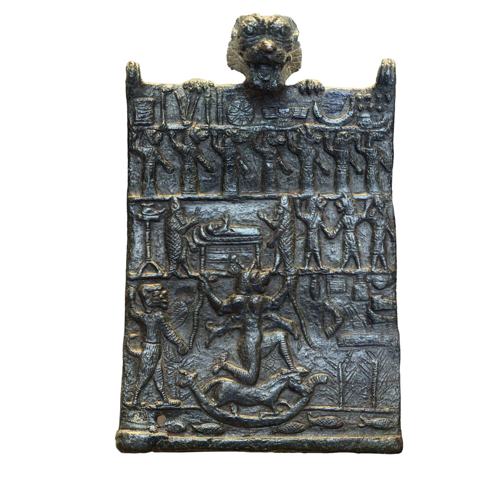
Daughter of Anu who preyed on pregnant women and infants, driven off by incantations, amulets, and the monstrous protection of Pazuzu.
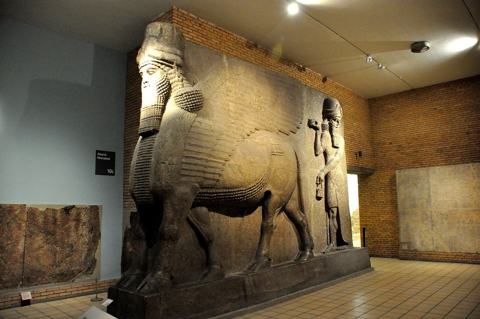
The human-headed winged bull that guarded Assyrian palace gates, sculpted with five legs so it reads correctly as both standing and walking.
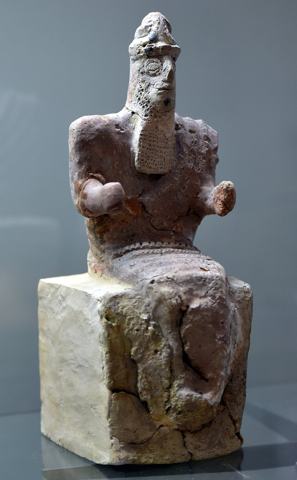
Lord of the moving air — the Sumerian executive of the gods, whose word carried out destinies, who split heaven from earth and sent the Flood.
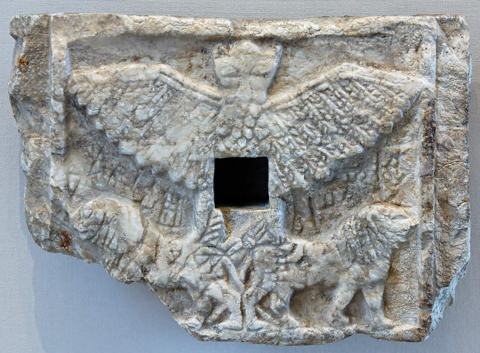
The monstrous lion-headed eagle who stole the Tablet of Destinies from Enlil's sanctuary and was hunted down by the god Ninurta.
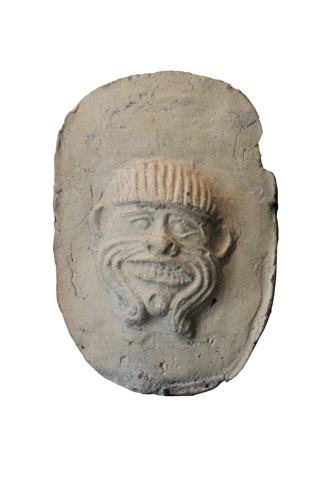
Guardian of the Cedar Forest, killed by Gilgamesh and Enkidu -- and, since a 2015 tablet turned up, a monster who kept court to a chorus of monkeys.
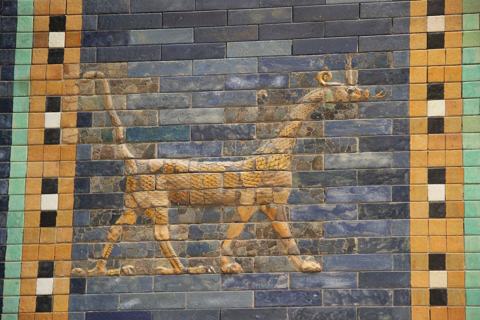
The scaled, horned dragon that once fought for Tiamat, was defeated by Marduk, and ended up as his tame guardian on the glazed brick of Babylon's Ishtar Gate.
Sources & Further Reading
- 1.Inscriptions on bronze Pazuzu statuettes and amulets (1st millennium BCE).
- 2.The Lamastu Series (canonical incantations and rituals against Lamashtu, 2nd-1st millennia BCE).
- 3.Wiggermann, F.A.M. 'Pazuzu.' Reallexikon der Assyriologie und Vorderasiatischen Archaologie 10 (2005), 372-381.
- 4.Farber, Walter. Lamastu: An Edition of the Canonical Series of Lamastu Incantations and Rituals and Related Texts from the Second and First Millennia B.C. Mesopotamian Civilizations 17. Eisenbrauns, 2014.
- 5.Black, Jeremy & Anthony Green. Gods, Demons and Symbols of Ancient Mesopotamia: An Illustrated Dictionary. British Museum Press, 1992.
Spot an error or have a source to suggest? Write to info@viseterna.com. We cite primary sources and modern scholarship, and we correct fast.