
Anzu (the Lion-Headed Eagle)
The monstrous lion-headed eagle who stole the Tablet of Destinies from Enlil's sanctuary and was hunted down by the god Ninurta.
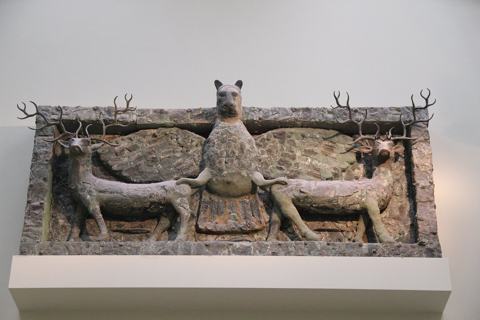
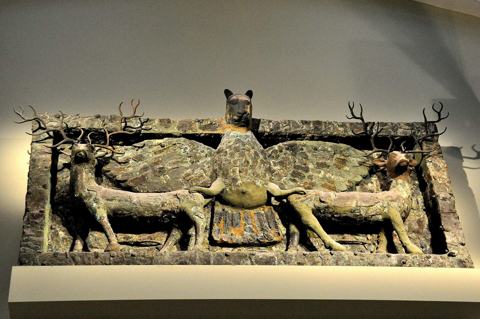
Relief of Imdugud (Anzu), the lion-headed eagle, grasping two stags, Early Dynastic Mesopotamia (Musee du Louvre, AO 2783) · Public domain · source
What Anzu Is
Anzu — older Sumerian Imdugud, "heavy wind" or "great storm bird" — is a composite monster: a colossal bird of prey with a lion's head, able to roar like a lion and shriek like an eagle, and credited with the power to breathe fire and flood water at once 3,5. He belongs to the same family of storm-and-chaos imagery as the great winged bulls and horned serpents of Mesopotamian art, a creature whose very body is made out of weather and violence rather than out of any single recognizable animal 5.
What separates Anzu from most Mesopotamian monsters is that he did not start out as an enemy. Long before the myth that made him famous, Imdugud was a protective divine emblem in his own right, particularly at Girsu in the state of Lagash, where the eagle-lion grasping two animals in its talons decorates temple façades, ceremonial maceheads, and votive vessels as a mark of divine strength rather than of menace 5,6. The most famous surviving examples, including a stone relief now in the Louvre showing Imdugud frontal, wings spread, gripping two stags, and a related copper frieze excavated from the facade of Ninhursag's temple at Tell al-Ubaid, come from exactly this earlier, benevolent tradition 5.
Lugalbanda and the Anzu Bird
The oldest narrative role for the bird is not villainous at all. In the Sumerian epic Lugalbanda and the Anzu Bird, the hero Lugalbanda finds the Anzu bird's nest abandoned by its parents and secretly feeds and pampers the chick while they are away; when the parent birds return and find their offspring thriving, the grateful Anzu bird grants Lugalbanda superhuman speed, letting him outrun any army and cross any distance 2. Read alongside the later Epic of Anzu, the story is a reminder that Mesopotamian tradition did not always agree on how to treat a divine monster, and that "friend or enemy" could depend entirely on which text, and which century, one happened to be reading 2,5.
Theft of the Tablet of Destinies
The story that fixed Anzu's reputation for good is the Epic of Anzu, known in an Old Babylonian version naming the hero Ningirsu and a fuller Standard Babylonian recension naming him Ninurta 1,3. Anzu is placed by Enlil himself as guardian at the door of his private chamber, and while Enlil bathes, Anzu seizes the moment to snatch the Tablet of Destinies, the physical object that carries the authority to fix the gods' powers and the fates of everything else 1,3. He flies off to a mountain refuge, and with the tablet in his possession he can issue commands no god can countermand — the terror of the story is not simply a monster on the loose, but the cosmos's own operating instructions in the wrong hands 1,4.
The assembled gods are, for a time, helpless. Several senior deities decline the mission to retrieve the tablet outright, unwilling to face a creature who now holds their own destinies in his claws, and the epic lingers on that paralysis before Ninurta finally accepts the fight 1,3.
The Hero's Battle
Ninurta's first attempts fail. His arrows will not fly true against a creature who can simply command "arrow, return to your reed; bow, return to your wood" and be obeyed, since the words carry the Tablet's own authority 1,4. Ea (Enki) supplies the winning tactic: send the south wind against Anzu's own feathers in mid-flight, so that his wings tangle and he loses the advantage of the air, and only then loose the arrow 1,3. Ninurta kills him on the mountain, recovers the tablet, and restores it to Enlil, closing a crisis that had left the entire pantheon exposed 1,3.
Later Babylonian theology, which folded a great many older gods' exploits into Marduk's expanding résumé as Babylon's political power grew, occasionally credits Marduk himself with Anzu's defeat in god-list and commentary texts — not an independent tradition so much as one more feat absorbed into Marduk's identity alongside those of Ninurta and other gods he came to represent 3.
Anzu in Assyrian Imagery
The lion-headed eagle kept a long visual afterlife even after the epic fixed him as a defeated villain. Neo-Assyrian palace art at Nimrud and Nineveh reuses composite eagle-and-lion figures in guardian and decorative roles reminiscent of Anzu's older, protective Imdugud identity, standing alongside other hybrid guardians like the winged bull lamassu at palace gates, even as the textual tradition kept telling the story of his defeat 5.
A Monster That Was Also a Symbol
Anzu's career, taken whole, runs backward from most monster myths: an emblem of divine power first, a friend to a wandering hero second, and only in his most famous telling a thief and an enemy who has to be hunted down. Mesopotamian religion was comfortable holding all three versions of the same bird at once, using Imdugud's raw power as a compliment on a temple wall in one context and, in another, as the clearest illustration available of what happens when that power ends up in the wrong claws 5,6.
Continue Exploring
Lord of the moving air — the Sumerian executive of the gods, whose word carried out destinies, who split heaven from earth and sent the Flood.
Son and champion of Enlil, who slew the demon Asag and the bird Anzu, and whose plow shaped the rivers and fields of Mesopotamia.
The cuneiform tablet that fixes the fates of gods and things — fought over by Marduk and Tiamat, stolen by the bird-demon Anzu, always worth a war.
Sumer's mother goddess, who shapes the first humans from clay, births the gods of Dilmun, and heals the god she once cursed.
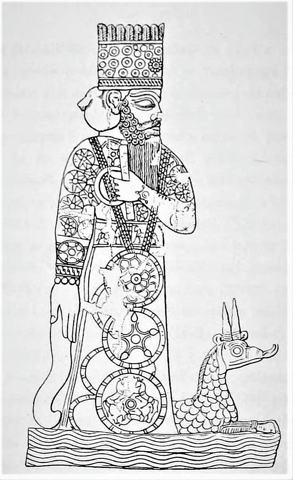
Champion of the gods — Babylon's patron, who killed the sea-dragon Tiamat, built heaven and earth out of her body, and was crowned king over all the gods.
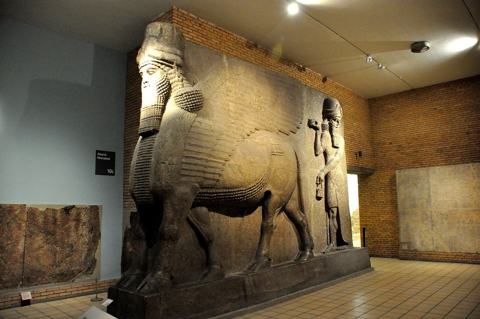
The human-headed winged bull that guarded Assyrian palace gates, sculpted with five legs so it reads correctly as both standing and walking.
Sources & Further Reading
- 1.The Epic of Anzu (the Epic of Zu), Standard Babylonian recension.
- 2.Lugalbanda and the Anzu Bird, Sumerian composition.
- 3.Dalley, Stephanie. Myths from Mesopotamia. Oxford University Press, revised edition 2000.
- 4.Foster, Benjamin R. Before the Muses: An Anthology of Akkadian Literature. CDL Press, 2nd edition, 1996.
- 5.Black, Jeremy & Anthony Green. Gods, Demons and Symbols of Ancient Mesopotamia: An Illustrated Dictionary. British Museum Press, 1992.
- 6.Penglase, Charles. Greek Myths and Mesopotamia: Parallels and Influence in the Homeric Hymns and Hesiod. Routledge, 1994.
Spot an error or have a source to suggest? Write to info@viseterna.com. We cite primary sources and modern scholarship, and we correct fast.