
The Bhagavad Gita
Eighteen chapters embedded in the Mahabharata where Krishna counsels Arjuna — read, translated and argued over more than any other Hindu text.
Vishvarupa: Krishna Shows Arjuna His Cosmic Form, unknown artist, medieval Indian miniature painting · Public domain · source
Eighteen Chapters, One Battlefield
The Bhagavad Gita ("Song of the Lord") is a poem of roughly 700 Sanskrit verses cast as a dialogue between the warrior Arjuna and his charioteer Krishna, set inside the Bhishma Parva — the sixth book — of the Mahabharata, in the moment just before the eighteen-day war at Kurukshetra begins 1. Arjuna, seeing his own kinsmen and teachers arrayed for battle on both sides, drops his bow and refuses to fight; Krishna's answer to that refusal is the poem in full, and by its final verse Arjuna picks the bow back up 1,6. Read on its own the Gita looks complete — a self-contained philosophical dialogue rather than a mere episode — and that apparent self-sufficiency is exactly what eventually let it walk out of the epic and become independent scripture 4.
Where It Sits in the Epic
Scholars broadly agree the Gita's language belongs somewhere inside the Mahabharata's long compositional window, roughly the fourth century BCE to the fourth century CE, but they disagree sharply on where, and on whether it was composed as part of the epic or added to it later. Nineteenth-century German philologists, including Adolf Holtzmann and Richard Garbe, argued the Gita was a later, doctrinally motivated insertion into an older and more purely martial epic, pointing to apparent shifts in register between it and its surroundings 5. Van Buitenen's edition makes the opposite case from the manuscript and narrative evidence: the poem is metrically and narratively continuous with what surrounds it, and the epic's own logic of duty and kingship needs exactly this speech at exactly this point 2. Hiltebeitel goes further still, reading the Gita not as philosophy interrupting a war story but as the war story's own theology spoken aloud 6. No surviving manuscript is old enough to settle the question directly, since the oldest complete Mahabharata manuscripts are themselves medieval and already contain the Gita substantially as it now stands 5.
What the Poem Argues
The eighteen chapters move through several linked teachings rather than one argument stated once. Krishna opens with karma yoga: action performed without craving its results does not bind the actor, so refusing a rightful duty out of grief is a failure of understanding rather than a virtue 2,5. He widens into jnana yoga, the imperishability of the self behind the body it temporarily occupies, and bhakti yoga, devotion to Krishna as the ground underlying every other path 5,7. The poem's best-known scene comes near its center: at Arjuna's own request, Krishna reveals his vishvarupa, a terrifying universal form in which Arjuna sees every world and every death at once, warriors on both armies devoured in Krishna's mouths — the single image most later illustrators of the text have chosen to paint 2,7. Arjuna is not talked out of his despair by argument alone; he is shown something, and only then does he fight 1,2.
Commentary and Contest
Because the Gita offers several paths to liberation without ranking them cleanly, it became a text that rival philosophical schools could each read as confirming their own position. The eighth-century non-dualist Shankara reads it as pointing past all action toward knowledge of an undivided reality; the eleventh-century qualified non-dualist Ramanuja reads the same verses as building toward loving devotion to a personal God; Madhva's later dualist commentary keeps God and soul permanently distinct 5,7. None of the three has displaced the others, and the disagreement between their readings is still how the text is taught 5,7.
From Epic Chapter to World Scripture
The Gita's life as a free-standing scripture, read and quoted apart from the epic around it, is largely a phenomenon of the last two and a half centuries rather than an ancient default 4. Charles Wilkins produced the first English translation directly from Sanskrit in 1785, under the patronage of the colonial administrator Warren Hastings and published by the East India Company's own directors — a landmark reception historians treat as the moment the text entered a world literature it had not previously belonged to 4. R. C. Zaehner's densely annotated 1969 Oxford edition later continued that philological line for English readers wanting the original terms alongside the translation 3. European readers who came after Wilkins pulled the poem in their own directions — Emerson and Thoreau carried extracts into New England Transcendentalism — and its Indian readers split even more sharply: Bal Gangadhar Tilak read the Gita as sanctioning committed political action against colonial rule, while Gandhi's own commentary, Anasaktiyoga, found in the identical verses a doctrine of detached, nonviolent duty 4,7. J. Robert Oppenheimer, who had studied Sanskrit, recalled the vishvarupa verse — "Now I am become Death, the destroyer of worlds" — on watching the first nuclear test in 1945, the single line of the poem now best known outside any of its philosophical readings 4.
Why the Argument Never Closes
No single reading of the Gita has won, and the text does not obviously want one to. It has been published as a manual for renunciation and as a manual for revolutionary struggle, quoted by pacifists and by soldiers, translated into nearly every major world language, and it remains the passage of Hindu scripture most people outside specialist tradition can quote from memory 4,7. That the poem holds all of these readings without breaking apart is, on Davis's account of its whole afterlife, the real reason it escaped the epic that still, technically, contains it 4.
Related entries: Krishna, Arjuna, The Mahabharata, Vishnu.
Continue Exploring
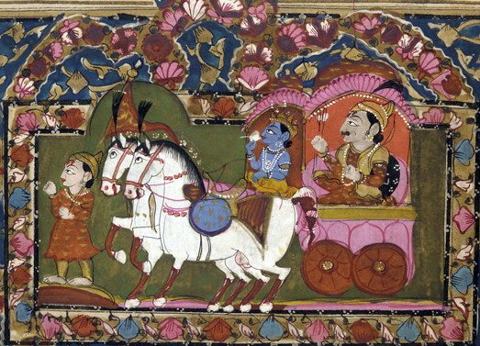
Cowherd, lover, statesman and charioteer — the avatar of Vishnu who speaks the Bhagavad Gita and anchors India's largest devotional tradition.
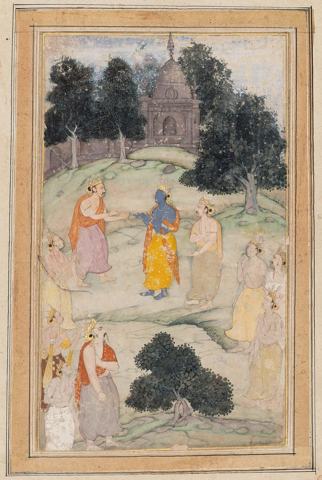
Roughly 100,000 verses attributed to the sage Vyasa — the frame for most of Hindu myth, including the Bhagavad Gita, and still the longest epic poem known.
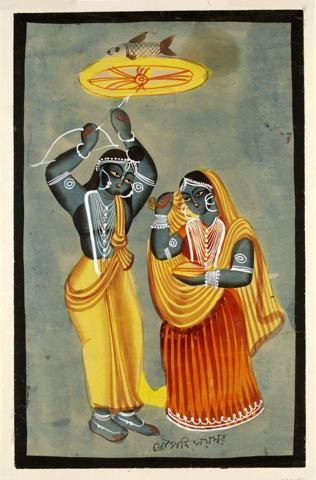
The Pandava hero of the Mahabharata, winner of Draupadi's hand and wielder of the bow Gandiva, whose crisis on the battlefield draws out the Bhagavad Gita.
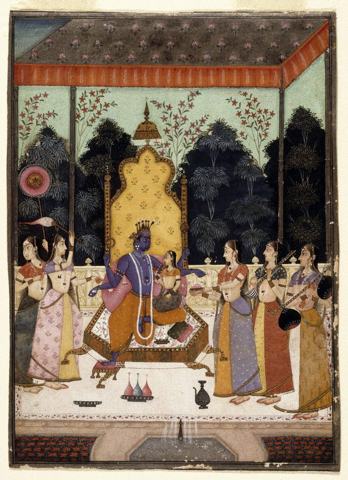
The preserver of cosmic order — the god who descends age after age, as Rama, as Krishna, and in other forms, to set dharma right when it fails.
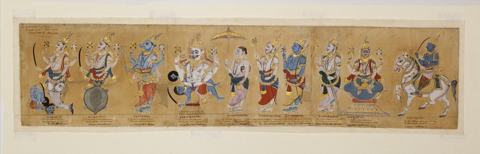
Fish, tortoise, boar, man-lion, dwarf, and five more — the standard list of Vishnu's ten descents, though the Puranas themselves never quite agree on it.
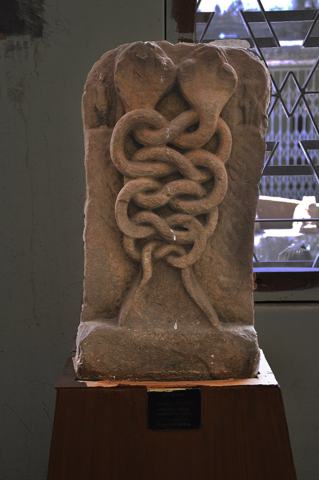
Semi-divine serpent beings of the waters and the underworld — hooded and jewel-crowned guardians of treasure, of rain, and of hidden knowledge.
Sources & Further Reading
- 1.The Bhagavad Gita, embedded in the Bhishma Parva of the Mahabharata; Sanskrit, composed within the epic's long compositional window, c. 4th century BCE - 4th century CE.
- 2.van Buitenen, J. A. B., trans. The Bhagavadgita in the Mahabharata. University of Chicago Press, 1981.
- 3.Zaehner, R. C., trans. The Bhagavad-Gita, with a Commentary Based on the Original Sources. Clarendon Press, 1969.
- 4.Davis, Richard H. The Bhagavad Gita: A Biography. Princeton University Press, 2014.
- 5.Malinar, Angelika. The Bhagavadgita: Doctrines and Contexts. Cambridge University Press, 2007.
- 6.Hiltebeitel, Alf. The Ritual of Battle: Krishna in the Mahabharata. Cornell University Press, 1976.
- 7.Flood, Gavin. An Introduction to Hinduism. Cambridge University Press, 1996.
Spot an error or have a source to suggest? Write to info@viseterna.com. We cite primary sources and modern scholarship, and we correct fast.