
Lakshmi (Laxmi)
Goddess of wealth, beauty and good fortune, born from the churning of the ocean and inseparable consort of Vishnu.
Goddess Lakshmi, Raja Ravi Varma, 1896 · Public domain · source
Shri and Lakshmi
Lakshmi — also spelled Laxmi, and constantly paired with or called Shri — is the goddess of shri: prosperity, abundance, beauty, royal splendour, and the general condition of things going well. The two names were originally distinct qualities and are treated as one goddess by the Puranic period 5,7. Where other deities govern a domain, Lakshmi governs a state: the presence of fortune in a house, a body, a kingdom or a harvest.
The earliest sustained text is the Shri Sukta, an appendix hymn attached to the Rig Veda rather than part of its core, and generally dated later than the main collection. Its imagery is already fixed: a golden, lotus-seated goddess, moist and gleaming, associated with cattle, gold, grain, horses and children — and explicitly with the banishment of her opposite, Alakshmi, misfortune 1,5,6. The doubling matters. Lakshmi is not simply the presence of wealth but the active exclusion of ruin.
Born from the Ocean
The best-known origin story is the samudra manthana, the churning of the ocean of milk, told in the Mahabharata, the Vishnu Purana and most fully in the Bhagavata Purana. Gods and asuras, having lost the world's vitality, use Mount Mandara as a churning-stick and the serpent Vasuki as the rope, and churn the ocean for the nectar of immortality. Among the treasures that rise is Shri-Lakshmi, seated on a lotus, and she chooses Vishnu 2,3,5.
The choosing is the point. Lakshmi is famously chanchala, restless — fortune arrives and departs, and cannot be held by force. Several texts, including epic passages on kingship, make her the guarantor of a ruler's legitimacy: she dwells with the righteous king and abandons the unrighteous one, which turns a goddess of wealth into a political theology 5,7. Some traditions hold that she was previously with the asura king Bali and left him; others that she is eternally Vishnu's and the churning merely re-manifests her.
With Vishnu
In mature Vaishnava thought Lakshmi is inseparable from Vishnu — she rests on his chest as the mark Shrivatsa, presses his feet in the milk ocean, and descends alongside each of his avatars. When Vishnu is Rama, she is Sita; when he is Krishna, traditions identify her variously with Rukmini or with Radha; when he is Vamana or Venkateshvara, she is Padmavati or Alamelu 3,5.
The Shrivaishnava schools of South India take this much further. There Shri is purushakara, the mediator: the soul cannot approach Vishnu's justice directly, so it approaches his compassion through her, and the difference between the Tenkalai and Vadakalai lineages turns partly on precisely how much independent saving power she holds — a genuine and long-running theological dispute, not a decorative one 5,6. The Pancharatra Lakshmi Tantra goes furthest, presenting Shri as the active energy through which the passive supreme actually creates 4,6.
How She Is Shown
Lakshmi's iconography is remarkably stable across two millennia: a woman standing or seated on a full-blown lotus, holding lotuses, often with gold coins falling from a lowered palm, and flanked by two elephants pouring water over her from raised trunks. That last form, Gaja-Lakshmi, appears on Buddhist railings at Bharhut and Sanchi in the second and first centuries BCE, which makes her one of the earliest identifiable goddesses in Indian art and shows how freely she crossed sectarian lines 5,7. Buddhist and Jain traditions both absorbed her.
Her usual vehicle is an elephant or, in eastern India, an owl — the owl being read either as the night-seeing companion of prosperity or, less flatteringly, as a warning about wealth's blindness. Both readings are late folk glosses rather than textual doctrine 5,7.
Diwali and Daily Practice
Lakshmi's principal festival is Diwali (Deepavali), the autumn festival of lights, when Lakshmi Puja is performed on the new-moon night of Kartika: houses are cleaned and whitewashed, doors and windows are left open, lamps are lit to guide her in, and account books are ritually opened for the new year in merchant communities 5,6. The logic is the Shri Sukta's — invite fortune, expel Alakshmi. Kojagari Lakshmi Puja on the full moon of Ashvin, widely observed in Bengal and Odisha, works on the same principle, with devotees keeping vigil because the goddess is said to walk at night asking who is awake 6.
Household practice keeps her close to the domestic economy: rangoli at the threshold, the Friday fast, Varalakshmi Vratam in the south, and the near-universal reluctance to sweep at dusk lest fortune be swept out with the dust 6,7.
A Note on Reading Her
It is easy to reduce Lakshmi to "money goddess". Scholars generally resist that. In the older material shri means something broader — radiance, well-being, the visible sign that a life is rightly ordered — and material wealth is one symptom among several 5,6,7. Her lotus, rooted in mud and untouched by it, is the tradition's own gloss on how prosperity is supposed to be held.
Related entries: Vishnu, Krishna, Rama, Saraswati, Durga, Ganesha, Garuda.
Continue Exploring
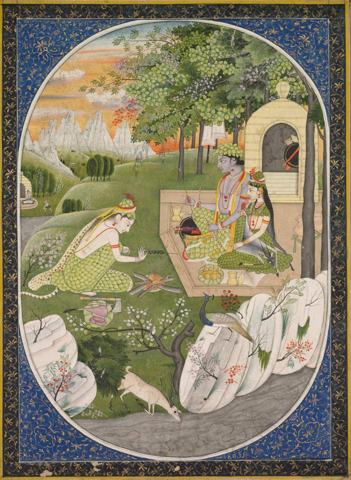
Prince of Ayodhya and seventh avatar of Vishnu — exiled hero of the Ramayana, slayer of Ravana, and the ideal of dharma.
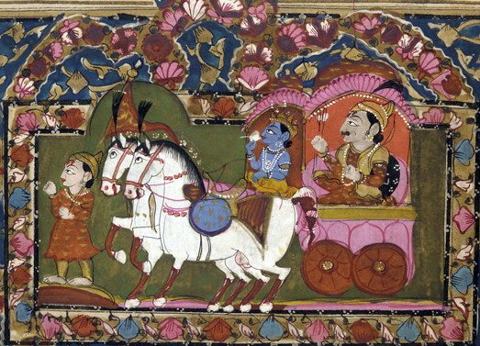
Cowherd, lover, statesman and charioteer — the avatar of Vishnu who speaks the Bhagavad Gita and anchors India's largest devotional tradition.
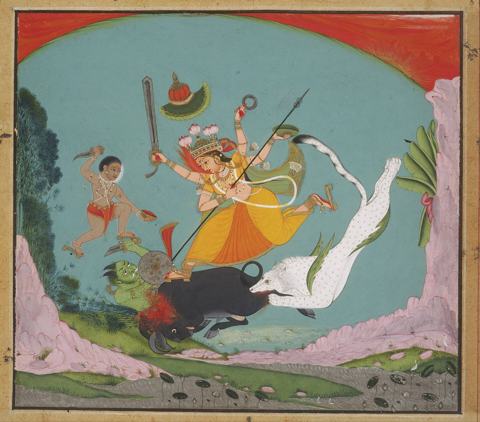
The warrior goddess assembled from the massed light of all the gods, lion-mounted slayer of the buffalo demon Mahishasura.
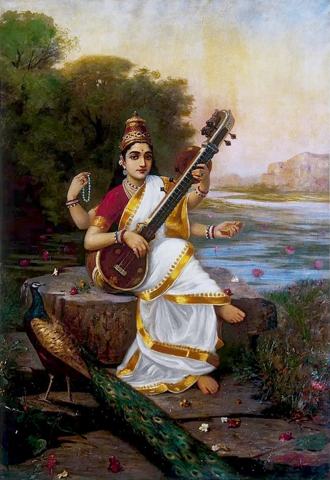
Goddess of speech, learning, music and the arts — a Vedic river who became the patron of every word written or sung.
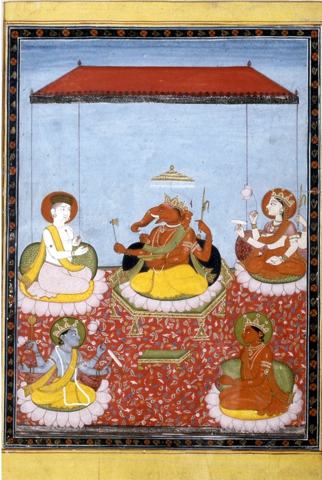
The elephant-headed son of Shiva and Parvati, lord of beginnings and remover (and placer) of obstacles, invoked before every undertaking.
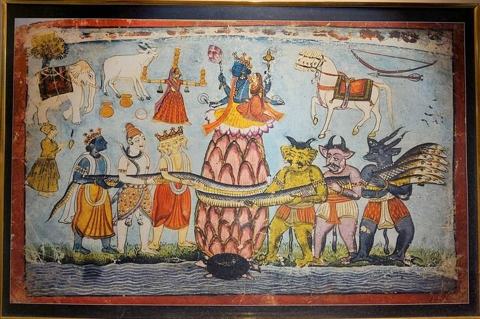
Gods and demons churn the cosmic ocean with a mountain and a serpent for the nectar of immortality — and very nearly destroy all creation before they get it.
Also mentioned inDiwali (Deepavali)ParvatiSita
Sources & Further Reading
- 1.Shri Sukta — a khila (appendix) hymn to the Rig Veda, generally dated later than the main collection.
- 2.Mahabharata and Vishnu Purana — the churning of the ocean of milk (samudra manthana) and Shri's emergence.
- 3.Bhagavata Purana — Book VIII, the churning; and the Lakshmi-Narayana theology (c. 9th-10th century CE).
- 4.Lakshmi Tantra — a Pancharatra Vaishnava text on Shri as active divine power (c. 9th-12th century).
- 5.Kinsley, David. Hindu Goddesses — Visions of the Divine Feminine in the Hindu Religious Tradition. University of California Press, 1986.
- 6.Rhodes, Constantina. Invoking Lakshmi — The Goddess of Wealth in Song and Ceremony. State University of New York Press, 2010.
- 7.Dhal, Upendra Nath. Goddess Laksmi — Origin and Development. Oriental Publishers, 1978.
Spot an error or have a source to suggest? Write to info@viseterna.com. We cite primary sources and modern scholarship, and we correct fast.