
Sudarshana Chakra
Vishnu's flaming, spinning discus — a weapon of last resort that beheads at a thought, and the emblem that marks him as the upholder of cosmic order.
Chaturbhuj Vishnu, 10th century, Sambhar, Rajasthan (Albert Hall Museum, Jaipur) · CC BY-SA 4.0 · source
Vishnu's Discus
The Sudarshana Chakra — "the discus of beautiful appearance" — is one of the four objects that identify Vishnu at a glance: the conch Panchajanya, the mace Kaumodaki, a lotus, and, held in his upper right hand or spinning on a raised finger, the discus 2,7. Unlike the mace or the conch, the chakra is not merely carried but thrown, and unlike almost any other weapon in Hindu myth it is described as intelligent in its own right — capable of leaving Vishnu's hand, pursuing a target across any distance, and returning on its own once the work is done 2,5. Gonda's study of early Vishnu worship reads the discus as the clearest single image the tradition has for its central theological claim: a god who does not merely watch over cosmic order but actively, forcibly restores it when it breaks 6,7.
How Vishnu Got It
The Puranas do not agree on a single origin, and the differences are worth keeping rather than flattening into one story. Several accounts, among them the Padma Purana, tell of Vishnu worshipping a thousand lotus blossoms at a Shiva linga and finding himself one flower short; rather than let the offering fail, he plucks out one of his own lotus-like eyes to complete the count, and Shiva, startled by the devotion, grants him the discus as a reward 3. Other Puranic passages simply describe the chakra as Vishnu's from the start, an eternal attribute rather than an acquired weapon, which is the more common assumption in the epic material 2,7. Both traditions agree on what the weapon signifies even where they disagree on how he came to hold it: a boundary Vishnu is prepared to enforce personally 3,7.
Shishupala's Hundred Insults
The discus's most famous single act comes at King Yudhishthira's rajasuya sacrifice in the Mahabharata. Shishupala, king of Chedi, insults Krishna publicly and at length, and Krishna is shown tolerating it under an old promise made to Shishupala's mother to forgive a fixed number of offenses before responding. When the hundredth insult is spoken, Krishna summons the Sudarshana Chakra, and it takes Shishupala's head in a single stroke, in front of the assembled kings 1. The episode is often read less as an act of anger than as a demonstration: the discus appears only once patience has been formally exhausted, and its use marks the exact point where restraint becomes indulgence of evil rather than virtue 1,7.
Beheading Rahu
The churning of the ocean supplies the discus's other canonical feat. When the amrita of immortality finally rises from the churned sea, the demon Rahu disguises himself among the gods and manages to swallow a portion before the sun and moon gods expose him; Vishnu, alerted, beheads him instantly with the chakra. Because the nectar had already reached Rahu's throat, both the severed head and the body survive as separate immortal beings, later blamed in Hindu astronomy for swallowing the sun and moon during eclipses 2. It is one of the few episodes in which the discus acts with no warning at all, a single decisive stroke rather than a weapon held in reserve 2.
A Weapon Lent to the Goddess
The discus is not permanently Vishnu's alone. The Devi Mahatmya's account of Durga's creation has each god arm the newly manifest goddess with his own signature weapon so she can face the buffalo-demon Mahishasura, and Vishnu's contribution is the Sudarshana Chakra itself, handed to Durga as one of the ring of divine arms she carries into battle 4. The scene makes explicit something the iconography implies everywhere else: the discus is less a personal possession than a portable principle, on loan to whichever deity is doing the work of restoring order at that moment 4,7.
A Weapon Worshipped on Its Own
South Indian temple tradition eventually gave the discus independent standing as an object of worship, not merely an attribute in Vishnu's hand. Gopinatha Rao's iconographic survey describes dedicated Sudarshana shrines, in which the wheel is personified as an armed deity in its own right, sometimes shown multi-armed and haloed in flame, installed and worshipped separately from the main image of Vishnu it belongs to 5. Sculptors elsewhere folded the same idea into a single image rather than two: the tenth-century stele that illustrates this entry gives Vishnu a discus so large it doubles as his halo, the weapon and the god's own radiance rendered as the same object 5,7.
Continue Exploring
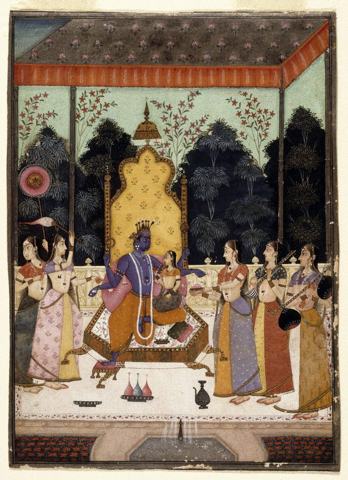
The preserver of cosmic order — the god who descends age after age, as Rama, as Krishna, and in other forms, to set dharma right when it fails.
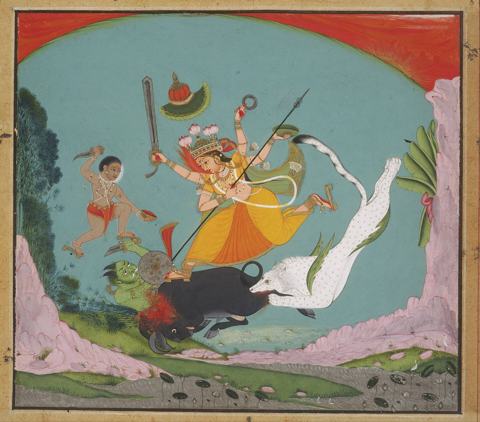
The warrior goddess assembled from the massed light of all the gods, lion-mounted slayer of the buffalo demon Mahishasura.
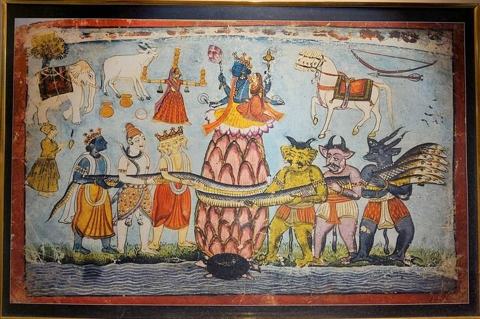
Gods and demons churn the cosmic ocean with a mountain and a serpent for the nectar of immortality — and very nearly destroy all creation before they get it.
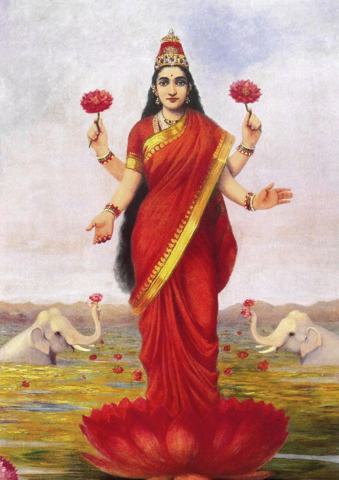
Goddess of wealth, beauty and good fortune, born from the churning of the ocean and inseparable consort of Vishnu.
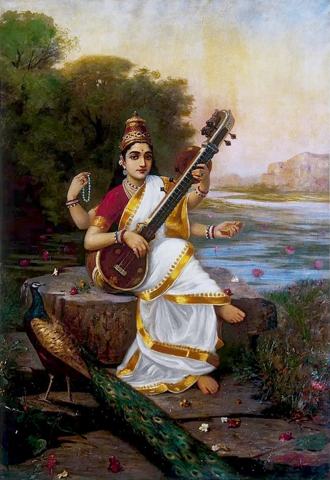
Goddess of speech, learning, music and the arts — a Vedic river who became the patron of every word written or sung.
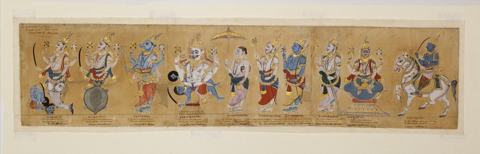
Fish, tortoise, boar, man-lion, dwarf, and five more — the standard list of Vishnu's ten descents, though the Puranas themselves never quite agree on it.
Sources & Further Reading
- 1.The Mahabharata, Sabha Parva.
- 2.The Bhagavata Purana.
- 3.The Padma Purana.
- 4.Devi Mahatmya (Markandeya Purana).
- 5.Rao, T. A. Gopinatha. Elements of Hindu Iconography. Law Printing House, 1914.
- 6.Gonda, Jan. Aspects of Early Visnuism. N.V. A. Oosthoek's Uitgevers Mij., 1954.
- 7.Flood, Gavin. An Introduction to Hinduism. Cambridge University Press, 1996.
Spot an error or have a source to suggest? Write to info@viseterna.com. We cite primary sources and modern scholarship, and we correct fast.