
The Ramayana
Valmiki's Sanskrit epic of Rama's exile and Sita's rescue — one telling among dozens across Asia, critically re-edited only in the twentieth century.
Opening folio of the Mewar Ramayana, attributed to the painter Manohar, Rajasthan, 1653 · CC BY-SA 4.0 · source
The First Poem
Tradition calls the Ramayana the adi kavya, the first true poem, and credits its authorship entirely to one sage, Valmiki, who is said to have discovered the shloka couplet — the meter that became the standard of later Sanskrit verse — in a moment of grief over a hunted bird, and then used it to tell the whole 24,000-verse story of Rama across seven books, or kandas 1,2. The poem gives itself a curious reflexive frame: in its later books Valmiki is not only the narrator but a character within his own story, the sage who shelters the exiled Sita and teaches her twin sons to sing the epic back to their father 1. Whatever the historical reality behind "Valmiki," the text presents itself as the origin point of Sanskrit poetry as a craft, not merely as one story among others 1,2.
A Poem With No Single Date
Philologists do not read the seven kandas as a single, simultaneous composition. Book I (Bala Kanda, Rama's childhood) and Book VII (Uttara Kanda, his later reign and Sita's banishment) differ in style, vocabulary, and theology from Books II through VI, and both are generally judged later additions to an original core that begins with Rama's exile and ends with his return to Ayodhya 2,6. The clearest evidence is doctrinal: the identification of Rama with Vishnu as a divine incarnation is concentrated almost entirely in the framing books, while the core narrative largely treats him as an exceptional but human prince 2. On that basis, scholars place the core narrative's formation mostly in the centuries before the common era, with Books I and VII added later still and the whole text reaching roughly its present form by about the third century CE — though the poem itself carries no date, and every proposed chronology rests on internal literary evidence rather than external record 1,6.
Recovering One Text From Thousands
By the twentieth century the Ramayana survived in hundreds of manuscripts spread across two broad manuscript families, a Northern and a Southern recension, which disagree with each other in a substantial share of their verses. Between 1960 and 1975 a team of scholars at the Oriental Institute in Baroda, working first under G. H. Bhatt and later under U. P. Shah, collated this entire manuscript tradition to produce a critical edition: not a claim to have recovered Valmiki's original words, but the best-supported common text the surviving witnesses agree on 3. That edition underlies the Princeton translation project led by Robert Goldman, the first complete scholarly English Ramayana built directly from the critical text rather than from any single regional manuscript 2,3.
What the Poem Contains
Stripped to its core narrative, the Ramayana tells of Rama's exile from Ayodhya, the abduction of his wife Sita by the rakshasa king Ravana, the alliance Rama forms with the vanara general Hanuman, and the war that recovers her 1. Almost every other Codex entry on this branch of the tradition depends directly on this text: Rama's own story, Ravana's, Hanuman's, and the churning of the ocean episode that produces some of the epic's supporting cast all trace back to Valmiki's narrative or to the Puranas that later absorbed it 1,2. The poem's closing books, whatever their date, fixed the version of Rama's story — divine king, exiled husband, uneasy judge of his own wife's fidelity — that most later retellings inherit or argue against 2,6.
Many Ramayanas
Valmiki's Sanskrit poem is the fountainhead, not the only river. Kamban's twelfth-century Tamil Iramavataram, the Jain Paumacariya in which Ravana is a tragic, learned king rather than a monster and Lakshmana kills him instead of Rama, the Thai Ramakien, the Javanese Kakawin Ramayana, and the Cambodian Reamker are all independent literary traditions built on the same story rather than translations of Valmiki's text 4. A. K. Ramanujan's influential essay on this plurality argues that asking which Ramayana is the correct one misunderstands how the tradition has always worked 4. Tulsidas's sixteenth-century Awadhi Ramcharitmanas went furthest of all: composed as an act of devotion rather than translation, it became — and largely remains — the version most North Indians actually know, performed annually across the region as the Ramlila cycle 7.
A Text That Stayed Political
The Ramayana has never settled into inert scripture. Sheldon Pollock's study of the epic's political life traces how Rama rajya, "Rama's reign," has been invoked across very different eras and causes — as Gandhi's image of just government, and, in the late twentieth century, as a rallying idea for the Hindu nationalist movement built around the disputed site of Rama's birthplace at Ayodhya 5. Reading the poem's afterlife rather than only its verses, Pollock treats it as public property still being argued over, not a closed classical text 5. That contest sits alongside an unbroken devotional life — sung, staged, and recited across South and Southeast Asia — that has continued regardless of who is quoting the poem for what 4,7.
Continue Exploring
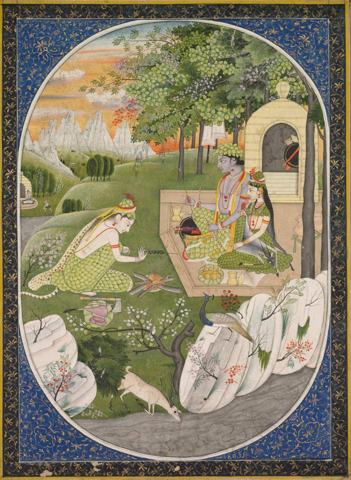
Prince of Ayodhya and seventh avatar of Vishnu — exiled hero of the Ramayana, slayer of Ravana, and the ideal of dharma.
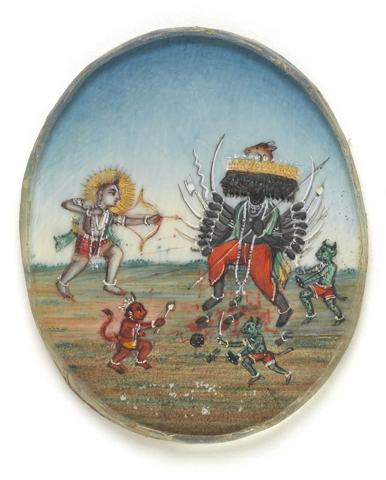
Lanka's rakshasa king, ten-headed abductor of Sita in the Ramayana and a devoted worshipper of Shiva — a villain regional traditions read very differently.
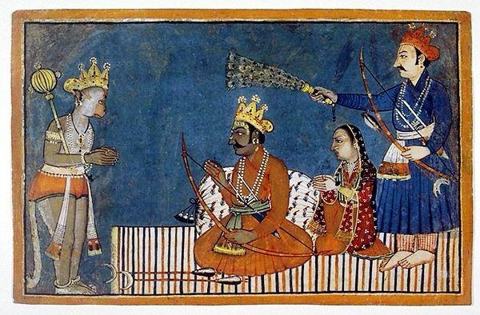
Son of the wind, greatest of the vanaras, and Rama's perfect servant — the leaper of oceans who became one of India's most worshipped gods.
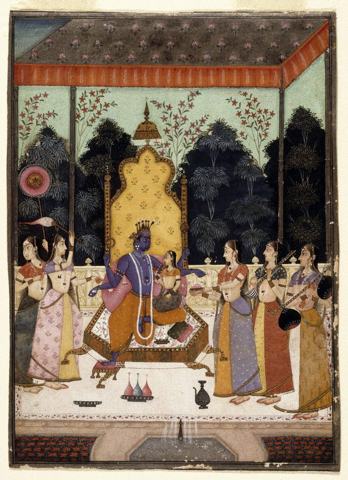
The preserver of cosmic order — the god who descends age after age, as Rama, as Krishna, and in other forms, to set dharma right when it fails.
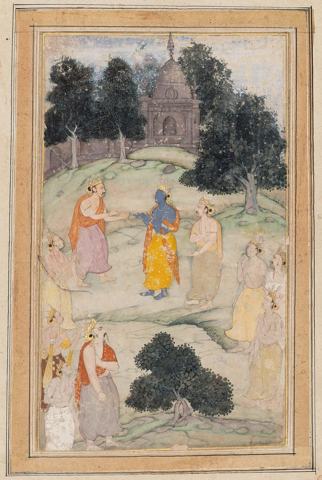
Roughly 100,000 verses attributed to the sage Vyasa — the frame for most of Hindu myth, including the Bhagavad Gita, and still the longest epic poem known.
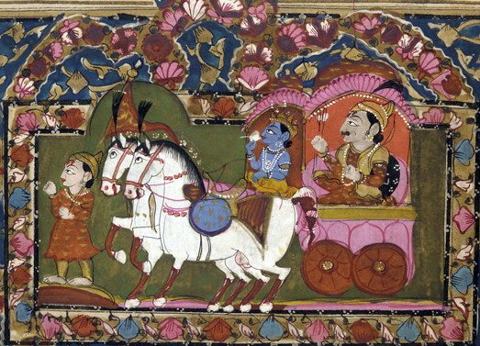
Cowherd, lover, statesman and charioteer — the avatar of Vishnu who speaks the Bhagavad Gita and anchors India's largest devotional tradition.
Sources & Further Reading
- 1.Valmiki, Ramayana - Sanskrit epic in seven books (kandas); core narrative layers c. 3rd century BCE - 3rd century CE, with Books I and VII generally regarded as later additions.
- 2.Goldman, Robert P., et al., trans. The Ramayana of Valmiki: An Epic of Ancient India. 7 vols. Princeton University Press, 1984-2017.
- 3.Bhatt, G. H., et al., eds. The Valmiki Ramayana: Critically Edited for the First Time. Oriental Institute, Baroda, 1960-1975.
- 4.Richman, Paula, ed. Many Ramayanas: The Diversity of a Narrative Tradition in South Asia. University of California Press, 1991.
- 5.Pollock, Sheldon. Ramayana and Political Imagination in India. Journal of Asian Studies 52, no. 2 (1993).
- 6.Brockington, John. The Sanskrit Epics. Brill, 1998.
- 7.Lutgendorf, Philip. The Life of a Text: Performing the Ramcaritmanas of Tulsidas. University of California Press, 1991.
Spot an error or have a source to suggest? Write to info@viseterna.com. We cite primary sources and modern scholarship, and we correct fast.