
Indra
King of the gods and lord of storm and war — wielder of the thunderbolt, slayer of the serpent Vritra, and the deity Hinduism gradually demoted.
Indra, Lord of Storms and King of the Gods' Heaven, gilt-bronze sculpture (Philadelphia Museum of Art) · CC BY-SA 4.0 · source
Who Indra Is
Indra (इन्द्र) is the king of the devas, the god of thunder, rain, and battle, and the overwhelming protagonist of India's oldest surviving text 1. He carries the vajra, the thunderbolt-weapon; he rides the white elephant Airavata; he is red-bearded, enormous, and famously fond of drink 1,3.
He also has the most dramatic career arc of any Hindu deity. In the Rigveda he is the greatest of the gods by a wide margin. Two thousand years later he is a fallible celestial bureaucrat whose heaven can be lost and whose pride is a standing joke in devotional literature 5,6,7. Tracing that decline is the clearest way to see how Hinduism itself changed.
The God of the Rigveda
Roughly a quarter of the Rigveda's hymns are addressed to Indra — far more than to any other deity, and more than to Vishnu and Rudra combined 1. He is invoked as the one who props apart heaven and earth so that there is a world between them, who stabilises the shaking mountains, who finds and releases what has been hidden, and who wins 1.
Jamison and Brereton's translation brings out how physical and how partisan these hymns are: Indra is celebrated as a champion who fights on behalf of the people making the offering, and his hymns are full of cattle, chariots, rivers, and plunder 1. His companions are the Maruts, a troop of young storm gods who ride the winds with him 1.
Vritra and the Waters
Indra's defining act is the killing of Vritra, and the Rigveda returns to it constantly. Vritra is a serpent or dragon lying across the mountains, "the encloser," holding the waters penned so that nothing can flow and nothing can grow 1.
The great hymn of the deed describes Indra drinking soma, taking up the vajra forged for him by the craftsman Tvashtr, and striking Vritra down. The serpent falls like a felled tree; the pent waters break loose and run to the sea; the sun, the dawn, and the sky are set in place 1. The epithet that follows Indra everywhere is Vritrahan, slayer of Vritra 1.
This is a cosmogony disguised as a battle: before the blow, obstruction and stagnation; after it, flow, season, and life 1,7. Comparativists have long noted that the formula — hero, weapon, serpent, released waters — recurs across the Indo-European poetic tradition, and Jamison and Brereton treat the dragon-slaying language as inherited 1.
Soma and the Vajra
Indra's power is not innate but fuelled. He drinks soma, the pressed ritual plant of the Vedic sacrifice, in absurd quantities before combat — lakes of it, three vats at a draught 1. The relation between offering and strength is direct and transactional: the sacrificers make Indra able to win, and he wins for them 1,7.
The vajra is made for him by the divine artisan. A later and much-repeated Puranic story gives it a different origin — that it was fashioned from the bones of the sage Dadhichi, who gave up his body so that the gods would have a weapon capable of killing their enemy 3,6.
The Guilt and the Fall
Then the tradition turns on him. Post-Vedic texts make Vritra a brahmin — a son of Tvashtr — so that Indra's greatest deed becomes brahmahatya, the killing of a brahmin, the gravest offence in the ritual system 2,3,6. Indra flees, hides, and must be ritually purified, with the guilt distributed among the earth, the waters, the trees, and women 2,6.
More stories accumulate around his appetites. He seduces Ahalya, the wife of the sage Gautama, by taking her husband's form, and is cursed for it — in the Ramayana's telling, marked all over his body 4,6. He fears the power that ascetics accumulate through austerity, and repeatedly sends celestial dancers to break their concentration, because a sufficiently disciplined mortal could take his throne 3,6.
That last anxiety is the key to his demotion. Indra's kingship is an office won by merit and lost the same way, and Doniger's collection shows the Puranas using him as the standing example of power without permanence 6.
Svarga and the Parade of Indras
Classical Hinduism gives Indra a heaven, Svarga, on Mount Meru — with the Nandana pleasure-grove, the wish-granting tree, the elephant Airavata, and the courts of apsaras and gandharvas 3,6. It is a good heaven, and a temporary one: those who reach it through merit stay only until their merit runs out, then are reborn — compared with liberation, a long holiday, and the devotional traditions say so 6,7.
Two stories complete the reduction. In one, told in a late Purana and much retold since, a proud Indra is building a palace fit for his greatness when a boy visitor points to a column of ants crossing the floor and remarks that every one of them was, in an earlier cycle, an Indra 6. In the other, from the Bhagavata Purana, Krishna persuades the cowherds of Vrindavan to stop sacrificing to Indra and honour their mountain instead; the insulted god sends a week-long deluge, and Krishna lifts Mount Govardhan on one finger as an umbrella until Indra gives up and bows 5.
The second is not just a good scene. It is the theological handover made visible: the Vedic storm-king is out-rained by a cowherd, and the future of Hindu devotion belongs to the cowherd 5,7.
Indra Elsewhere and Today
Indra had a long career outside Hinduism as well. In Buddhism he is Sakka or Sakra, ruler of the Heaven of the Thirty-Three, who appears repeatedly in the Pali canon as a devoted and rather anxious lay follower of the Buddha; Jain cosmology assigns Indras to its heavens too 7.
Within Hinduism he retains a permanent ritual place as dikpala, guardian of the eastern direction, invoked in temple consecration and in daily rites, and his Vedic hymns are still recited 1,7. Nepal keeps him publicly: Indra Jatra, the eight-day festival in Kathmandu with masked dances, chariot processions, and the appearance of the living goddess Kumari, remains one of the valley's major annual observances 7.
He is, in the end, the god who was too successful too early — kept in the ritual system, retired from the centre of devotion, and remembered chiefly for one immense blow that let the rivers run 1,7.
Continue Exploring
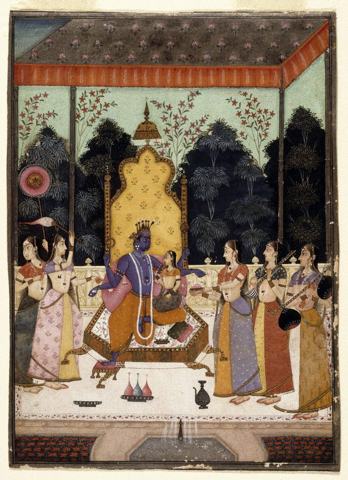
The preserver of cosmic order — the god who descends age after age, as Rama, as Krishna, and in other forms, to set dharma right when it fails.
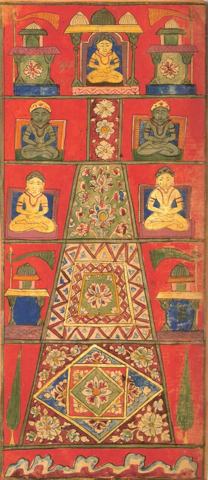
The golden mountain at the exact center of the universe, home of the gods and the fixed point Puranic cosmology measures every continent and ocean from.
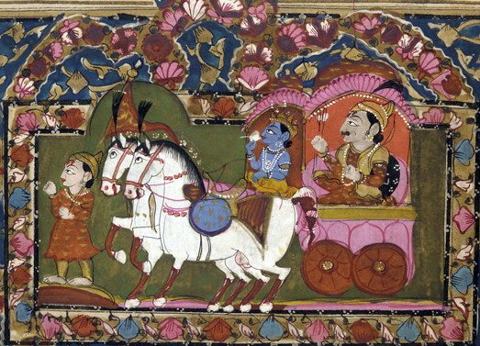
Cowherd, lover, statesman and charioteer — the avatar of Vishnu who speaks the Bhagavad Gita and anchors India's largest devotional tradition.
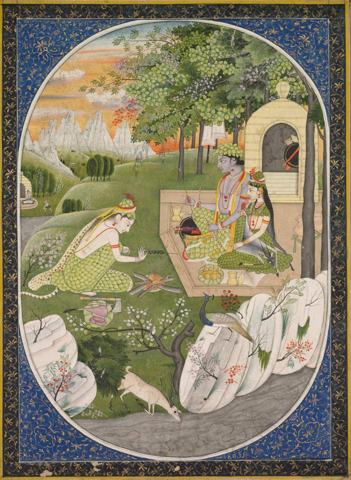
Prince of Ayodhya and seventh avatar of Vishnu — exiled hero of the Ramayana, slayer of Ravana, and the ideal of dharma.
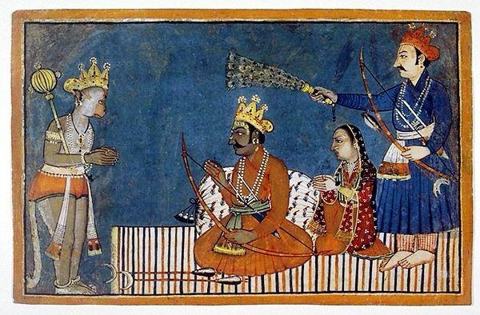
Son of the wind, greatest of the vanaras, and Rama's perfect servant — the leaper of oceans who became one of India's most worshipped gods.
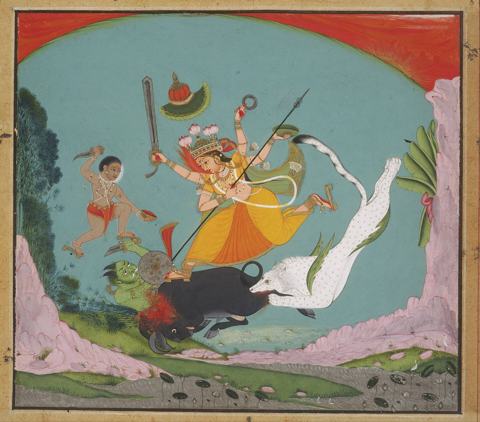
The warrior goddess assembled from the massed light of all the gods, lion-mounted slayer of the buffalo demon Mahishasura.
Also mentioned inAgni (Hindu Fire God)ArjunaGarudaSurya (Hindu Sun God)The Churning of the Ocean (Samudra Manthan)The RigvedaYama (Hindu God of Death)
Sources & Further Reading
- 1.The Rigveda (c. 1500–1200 BCE); trans. Stephanie W. Jamison & Joel P. Brereton. Oxford University Press, 2014.
- 2.The Shatapatha Brahmana.
- 3.The Mahabharata.
- 4.The Ramayana of Valmiki.
- 5.The Bhagavata Purana.
- 6.O'Flaherty, Wendy Doniger. Hindu Myths: A Sourcebook Translated from the Sanskrit. Penguin Classics, 1975.
- 7.Flood, Gavin. An Introduction to Hinduism. Cambridge University Press, 1996.
Spot an error or have a source to suggest? Write to info@viseterna.com. We cite primary sources and modern scholarship, and we correct fast.