
Dashavatara
Fish, tortoise, boar, man-lion, dwarf, and five more — the standard list of Vishnu's ten descents, though the Puranas themselves never quite agree on it.
The Incarnations of Vishnu, Company school painting, India, c. 1771-1779 (Victoria and Albert Museum, London) · Public domain · source
Descent, Not Incarnation
Avatara means "descent" or "crossing down," and it names Vishnu's defining doctrine: that the preserving god periodically takes bodily form in the world rather than governing it only from a distance 4,8. The classic statement is the Bhagavad Gita's own formula, spoken by Krishna to Arjuna — that whenever righteousness declines and unrighteousness rises, he brings himself into being, age after age, to protect the good and restore dharma 8. Parrinder's comparative study is careful to mark how different this is from the Christian idea of incarnation it is often loosely translated as: an avatara is repeatable rather than singular, partial rather than a total emptying of divinity into flesh, and each descent ends when its purpose is served rather than founding a single permanent union of god and world 6.
Counting to Ten
The list that later tradition settled on as standard runs: Matsya the fish, who saves the first man and the scriptures from a world-ending flood; Kurma the tortoise, who bears the mountain used to churn the ocean of milk; Varaha the boar, who lifts the sunken earth clear of the cosmic waters on his tusk; Narasimha, the man-lion who kills a demon at a threshold at twilight to satisfy the exact wording of a boon that made him unkillable by day or night, indoors or out, by man or beast; Vamana the dwarf, who asks the demon-king Bali for three paces of ground and then strides across the universe in two; Parashurama, the axe-wielding brahmin who purges a corrupt warrior class; Rama; Krishna; the Buddha; and Kalki, a rider on a white horse still to come, who will end the present degenerate age 1,2,4. Gonda traces the doctrine's roots to a scattering of earlier Vedic and epic stories about Vishnu intervening directly in crises — the tortoise and the boar both appear as independent rescue myths before any text organizes them into a numbered sequence 4.
A List That Never Quite Fixes
No single Purana states this exact list in this exact order as final. The Bhagavata Purana's own third chapter enumerates twenty-two incarnations, not ten, and treats the standard ten as merely the most prominent among many; the Matsya Purana gives its own, differently ordered list of ten, and the Vishnu Purana discusses several of the same descents without ever numbering them into a fixed set at all, so the tidy list familiar from posters and calendars is itself an editorial choice later tradition made from looser Puranic material 1,2,3,5. The two most debated seats on the list are the eighth and the ninth. Several older or more sectarian tellings give the eighth position to Krishna's elder brother Balarama rather than Krishna himself, since some traditions count Krishna as the source of all avataras rather than one among them 5. The ninth slot, the Buddha, is later still, and O'Flaherty's sourcebook preserves Puranic material that reads his inclusion two ways at once: as an act of genuine reverence absorbing a rival teacher into the Vaishnava fold, and as a deliberately double-edged story in which Vishnu takes Buddhist form specifically to mislead the wicked away from Vedic sacrifice and toward their own destruction 7.
An Evolutionary Reading That Isn't Ancient
A popular modern account reads the sequence as a kind of parable of evolution — fish, amphibian-adjacent tortoise, land mammal, part-animal part-human, small human, flawed human, ideal human king, fully divine man, teacher, and a final rider still to come — advancing from water to land to increasingly refined humanity. This reading is a nineteenth- and twentieth-century one, part of a wider effort by some Hindu reformers of the colonial period to read older Puranic material as anticipating modern science, and it is not how the Puranas themselves frame the order, which is narrative and theological rather than developmental 6,8. The sources describe ten separate rescues at ten separate moments of crisis, not a single ascending ladder, and the sequence's fixed order is itself a later systematization imposed on stories that originally circulated on their own 4,6.
An Open List
Only Kalki has not yet arrived, which keeps the doctrine formally open in a way the other nine descents are not: tradition holds his avatara for the future, riding to end the current age of decline, and various claimants across Indian history have been proposed or have proposed themselves for the role, none accepted by mainstream tradition 5,7. That unfinished status is, in miniature, what the whole doctrine argues: that Vishnu's interventions are not a closed set of ancient stories but a standing promise about how the world keeps being saved 7,8.
Related entries: Vishnu, Rama, Krishna, The Churning of the Ocean, The Bhagavad Gita.
Continue Exploring
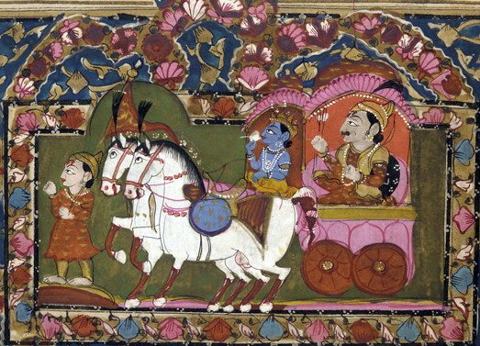
Cowherd, lover, statesman and charioteer — the avatar of Vishnu who speaks the Bhagavad Gita and anchors India's largest devotional tradition.
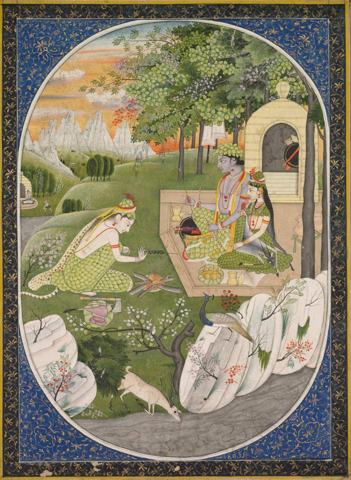
Prince of Ayodhya and seventh avatar of Vishnu — exiled hero of the Ramayana, slayer of Ravana, and the ideal of dharma.
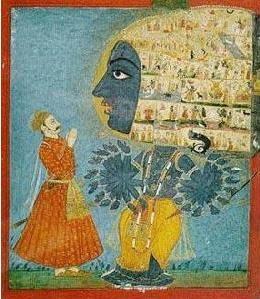
Eighteen chapters embedded in the Mahabharata where Krishna counsels Arjuna — read, translated and argued over more than any other Hindu text.
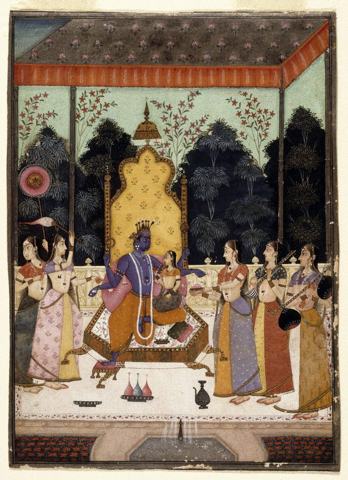
The preserver of cosmic order — the god who descends age after age, as Rama, as Krishna, and in other forms, to set dharma right when it fails.
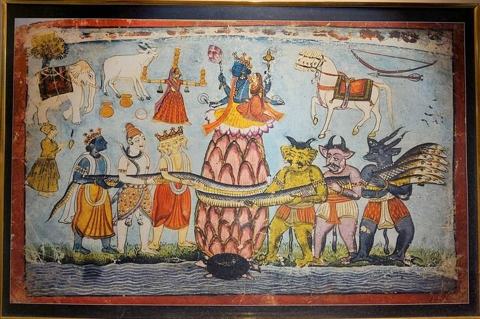
Gods and demons churn the cosmic ocean with a mountain and a serpent for the nectar of immortality — and very nearly destroy all creation before they get it.
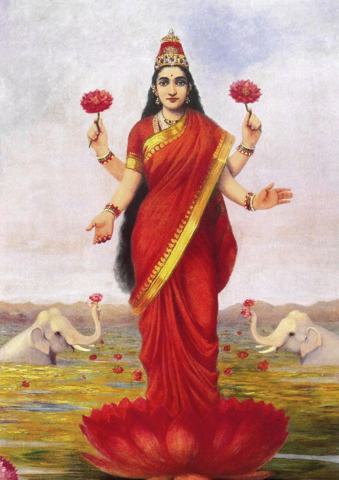
Goddess of wealth, beauty and good fortune, born from the churning of the ocean and inseparable consort of Vishnu.
Sources & Further Reading
- 1.The Bhagavata Purana, Book I, chapter 3 - an early list of Vishnu's incarnations, one of several such lists across the Puranic corpus.
- 2.The Vishnu Purana.
- 3.The Matsya Purana.
- 4.Gonda, Jan. Aspects of Early Visnuism. N.V. A. Oosthoek's Uitgevers Mij, 1954.
- 5.Matchett, Freda. Krishna, Lord or Avatara? Curzon, 2001.
- 6.Parrinder, Geoffrey. Avatar and Incarnation. Faber, 1970.
- 7.O'Flaherty, Wendy Doniger, trans. Hindu Myths: A Sourcebook Translated from the Sanskrit. Penguin Classics, 1975.
- 8.Flood, Gavin. An Introduction to Hinduism. Cambridge University Press, 1996.
Spot an error or have a source to suggest? Write to info@viseterna.com. We cite primary sources and modern scholarship, and we correct fast.