
The Rigveda
Ten books of hymns to Agni, Indra and Soma — the oldest surviving Sanskrit text, kept by memory alone for two millennia before it was ever written down.
Rigveda manuscript fragment, Sharada script on palm leaf, copied before the 14th century (Bhandarkar Oriental Research Institute, Pune) · CC0 · source
The Oldest Book in the House
The Rigveda is the first and, by scholarly consensus, the oldest of the four Vedas, the foundational scriptures of Hinduism: a collection of 1,028 hymns, or suktas, gathered into ten books, or mandalas, composed in an archaic form of Sanskrit by many different poet-seers, rishis, over generations 1,2. Its hymns are addressed chiefly to Agni, the fire that carries offerings to the gods, Indra, the storm-king and dragon-slayer who receives more hymns than any other deity, Soma, the ritual plant and the god identified with it, and a wider circle including Varuna, the Ashvins, and Ushas, goddess of dawn 1,2. Everything in the collection is built around a single institution, the yajna or fire sacrifice, and the hymns are, in the plainest sense, the words that Vedic priests actually spoke while performing it 2.
A Text Older Than Any Surviving Copy of It
No manuscript anywhere near the Rigveda's age of composition exists; the oldest physical Rigveda manuscripts that survive are paper or palm-leaf copies from the medieval period, many centuries younger than the hymns they preserve 1. Dating the text therefore rests on internal evidence rather than an artifact: comparison with the closely related Old Avestan language of the Iranian Gathas, the relative chronology of the Vedic corpus's own internal layers, and the rivers and places its hymns name, which locate its composition in the greater Punjab and northwest of the Indian subcontinent. On that basis, linguists conventionally place the bulk of its composition between roughly 1500 and 1200 BCE, though the text supplies no date of its own and this figure remains a scholarly estimate rather than a fixed fact 2,4. That question of dating has become entangled with a genuinely modern controversy: mainstream historical linguistics holds that Indo-Aryan speakers arrived in South Asia from the northwest during the second millennium BCE, while some Indian nationalist scholarship argues instead for an "indigenous Aryan" or "Out of India" origin that would place Rigvedic culture natively in South Asia far earlier. Bryant's survey of the dispute walks through the linguistic, archaeological, and genetic evidence on each side without declaring a final verdict, noting that most specialists in historical linguistics still favor migration while a vocal minority, often for reasons entangled with modern Indian politics, argue otherwise 4.
Preserved by Memory, Not by Ink
For most of its history the Rigveda was not a written text at all. Vedic reciters developed an elaborate set of recitation techniques — the continuous samhita-patha, the word-by-word pada-patha, and more complex permutation methods such as the krama-patha and ghana-patha — that functioned as internal cross-checks, so that an error introduced anywhere in the chain of transmission would surface and be corrected 5. Staal's study of this system argues that oral transmission of this kind, precisely because it is checked constantly by a trained community rather than copied silently by a single scribe, preserved the hymns with a fidelity that most written manuscript traditions cannot match 5. UNESCO inscribed the continuing practice on the Representative List of the Intangible Cultural Heritage of Humanity in 2008, an acknowledgment that this is a living performance tradition and not merely an archive 5,6.
The Text Reaches Europe
Western philology encountered the Rigveda relatively late and largely through one project. Friedrich Max Müller, working under the patronage of the British East India Company, produced the first full printed edition of the text together with the medieval commentary of Sayana between 1849 and 1874, a work that effectively founded European Vedic scholarship and, with it, the broader field of comparative Indo-European linguistics 4. Ralph T. H. Griffith's complete English verse translation followed soon after, first published in 1889 and revised in 1896; despite its dated philology it remained the standard English Rigveda for general readers for over a century 3. Stephanie Jamison and Joel Brereton's 2014 translation, the product of decades of work, is now the standard scholarly English version, and it reads each hymn primarily against the grammar and poetics of the Vedic corpus itself rather than through Sayana's later ritual gloss 2.
Still Recited
Fragments of the Rigveda remain part of ordinary Hindu practice. The Gayatri Mantra, addressed to the solar deity Savitr, is recited daily by observant Hindus and is drawn directly from the third mandala; the wedding hymn, the Vivaha Sukta of the tenth mandala, is still recited at Hindu weddings today 1,6. Not every legacy is comfortable: the Purusha Sukta, a late hymn in the tenth mandala describing the cosmic man's dismemberment into the four social orders, is the earliest textual basis later invoked to justify the varna system, and it remains a genuinely contested passage rather than a settled piece of ancient poetry 6. The Rigveda's descendants run through nearly everything else this Codex covers under the Hindu pantheon — its hymns are the earliest layer beneath Vishnu, Indra, Agni, and the sacrificial world the later epics and Puranas all still assume 1,2.
Related entries: Agni, Indra, Vishnu, The Mahabharata.
Continue Exploring
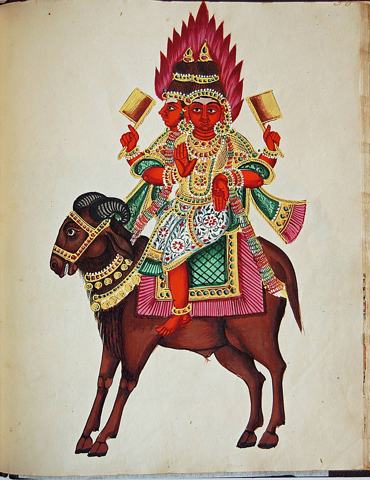
The fire god who opens the Rigveda — household priest among men and messenger among the gods, carrying every offering from the altar to the deities themselves.
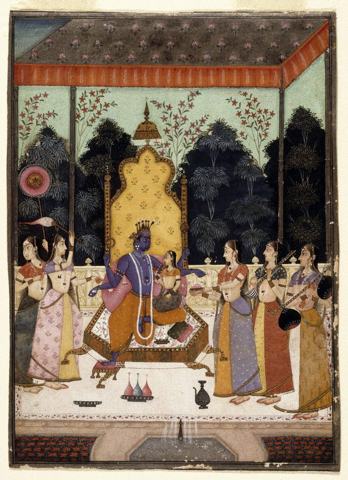
The preserver of cosmic order — the god who descends age after age, as Rama, as Krishna, and in other forms, to set dharma right when it fails.
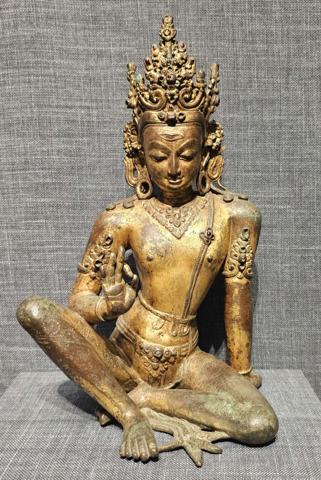
King of the gods and lord of storm and war — wielder of the thunderbolt, slayer of the serpent Vritra, and the deity Hinduism gradually demoted.
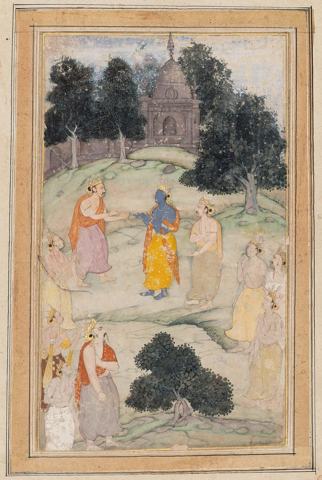
Roughly 100,000 verses attributed to the sage Vyasa — the frame for most of Hindu myth, including the Bhagavad Gita, and still the longest epic poem known.
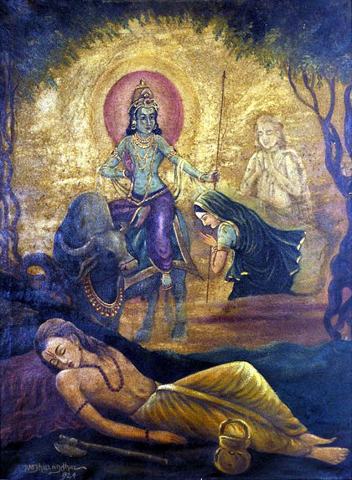
The Rigveda's first mortal to find the path of death, later Lord of the Dead — met by the boy Nachiketas in the Katha Upanishad and once outwitted by Savitri.
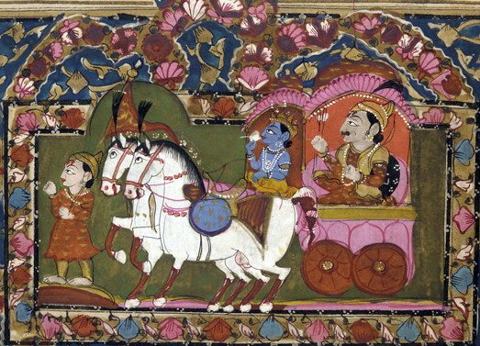
Cowherd, lover, statesman and charioteer — the avatar of Vishnu who speaks the Bhagavad Gita and anchors India's largest devotional tradition.
Sources & Further Reading
- 1.The Rigveda; Sanskrit, composed c. 1500-1200 BCE in ten mandalas of 1,028 hymns, transmitted orally for roughly two millennia before being committed to writing.
- 2.Jamison, Stephanie W., and Joel P. Brereton, trans. The Rigveda: The Earliest Religious Poetry of India. 3 vols. Oxford University Press, 2014.
- 3.Griffith, Ralph T. H., trans. The Hymns of the Rigveda. 1896.
- 4.Bryant, Edwin F. The Quest for the Origins of Vedic Culture: The Indo-Aryan Migration Debate. Oxford University Press, 2001.
- 5.Staal, Frits. Discovering the Vedas: Origins, Mantras, Rituals, Insights. Penguin Books, 2008.
- 6.Flood, Gavin. An Introduction to Hinduism. Cambridge University Press, 1996.
Spot an error or have a source to suggest? Write to info@viseterna.com. We cite primary sources and modern scholarship, and we correct fast.