
Garuda
The golden sun-eagle who carries Vishnu — thief of the gods' nectar, liberator of his enslaved mother, and the eternal enemy of the serpents.
Vishnu Riding on Garuda, eastern India, early Pala period, 7th century (Cleveland Museum of Art) · CC0 · source
Who Garuda Is
Garuda (गरुड) is the king of birds, the mount and standard of Vishnu, and one of the few figures in Hindu narrative whose entire mythology is built around a single act of filial devotion 2,5. He is depicted with a golden body, a white face, an eagle's beak and wings, and a human torso and arms — huge enough that his wingbeats stop the turning of the worlds 2,4.
A winged solar bird appears already in the Rigveda, where a celebrated verse says that the one reality is called Indra, Mitra, Varuna, Agni, and also the heavenly winged Garutman — a name generally taken as the antecedent of Garuda's 1,6. The developed figure, however, belongs to the epics and Puranas, and his full story is told at length in the opening book of the Mahabharata 2.
The Wager and the Slavery
The story starts with two sisters, Kadru and Vinata, both married to the sage Kashyapa, each granted a boon. Kadru asks for a thousand serpent sons — the nagas. Vinata asks for two sons who will surpass them in strength 2,5.
Vinata's impatience ruins the first. She cracks one egg early, and out comes Aruna, brilliant above and unformed below, who curses his mother to slavery for five hundred years before he departs to become the charioteer of the sun 2,5. The second egg she leaves alone.
The curse arrives through a bet. The sisters see Uchchaihshravas, the celestial horse that rose from the churning of the ocean, and wager on the colour of its tail; Kadru says black, Vinata says white. Kadru then orders her serpent sons to wind themselves black through the horse's tail, and Vinata — technically wrong — becomes her sister's slave 2,5.
Then the second egg hatches. Garuda emerges blazing, so bright that the gods mistake him for the fire at the end of the world and beg him to shrink 2,6.
The Raid on Heaven
Garuda finds his mother enslaved and asks the nagas what it would take to free her. They name the price: amrita, the nectar of immortality, which is in the keeping of the gods 2,5.
He eats to gain strength for the journey — including, in the epic's account, an elephant and a tortoise locked in an ancient quarrel, which he devours perched on a bough that cannot hold him 2. Then he flies to heaven and takes on the assembled gods, scattering them with wind from his wings 2,6.
Three defences guard the nectar: a wall of fire, which he quenches by carrying river water in his beak; a spinning wheel of razor blades, which he passes by shrinking to fit between the spokes; and two enormous venomous serpents with lightning in their eyes, which he blinds with dust and cuts apart 2,5. He takes the vessel and flies 2.
The Bargain
Indra pursues him and strikes him with the vajra, the thunderbolt that has never failed. Garuda is unhurt — but out of respect for the weapon and for the sage whose bones made it, he lets fall a single feather 2,6.
Two negotiations follow. Vishnu, impressed that a creature would seize immortality and not drink it, offers Garuda a boon; Garuda asks to be deathless without the nectar, and to rank above Vishnu himself. Vishnu grants both — and takes him as his mount, which places Garuda on his banner and thus, literally, above him: a hierarchy settled without humiliating either party 2,6.
Indra then asks for the nectar back and is refused; Garuda has promised to deliver it, not to let it be kept. The compromise they reach is that Indra may retrieve it once it has been handed over, and that serpents will be Garuda's food forever 2,5.
Why Serpents Have Forked Tongues
Garuda sets the vessel down before the nagas on a bed of kusha grass, and his mother is released from her bondage as agreed 2. But he advises the serpents to purify themselves ritually before drinking, as such a moment deserves — and while they are away bathing, Indra swoops in and carries the amrita off 2,5.
The nagas rush back to find the grass bare. Desperate for any residue, they lick the sharp blades of kusha, and their tongues are split — which is why, the epic says, snakes have forked tongues, and why the grass is holy 2,5. Vogel treats this as a clear example of Indian serpent-lore tying ritual objects and observed animal features into one narrative 5.
The hatred between eagles and serpents is fixed from that day, and it is the frame for a great deal of later Indian art: Garuda grasping a naga in his talons or beak, wings spread 4,5.
Garuda in Temple and Ritual
In Vaishnava practice Garuda is not merely transport. A Garuda pillar or shrine faces the sanctum in Vishnu temples, the bird kneeling with palms joined toward his lord, so that worshippers approach the deity past his most devoted servant; the garuda vahana procession, carrying the god on his mount, is a major event in South Indian temple calendars 7.
He is also invoked against poison. Garuda mantras and amulets form a recognised body of protective practice against snakebite, on the logic that the enemy of serpents is the friend of anyone they threaten 5,7.
And he gives his name to a scripture. The Garuda Purana is framed as Vishnu's teaching delivered to Garuda, and its section on death, the intermediate state, and the fate of the departed is widely recited at Hindu funerals — which makes Garuda, by association, a familiar presence at the end of life 3,7.
Garuda Beyond India
Garuda travelled with Indian religion across Asia. Buddhist cosmology includes garudas as a class of vast birds perpetually at war with the nagas, and Himalayan Buddhism developed the garuda into a wrathful protector figure used in healing and poison rites 5,7.
In Southeast Asia he became a symbol of state. Garuda is the national emblem of Indonesia, whose coat of arms is the Garuda Pancasila and whose national airline bears his name; in Thailand the garuda is the royal emblem and appears on the seal granted to businesses holding a royal warrant; and Khmer temple reliefs at Angkor show him carrying Vishnu across their walls 7.
A bird invented to free one enslaved mother now flies on passports and letterheads across half a continent 7.
Continue Exploring
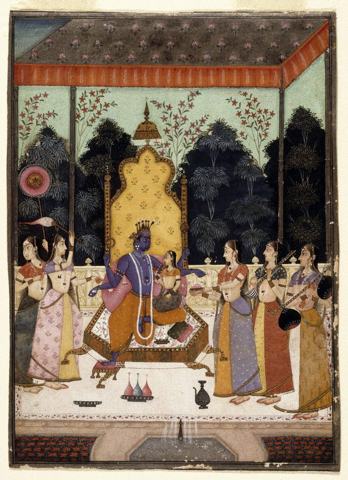
The preserver of cosmic order — the god who descends age after age, as Rama, as Krishna, and in other forms, to set dharma right when it fails.
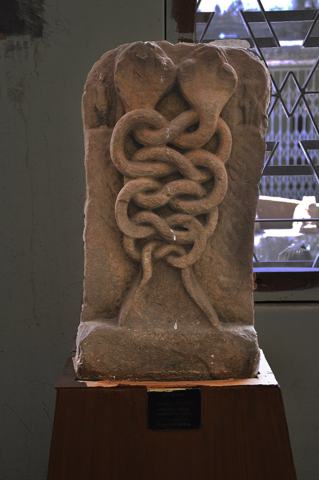
Semi-divine serpent beings of the waters and the underworld — hooded and jewel-crowned guardians of treasure, of rain, and of hidden knowledge.
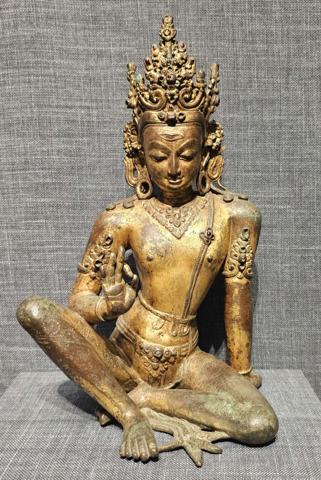
King of the gods and lord of storm and war — wielder of the thunderbolt, slayer of the serpent Vritra, and the deity Hinduism gradually demoted.
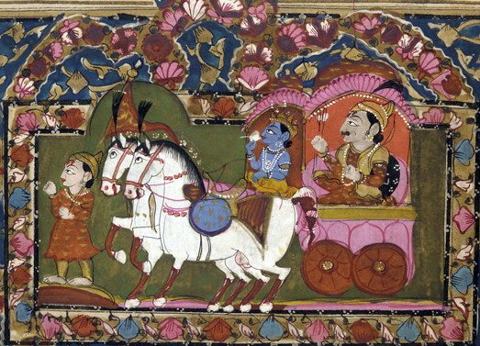
Cowherd, lover, statesman and charioteer — the avatar of Vishnu who speaks the Bhagavad Gita and anchors India's largest devotional tradition.
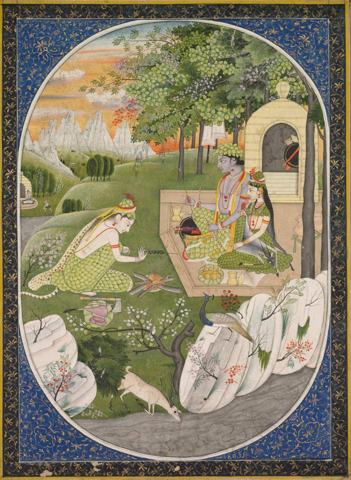
Prince of Ayodhya and seventh avatar of Vishnu — exiled hero of the Ramayana, slayer of Ravana, and the ideal of dharma.
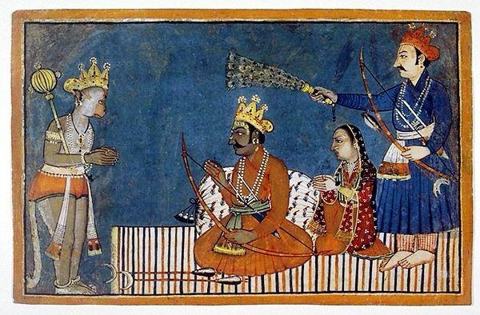
Son of the wind, greatest of the vanaras, and Rama's perfect servant — the leaper of oceans who became one of India's most worshipped gods.
Also mentioned inLakshmi (Laxmi)
Sources & Further Reading
- 1.The Rigveda (c. 1500–1200 BCE); trans. Stephanie W. Jamison & Joel P. Brereton. Oxford University Press, 2014.
- 2.The Mahabharata, Adi Parva.
- 3.The Garuda Purana.
- 4.The Vishnu Purana.
- 5.Vogel, J. Ph. Indian Serpent-Lore, or The Nagas in Hindu Legend and Art. Arthur Probsthain, 1926.
- 6.Gonda, Jan. Aspects of Early Visnuism. N.V. A. Oosthoek's Uitgevers Mij., 1954.
- 7.Flood, Gavin. An Introduction to Hinduism. Cambridge University Press, 1996.
Spot an error or have a source to suggest? Write to info@viseterna.com. We cite primary sources and modern scholarship, and we correct fast.