
Quetzalcoatl
The Feathered Serpent — god of wind, learning, and creation, who stole humanity's bones from the land of the dead and gave people maize.
Temple of the Feathered Serpent, Teotihuacan, c. 200 CE · CC BY 2.0 · source
The Feathered Serpent
Quetzalcoatl is Nahuatl for "quetzal-feathered serpent" — quetzalli, the shimmering green tail feather prized above gold, joined to coatl, snake 5. The name also carries a second sense, "precious twin," which the myths exploit: Quetzalcoatl has a dog-headed double, Xolotl, and a Venusian identity that rises and sets twice 5.
For the Mexica (Aztecs) he was the god of wind, of the morning star, of priesthood, writing, the calendar, and the arts of civilisation, and the patron of the calmecac, the schools that trained the priestly and noble class 1,5. He is the culture-bringer of Mesoamerica: the deity credited with giving humanity its bones, its maize, and its knowledge 2,5.
A God Older Than the Aztecs
The Feathered Serpent long predates the Aztec empire. A monumental temple at Teotihuacan, built around 200 CE, is covered in projecting feathered-serpent heads, and the imagery has antecedents reaching back to Olmec art 5. The Maya knew the same figure as Kukulkan and, in the K'iche' creation epic, as Q'uq'umatz 5.
By the Postclassic period the serpent had accumulated a second identity as a legendary ruler, and separating the god from the priest-king became — and remains — the central scholarly problem attached to him 6. Nicholson's study, the most thorough treatment of the sources, concludes that the ruler-figure is not pure invention and that some genuinely historical material about a Tollan priest-king lies under the accumulated myth 6.
Ehecatl, the Wind
In his wind aspect he is Ehecatl-Quetzalcoatl, wearing a conical cap, a conch-shell "wind jewel" pectoral cut in cross-section, and a protruding red buccal mask like a duck's bill through which he blows 1,5. His temples are the only round buildings in Mesoamerican architecture — built cylindrical, the sources say, so that the wind would not be obstructed by corners 1,5.
Ehecatl's job is to sweep the road for the rain gods; the winds that arrive before a storm are him clearing the way for Tlaloc 5. He is also the wind that first moved the sun. In the myth of the Fifth Sun, when the newly created sun refused to travel, it was Ehecatl who blew it into motion 2,5.
Bones from Mictlan, Maize from the Mountain
The most quoted Quetzalcoatl myth appears in the Leyenda de los Soles. After the destruction of the previous world, Quetzalcoatl descends into Mictlan, the land of the dead, and asks Mictlantecuhtli for the bones of the earlier humanity so that the earth can be peopled again 2. Mictlantecuhtli agrees, then sets a trick condition — circle the realm four times sounding a conch trumpet that has no holes — and Quetzalcoatl gets worms to bore it and bees to make it roar 2.
He takes the bones and runs. Mictlantecuhtli's servants dig a pit; a quail startles him; he falls and the bones shatter 2. He gathers the fragments anyway, carries them to Tamoanchan, and there the goddess Cihuacoatl-Quilaztli grinds them while Quetzalcoatl bleeds his own body over the meal. From that mixture humanity is made — and because the bones broke unevenly, people are not all the same size 2. It is a creation founded on theft, failure, improvisation, and self-sacrifice.
He then finds where maize is hidden. Transforming into a black ant, he follows a red ant into the Mountain of Sustenance, Tonacatepetl, and carries the first grains out to the gods 2,5.
He also acts with Tezcatlipoca in the making of the world: in one account the two gods transform into serpents and tear the earth-monster Tlaltecuhtli in half, making the sky from one part and the earth from the other 3,5. In the sequence of cosmic ages, Quetzalcoatl governs the second sun, Nahui Ehecatl (Four Wind), which ends in a hurricane that turns its people into monkeys 2,5.
Topiltzin Quetzalcoatl of Tollan
Alongside the god stands Topiltzin Quetzalcoatl, remembered as the priest-king of Tollan, the Toltec capital, in a golden age of craft and abundance 1,6. The Florentine Codex records that his offerings were snakes, birds, and butterflies, and that he refused human sacrifice — a claim which set him against the practice at the centre of later Mexica state religion 1.
His fall is engineered by Tezcatlipoca, his eternal antagonist, who comes disguised as an old man with a mirror, shows the king his own aged face, and offers a medicine that turns out to be pulque 1,2. Drunk, Topiltzin breaks his vows — the Anales de Cuauhtitlan have him sleeping with his sister Quetzalpetlatl — and wakes to disgrace 2. He abandons Tollan and travels east to the coast, where the traditions diverge: in one he immolates himself on a pyre and his heart rises as the morning star; in another he sails away on a raft of serpents 1,2,6.
The Return, and the Cortes Story
The best-known claim about Quetzalcoatl — that Moctezuma II mistook Hernán Cortés for the returning god in 1519 — deserves scepticism. The story is preserved almost entirely in sources written after the conquest, some of them by Spaniards with an obvious interest in a providential welcome and some by indigenous authors working within a colonial framework 6. Nicholson's source-by-source analysis shows how thin and how late the returning-god material is, and much subsequent scholarship treats the identification as substantially a post-conquest construction rather than a belief that shaped Moctezuma's decisions 6.
What is not in doubt is the god's standing before the Spaniards arrived: a deity worshipped across Mesoamerica for well over a thousand years, in feathers and in scales, as the wind and as the wisdom that made civilised life possible 5,6.
Continue Exploring
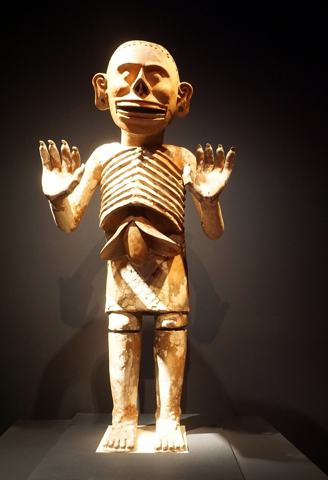
Lord of the Place of the Dead — the skeletal ruler of the ninefold underworld, keeper of humanity's bones and destination of everyone who dies ordinarily.
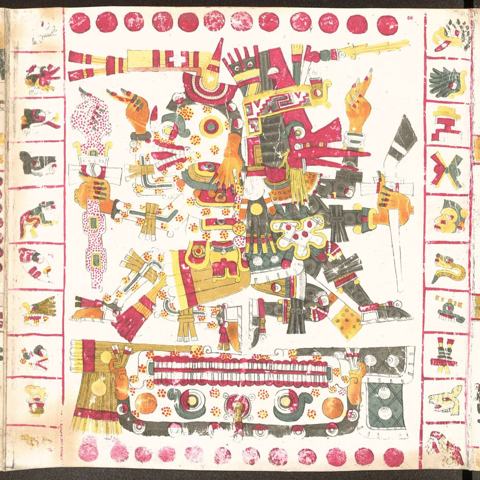
The Place of the Dead — a ninefold underworld reached by a four-year journey, where the ordinary dead arrive at last and simply cease.
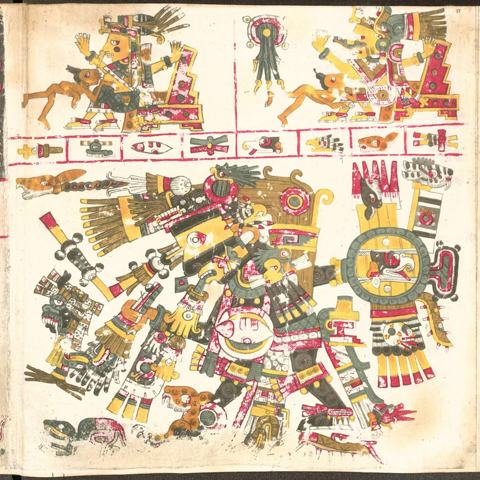
The Smoking Mirror — god of night, sorcery, kingship and fate, whose obsidian glass shows what men do in the dark and who owns them all as slaves.
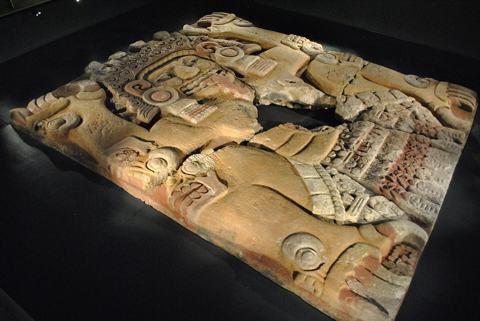
The crocodilian earth deity torn in two to make sky and ground — and the twelve-ton painted monolith of her unearthed at the Templo Mayor in 2006.
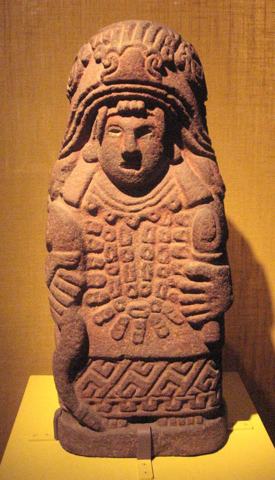
The Aztec goddess of childbirth and earth who helped shape humanity, lent her name to Tenochtitlan's second-in-command, and wept an omen before the conquest.
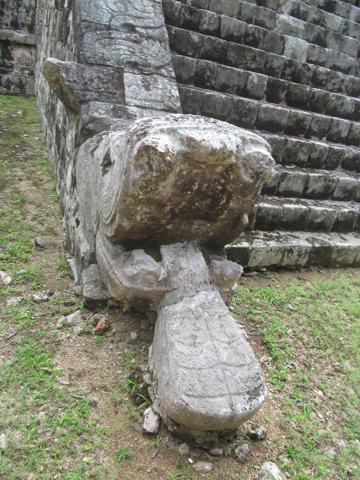
The Feathered Serpent of the Maya — creator's voice in the Popol Vuh, patron of Chichen Itza, and the shadow that descends its pyramid at the equinox.
Also mentioned inCipactliHuitzilopochtliItzamnaMayahuel (Aztec Goddess of Maguey and Pulque)Ometeotl (Aztec Dual God)TeotihuacanThe Codex BorgiaThe Five Suns (Aztec Creation Myth)Tonalpohualli (the 260-Day Sacred Calendar)Tonatiuh (Aztec Sun God)Xipe TotecXolotl
Sources & Further Reading
- 1.Bernardino de Sahagun, Florentine Codex — General History of the Things of New Spain (c. 1547–1579), Books 3 and 10.
- 2.Leyenda de los Soles and Anales de Cuauhtitlan (Codex Chimalpopoca, 1558/1570).
- 3.Historia de los Mexicanos por sus pinturas (16th century).
- 4.Codex Borgia (pre-Columbian ritual manuscript).
- 5.Miller, Mary & Karl Taube. The Gods and Symbols of Ancient Mexico and the Maya. Thames & Hudson, 1993.
- 6.Nicholson, H. B. Topiltzin Quetzalcoatl: The Once and Future Lord of the Toltecs. University Press of Colorado, 2001.
Spot an error or have a source to suggest? Write to info@viseterna.com. We cite primary sources and modern scholarship, and we correct fast.