
Xipe Totec
Our Lord the Flayed One — the Mesoamerican god of spring, seed and renewal, whose priests wore the skins of sacrificial victims for twenty days.
Xipe Totec, Codex Borgia, pre-conquest central Mexico (Biblioteca Apostolica Vaticana) · Public domain · source
The Name and the Idea
Xipe Totec is Nahuatl xipehua, "to flay", joined to totec, "our lord": Our Lord the Flayed One 5,6. Every element of him follows from that name. He is a god of spring planting, of the seed that splits its husk, of the new growth that arrives only when the old covering is discarded — and the rite that honoured him made that metaphor literal, in a way that has fixed him in the popular imagination as the most disturbing figure in the Mexica pantheon 1,5.
He carries other titles. Colonial sources call him Yopi, after the Yopi or Tlapanec peoples of what is now Guerrero, from whom the Nahua believed the cult had come, and his temple precinct in Tenochtitlan was named Yopico for the same reason 1,6. The Historia de los Mexicanos por sus pinturas also identifies him as the red Tezcatlipoca, one quarter of a four-fold creator scheme in which Tezcatlipoca and Quetzalcoatl hold the other directions 4. That scheme is a colonial-era systematisation, and scholars treat it as one indigenous theology among several rather than a settled orthodoxy 6.
Tlacaxipehualiztli
The second twenty-day month of the Mexica solar year was named for the rite itself: Tlacaxipehualiztli, "the flaying of men", falling in early spring 1,2. Sahagun's Nahua informants describe it in more detail than almost any other festival 1.
Captives taken in war were killed at the temple, and a portion of them died in a public combat the sources call tlahuahuanaliztli, the "striping" or gladiator sacrifice: the captive was tethered by the waist to a round stone, the temalacatl, and given a club edged with feathers instead of obsidian, then set against a succession of fully armed jaguar and eagle warriors 1,2. The bodies were afterwards flayed, and the skins were worn — by priests, by penitents, by the captor's kin — for the twenty days of the month, until they were rotted and were deposited in a vault at Yopico 1,2. The wearers were called xixipeme or tototecti, "the Xipes", and were understood to be the god for the duration 1.
Duran, writing a generation after the conquest, adds that men in the skins begged through the streets and that the alms they collected went to the temple 2. Both he and Sahagun were describing a suppressed practice at second hand, and the accounts they collected were shaped by their informants' need to explain a defeated religion to its conquerors — a distortion modern scholarship treats as unavoidable rather than disqualifying 5,6.
How He Is Shown
In the ritual manuscripts Xipe Totec is unmistakable. He wears a flayed human skin as a garment, the dead hands dangling loose at his wrists, the slack face of the skin worn over his own so that his living mouth and eyes appear behind a second, sagging set 3,5. The skin is often painted yellow, the colour of ripening; his body beneath may be striped red 3. He carries a rattle-staff, the chicahuaztli, which was struck against the ground and is generally read as an instrument for waking the earth at sowing time 5.
Stone and ceramic sculptures repeat the same figure, and in the round the doubling is even clearer: the sculptor cuts the seam of the skin down the back and shows it laced shut 5.
Older and Wider Than the Mexica
Xipe Totec was not a Mexica invention. Figures wearing flayed skins appear in central Mexican and Gulf Coast art well before the rise of Tenochtitlan, and the deity is generally reckoned among the older, widely shared gods of the Mesoamerican highlands, like Tlaloc, rather than a late tutelary god like Huitzilopochtli 5,6.
Archaeology has since supplied a temple. Between 2018 and 2019 Mexican researchers working at Ndachjian-Tehuacan in Puebla — a Popoloca site, occupied roughly between 1000 and 1260 CE and only later brought under Mexica control — reported two circular sacrificial altars and three volcanic-stone sculptures, two flayed skulls and a torso carved wearing a loose human skin with one arm hanging free 7. It was announced as the first structure that could be identified specifically with Xipe Totec's cult, and it pushes the practice several centuries earlier than the Nahuatl-language descriptions of it 7.
Goldsmiths, Healing, and Reading the Rite
He was also the patron of goldworkers. The connection is not arbitrary: gold leaf laid over an object covers it the way a skin covers a body, and Sahagun's account of the crafts places the metalworkers' observances within his month 1,5. Sufferers of skin and eye afflictions were held to be under his particular attention, and vows were made to wear a skin in exchange for a cure 1,2.
What the whole complex meant is still argued. The dominant reading takes the rite as an agricultural drama — the withered husk of the old year worn until it falls away, the green shoot beneath — and points to the timing, the yellow paint and the rattle-staff in support 5,6. Others stress the martial and political dimension: the flayed skins were trophies of captured warriors, the gladiator stone stood in the middle of the city, and the whole performance advertised the empire's power over its neighbours 6. The two readings are not exclusive, and most current scholarship holds both at once.
Continue Exploring
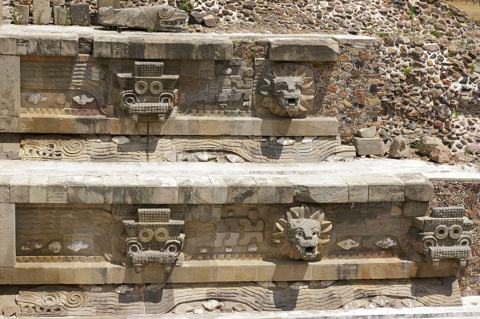
The Feathered Serpent — god of wind, learning, and creation, who stole humanity's bones from the land of the dead and gave people maize.
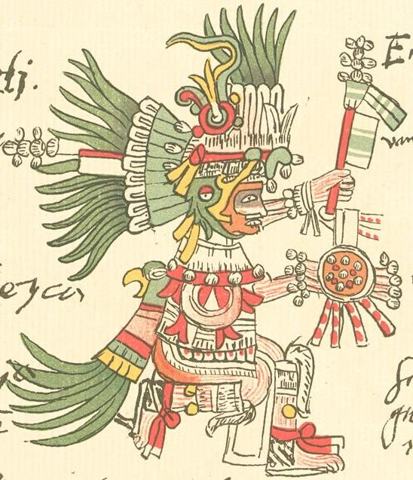
Hummingbird of the Left — the Mexica sun-and-war god, born fully armed on Serpent Mountain and enthroned atop the Great Temple of Tenochtitlan.
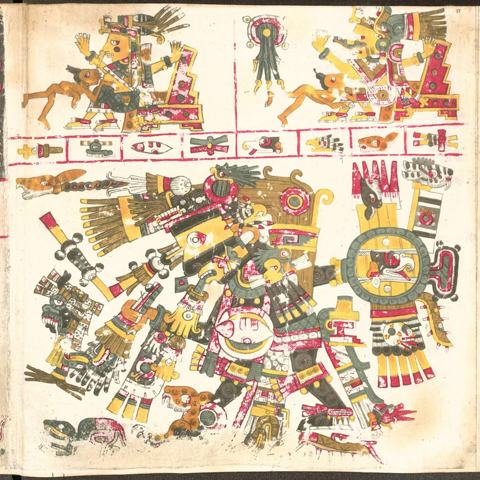
The Smoking Mirror — god of night, sorcery, kingship and fate, whose obsidian glass shows what men do in the dark and who owns them all as slaves.
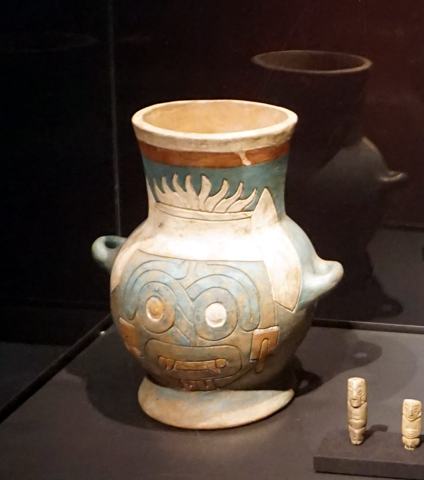
The goggle-eyed rain god who makes things sprout — giver of the storms that feed the maize, keeper of a green paradise, and taker of children.
The Aztec goddess of lust and vice who is also the goddess of confession — the one being who can absorb a person's wrongdoing and leave them clean.
The Aztec myth of four ruined world-ages before this one, each ended by its own catastrophe, in an order and cast of gods the sources don't agree on.
Sources & Further Reading
- 1.Bernardino de Sahagun, Florentine Codex — General History of the Things of New Spain (c. 1547–1579), Books 1, 2 and 9.
- 2.Diego Duran, Book of the Gods and Rites and The Ancient Calendar (c. 1574–1579).
- 3.Codex Borgia (pre-conquest ritual manuscript) and Codex Borbonicus (early 16th century).
- 4.Historia de los Mexicanos por sus pinturas (16th century).
- 5.Miller, Mary & Karl Taube. The Gods and Symbols of Ancient Mexico and the Maya. Thames & Hudson, 1993.
- 6.Nicholson, H.B. 'Religion in Pre-Hispanic Central Mexico', Handbook of Middle American Indians vol. 10. University of Texas Press, 1971.
- 7.Instituto Nacional de Antropologia e Historia, announcement of the Xipe Totec temple at Ndachjian-Tehuacan, Puebla (2018–2019), reported in Smithsonian Magazine.
Spot an error or have a source to suggest? Write to info@viseterna.com. We cite primary sources and modern scholarship, and we correct fast.