
Tlaltecuhtli (Aztec Earth Monster)
The crocodilian earth deity torn in two to make sky and ground — and the twelve-ton painted monolith of her unearthed at the Templo Mayor in 2006.
Monolith of Tlaltecuhtli, Mexica, 1502 (Museo del Templo Mayor, Mexico City) · CC BY-SA 4.0 · source
The Monster in the Water
Before the present earth existed, the colonial-era sources agree, there was only a vast sea, and swimming in it was an enormous creature — reptilian, crocodile-like, with gnashing mouths at every joint, hungry for anything it touched 1,2. The Historia de los Mexicanos por sus pinturas calls the creature Cipactli; other tellings simply describe "the earth" as this devouring animal without settling on one fixed name, and "Tlaltecuhtli" — tlalli, earth, plus tecuhtli, lord — is the label modern scholarship generally applies to her, more consistently than any single sixteenth-century source does 1,2,4. Quetzalcoatl and Tezcatlipoca, looking down from the sky that already existed, decided the world needed solid ground, and the monster was in their way.
Torn in Two to Make the World
The two gods transformed themselves into enormous serpents, descended, and seized the creature — one by the right hand and left foot, the other by the left hand and right foot — and pulled until she tore apart. The Histoyre du Mechique gives the fullest version of the division of spoils: the upper half of her body was hauled up to become the sky and the heavenly bodies, while the lower half stayed below to become the visible earth on which people would eventually walk 1,2. It is a creation founded on violence against a being who was, by any reading of the sources, doing nothing more than being hungry in the water where she lived.
Payment for the Violence
The other gods were troubled by what had been done, and the sources describe a kind of restitution: because the earth had been torn apart to make the world habitable, everything people would need to live was decreed to grow from her body. Her hair became trees, flowers, and grass; her skin, the smaller grasses and flowers; her eyes, the wells, springs, and small caves; her mouth, the great rivers and caverns; her nose, the mountain ridges and valleys 1. It did not fully console her. She was said to weep in the night, demanding hearts and blood, and unwilling to bear fruit until she was fed them — a myth the Mexica read as an explanation, not a justification, for a state religion built around offering her exactly that 1,4,7. The formal Nahuatl speeches Sahagun's informants recorded for occasions of birth and death return again and again to the image of human beings standing, briefly and precariously, on top of this same restless earth-lord, a figure of humility built directly into everyday rhetoric rather than confined to myth 3.
A Face Meant to Be Hidden
Mexica sculptors carved Tlaltecuhtli again and again, almost always in the same posture: squatting in a splayed, frog-like birthing position, clawed at the hands and feet, her joints marked with the same devouring mouths from the origin story, sometimes shown mid-birth, sometimes mid-swallow 4. Distinctively, these carvings were routinely placed face-down — on the undersides of statues, altars, and offering boxes, pressed against the earth she represented, visible to the gods below rather than to people above 4,5. That convention makes the ordinary museum encounter with Tlaltecuhtli slightly false to how she was originally meant to be seen: worshippers rarely looked directly at her face at all.
The Monolith of 2006
That convention is also what makes the largest known Tlaltecuhtli the exception. On 2 October 2006, archaeologists with Mexico's Urban Archaeology Program uncovered a monumental relief of the goddess in downtown Mexico City, close to the Templo Mayor — pink andesite, painted, close to four meters by three and a half, weighing near twelve tonnes, and found broken into four pieces 5. It is the largest Mexica monolith yet recovered, surpassing even the Sun Stone. A glyph on one clawed foot reads 10 Rabbit, the year-sign for 1502, the year the emperor Ahuizotl died, and archaeologists found the relief had originally lain face-up at the foot of the pyramid's sixth building stage, with a deposit of roughly twelve thousand offered objects buried beneath it 5. Leonardo Lopez Lujan directed the seventh field season of the Proyecto Templo Mayor from 2007 to study the find in context, and published the monolith's definitive study in 2010 5,6.
The Face on the Sun Stone
Tlaltecuhtli's dismemberment also shadows another famous monument. The central face carved into the Aztec Sun Stone is conventionally identified as the sun god Tonatiuh, but a substantial body of scholarship reads it instead as Tlaltecuhtli — earth and its four failed prior ages, framed together on the same stone 4. The identification is not settled, and probably cannot be from the object alone; what is not in doubt is that Mexica sculptors returned to the earth-monster's torn, hungry, life-giving body as one of the central images through which they explained why the world looked the way it did.
Continue Exploring
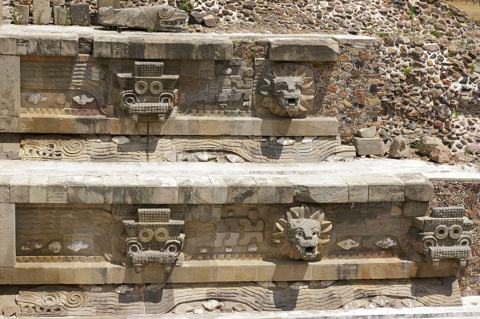
The Feathered Serpent — god of wind, learning, and creation, who stole humanity's bones from the land of the dead and gave people maize.
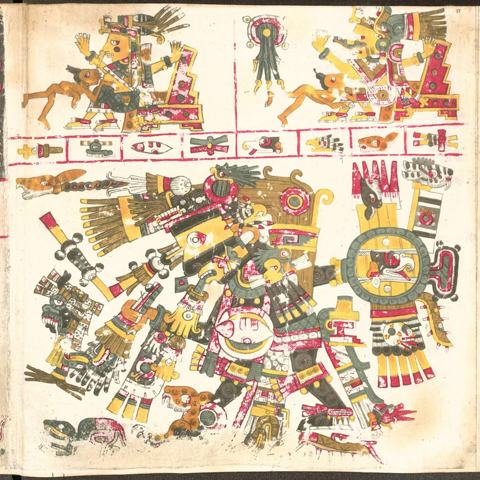
The Smoking Mirror — god of night, sorcery, kingship and fate, whose obsidian glass shows what men do in the dark and who owns them all as slaves.
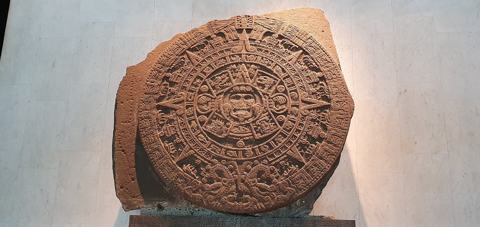
The Aztec myth of four ruined world-ages before this one, each ended by its own catastrophe, in an order and cast of gods the sources don't agree on.
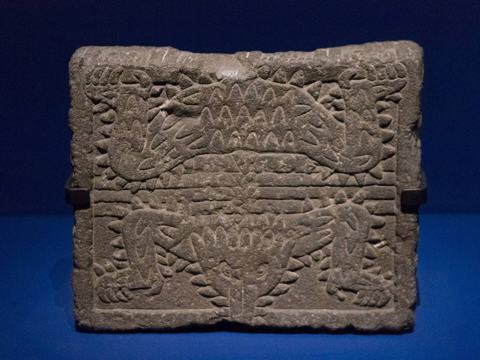
The primordial crocodilian monster torn apart to make earth and sky, and the creature whose name opens every 260-day count in the Aztec calendar.
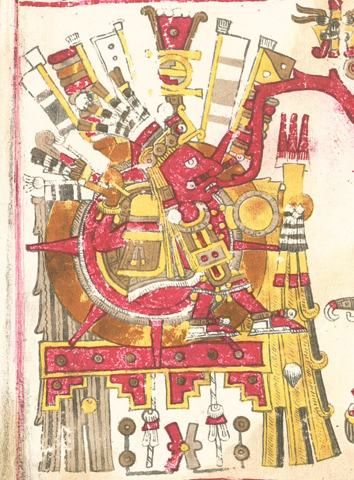
The Aztec sun of the present age, born from a beggar-god's leap into fire and kept moving only by the daily payment of human hearts and blood.
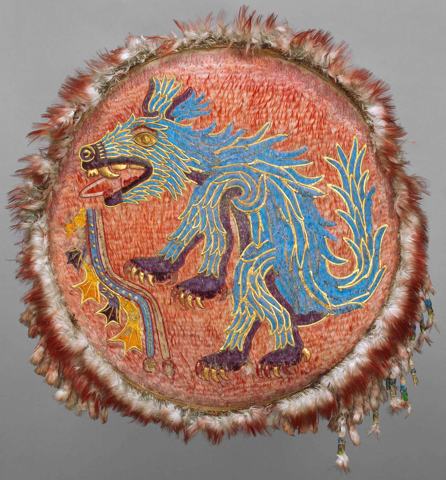
A small, dog-sized water beast with a hand at the end of its tail, said to drown swimmers and eat their eyes, nails, and teeth.
Also mentioned inThe Aztec Sun Stone
Sources & Further Reading
- 1.Historia de los Mexicanos por sus pinturas (16th century).
- 2.Histoyre du Mechique, Andre Thevet's French translation of a lost Spanish treatise attributed to Andres de Olmos (c. 1543/1553).
- 3.Bernardino de Sahagun, Florentine Codex — General History of the Things of New Spain (c. 1547–1579), Book 6.
- 4.Miller, Mary & Karl Taube. The Gods and Symbols of Ancient Mexico and the Maya. Thames & Hudson, 1993.
- 5.Lopez Lujan, Leonardo. Tlaltecuhtli. INAH / Fundacion Conmemoraciones / Sextil Editores, 2010.
- 6.Matos Moctezuma, Eduardo. The Great Temple of the Aztecs: Treasures of Tenochtitlan. Thames & Hudson, 1988.
- 7.Nicholson, H. B. 'Religion in Pre-Hispanic Central Mexico.' Handbook of Middle American Indians, vol. 10. University of Texas Press, 1971.
Spot an error or have a source to suggest? Write to info@viseterna.com. We cite primary sources and modern scholarship, and we correct fast.