
Mictlantecuhtli
Lord of the Place of the Dead — the skeletal ruler of the ninefold underworld, keeper of humanity's bones and destination of everyone who dies ordinarily.
Mictlantecuhtli, Aztec ceramic sculpture, Templo Mayor, Tenochtitlan (Museo del Templo Mayor, Mexico City) · CC BY-SA 4.0 · source
Lord of the Place of the Dead
Mictlantecuhtli is Nahuatl mictlan, the place of the dead, plus tecuhtli, lord — the ruler of Mictlan, the lowest and most distant of the underworld's nine levels 5,7. He rules with Mictecacihuatl, the Lady of the Place of the Dead, and the pair are usually shown together or as mirror figures 5.
He receives the overwhelming majority of the dead. Mexica cosmology sorted the afterlife by manner of death rather than by conduct: warriors and women who died in childbirth accompanied the sun, the water-taken went to Tlalocan under Tlaloc, and everyone else — the great majority, dead of age, illness, or accident — travelled to Mictlantecuhtli 1,7. He is therefore not a punisher of the wicked but the lord of the ordinary end.
How He Is Shown
In the ritual manuscripts he appears as a skeleton or a partly fleshed corpse: skull head with a wide grin and staring eyes, exposed ribs, a liver hanging from the open body cavity, and hair full of stellar or paper ornaments 3,5. He is often given clawed hands and feet, a paper banner, and the black-and-white bone ornaments and conical caps of the death complex 3,5.
The most striking Mexica images of him are two nearly life-size ceramic figures recovered from the House of the Eagles beside the Templo Mayor, standing in a matched pair, arms raised, with holes at the chest through which a liver was probably modelled or hung 6. Their scale and their position in a ritual building suggest death had a working presence in the ceremonial centre, not merely a symbolic one 6.
In the divinatory manuscripts he is one of the Nine Lords of the Night, patron of the day-sign Itzcuintli (dog) and of the trecena beginning One Flint in some almanacs; the Codex Borgia pairs him back to back with Quetzalcoatl in one celebrated image, life and death set against each other along a single spine 3,5.
The Bones of Humanity
His most consequential appearance is in the Leyenda de los Soles. After the destruction of the previous world, Quetzalcoatl descends to Mictlan to ask Mictlantecuhtli for the bones of the earlier humanity so that the earth can be peopled again 2.
Mictlantecuhtli agrees, then sets a trick condition: circle his realm four times sounding a conch trumpet, and the conch he hands over has no finger-holes. Quetzalcoatl has worms bore it and bees make it roar 2. Even after the trumpet sounds, the death lord changes his mind and orders a pit dug; a quail startles Quetzalcoatl, he falls, and the bones shatter 2. The fragments are gathered and ground by the goddess Cihuacoatl-Quilaztli, Quetzalcoatl bleeds over the meal, and humanity is formed from the mixture — uneven in size because the bones broke unevenly 2.
The story is worth reading closely. Mictlantecuhtli is neither defeated nor persuaded; he loses a negotiation he never intended to honour, and the imperfection of the human race is the residue of his obstruction 2,5.
The Nine Levels and the Four-Year Road
The dead did not arrive in his presence quickly. The appendix to Book 3 of the Florentine Codex describes a journey of four years through the levels of Mictlan, past clashing mountains, an obsidian-bladed wind, and finally a wide river, Chiconahuapan, which the dead crossed with the help of a dog 1. On arrival the traveller presented offerings to Mictlantecuhtli and Mictecacihuatl, and there the soul ceased — an ending, not a reward or a torment 1,7.
The Codex Vaticanus A, a colonial manuscript with Italian glosses, gives the fullest surviving diagram of the nine levels and is the source of most numbered lists that circulate today 4. It should be handled with care: it was produced under European supervision, its glossator was working from an indigenous pictorial original he did not fully understand, and its neatness may be more his than Mexica 4,5.
Not a Devil
Colonial writers reached for the vocabulary they had, and Mictlantecuhtli was frequently rendered as Lucifer and Mictlan as hell 1,5. The equation does not hold. There is no judgement in Mictlan, no sorting of the good from the wicked, no eternal punishment, and no salvation to be missed — only a hard road and a final stillness at the bottom of it 1,7.
Death in this system is a phase of the same cycle that produces life. The living owed the dead offerings during the twentieth-day feasts of Miccailhuitontli and Hueymiccailhuitl, and the modern observances of Day of the Dead grew out of the collision of those rites with the Catholic calendar of All Saints and All Souls — a genuine continuity, though not an unbroken one, and one whose details were reshaped substantially in the colonial and modern periods 5,7.
Continue Exploring
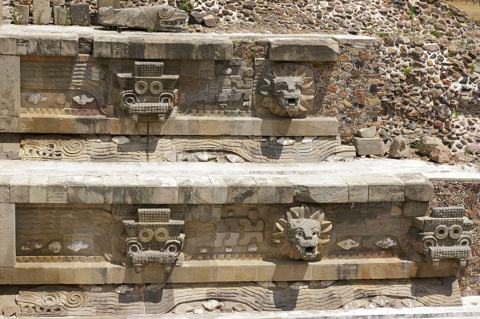
The Feathered Serpent — god of wind, learning, and creation, who stole humanity's bones from the land of the dead and gave people maize.
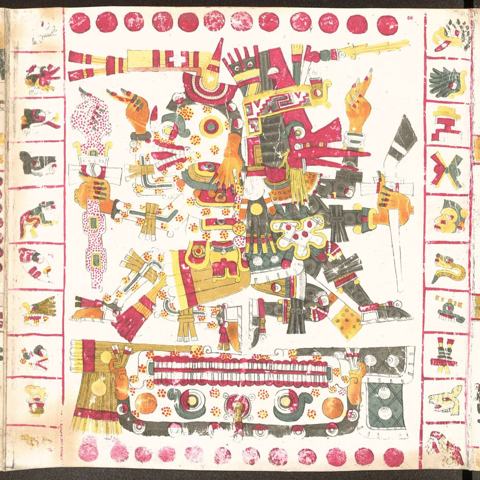
The Place of the Dead — a ninefold underworld reached by a four-year journey, where the ordinary dead arrive at last and simply cease.
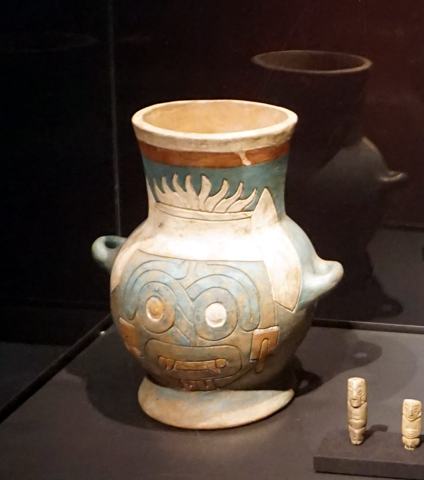
The goggle-eyed rain god who makes things sprout — giver of the storms that feed the maize, keeper of a green paradise, and taker of children.
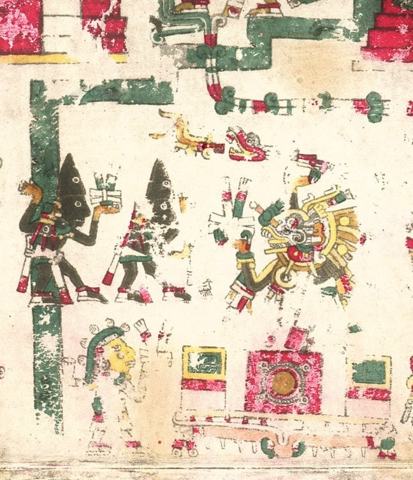
A pre-conquest screenfold of gods and days, painted for diviners to read fate — one of the few Mexican books that survived the conquest untouched.
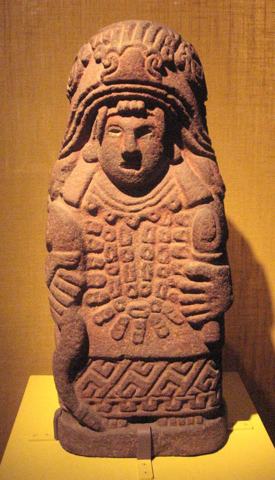
The Aztec goddess of childbirth and earth who helped shape humanity, lent her name to Tenochtitlan's second-in-command, and wept an omen before the conquest.
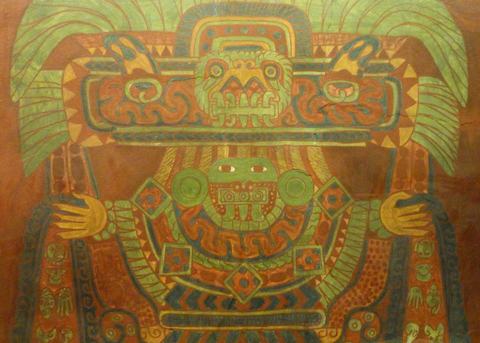
The rain god's paradise of unfailing summer, reserved for those the water took — and the name modern scholars gave a debated mural at Teotihuacan.
Also mentioned inXolotl
Sources & Further Reading
- 1.Bernardino de Sahagun, Florentine Codex — General History of the Things of New Spain (c. 1547–1579), Books 3 (appendix), 6 and 10.
- 2.Leyenda de los Soles and Anales de Cuauhtitlan (Codex Chimalpopoca, 1558/1570).
- 3.Codex Borgia and Codex Vaticanus B (pre-Columbian ritual manuscripts).
- 4.Codex Vaticanus A (Codex Rios, c. 1570).
- 5.Miller, Mary & Karl Taube. The Gods and Symbols of Ancient Mexico and the Maya. Thames & Hudson, 1993.
- 6.Matos Moctezuma, Eduardo. The Great Temple of the Aztecs: Treasures of Tenochtitlan. Thames & Hudson, 1988.
- 7.Read, Kay Almere & Jason J. Gonzalez. Handbook of Mesoamerican Mythology. ABC-CLIO, 2000.
Spot an error or have a source to suggest? Write to info@viseterna.com. We cite primary sources and modern scholarship, and we correct fast.