
Itzamna
The aged creator — supreme sky god of the Maya, patron of writing, healing and divination, and the old man scholars know as God D.
Lidded bowl with Itzamna riding a peccary, Maya, c. 200-450 CE (Dallas Museum of Art) · Public domain · source
The Old Man in the Codices
Itzamna — in Classic Maya inscriptions Itzamnaaj — is the aged supreme deity of the Maya: a sky god, a creator, and the patron of writing, learning, divination and healing 4,5. When nineteenth-century scholars began assigning letters to the recurring figures in the surviving Maya books, he became God D, and he is the most frequently depicted deity in the codices after the rain god Chaac 2,4.
He is drawn old: toothless or with a single tooth, sunken cheeks, a large square eye, an aquiline nose, and a headdress incorporating a mirror or flower element 2,4. Age in Maya art is authority. He does not fight, he does not storm, and he is not shown in the aggressive postures given to younger gods; he presides 4,5.
The Name Problem
The standard old translation of the name — "iguana house," from itzam, a Yucatec term for iguana, plus naaj, house — was proposed by J. Eric S. Thompson and repeated for decades 4,5. It has largely been abandoned. Later epigraphers found the reading unsupported by the Classic spellings, and no replacement has won consensus 4.
The most-cited alternative attaches the name to the root itz, which in Yucatec covers secretions of many kinds — dew, sap, resin, milk, tears — and by extension the substance of sorcery and blessing, giving a sense along the lines of "he who does itz," an enchanter or dispenser of divine essence 4,5. This is a reasoned proposal rather than a settled reading, and it should be quoted as such 4.
Sky, Caiman and Bird
Itzamnaaj sits at the top of a set of related forms rather than standing alone. The Maya conceived the earth as the back of a great caiman floating in water, and the Dresden Codex opens with pages showing an aged god within a caiman's maw; Taube argues that Itzam Cab Ain, the earth-caiman, is a manifestation of the same complex rather than an unrelated monster 4.
His avian form is the so-called Principal Bird Deity of Classic art, a supernatural bird with serpent-headed wings that perches at the summit of the world tree; epigraphers have read one of its names as Muut Itzamnaaj, "the bird Itzamnaaj" 4,5. The same bird appears in the Popol Vuh tradition as the boastful Seven Macaw, shot down by the Hero Twins — a relationship of iconographic descent rather than identity, and one still argued over 4,5.
He is also paired with a female counterpart. The aged goddess of the codices, Goddess O, often identified with Ix Chel, is frequently taken as his consort, though the pairing is clearer in Postclassic sources than in Classic ones 4,5.
What Landa Recorded
Diego de Landa, the Franciscan whose Relacion preserves invaluable Yucatec detail alongside his own destruction of Maya books, names Itzamna repeatedly 1. He reports the god was called Zamna, credited with inventing writing and the characters of the books, with naming the places of Yucatan, and with being honoured as the first priest 1.
Landa also places Itzamna at the centre of practical ritual: he was invoked in the ceremonies of the month Uo by the ah kinob, the day-keeper priests, who consulted their books and their divining stones under his patronage, and he appears in healing and new-year rites 1. The Books of Chilam Balam, written by Maya scribes in the colonial period, keep him in the prophetic and calendrical framework, folded into the cyclical k'atun histories 3.
Landa's habit of describing Maya religion through Catholic categories is a persistent problem. His account has been used to make Itzamna into a single supreme creator on a European model, and the codical and Classic evidence supports a high god of great scope without supporting that particular shape 4,5.
Classic and Postclassic Evidence
Two bodies of evidence must be kept apart. The Classic period (roughly 250–900 CE) supplies Itzamnaaj through carved inscriptions, painted pottery and monumental art, where he appears enthroned, receiving offerings, and lending his name to rulers — the Yaxchilan kings styled Itzamnaaj B'alam are the best-known case 4,6. The Postclassic and colonial evidence — the codices, Landa, Chilam Balam — comes from centuries later and mainly from northern Yucatan 2,4,6.
They agree on an aged, high-ranking, scribal and priestly deity, which is a strong result across that span. They do not license reading Landa's sixteenth-century Yucatec description straight back onto a seventh-century Peten city, and Sharer and Traxler are explicit that Maya religion varied by region and period rather than forming one uniform system 6.
Patron of the Scribes
If one thread runs through everything attributed to him, it is knowledge. He is credited with writing, with the calendar and its divination, with medicine, and with the ritual instruction of priests 1,4,5. Classic vase paintings show an aged god presiding over scribal scenes, and the association of God D with books, brushes and codices is consistent across media 4,5.
That makes him the counterpart, in function, of the central Mexican culture-bringer Quetzalcoatl — without being the same figure, and without the Feathered Serpent role that in the Maya world belongs to Kukulkan 5.
Continue Exploring
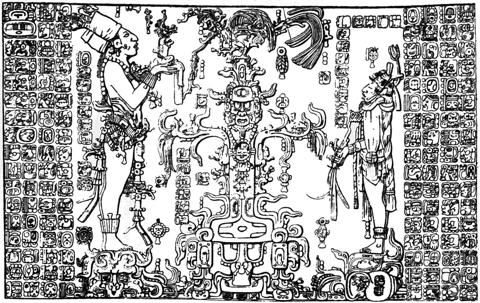
The great ceiba that joins underworld, earth and sky in Maya cosmology — carved at Palenque's Temple of the Cross and reborn each time maize is planted.
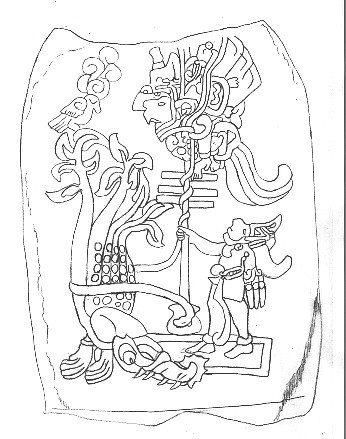
The vain bird who declared himself sun and moon in the Popol Vuh, brought down by the Hero Twins along with his sons Zipacna and Cabracan.
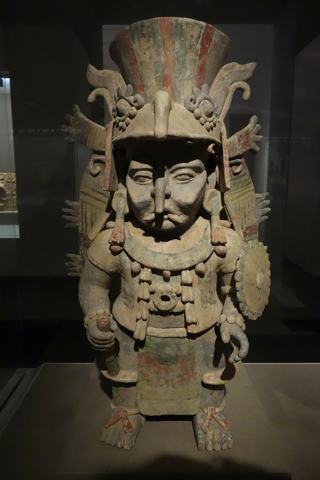
The rain god who splits the clouds with a lightning axe — one god and four, the most frequently depicted deity in the surviving Maya books.
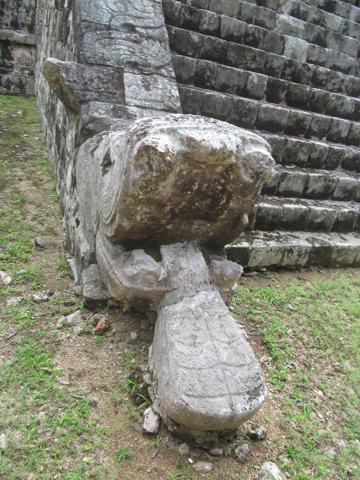
The Feathered Serpent of the Maya — creator's voice in the Popol Vuh, patron of Chichen Itza, and the shadow that descends its pyramid at the equinox.
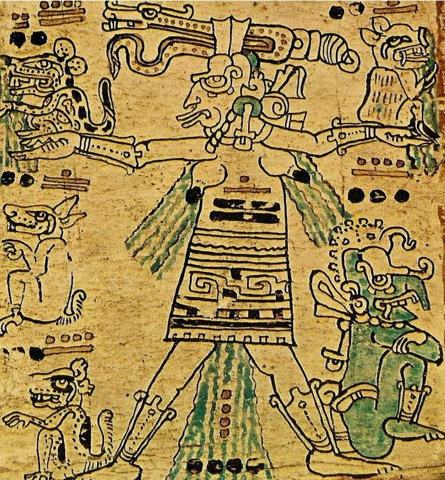
"Rainbow Lady" — the Maya goddess of childbirth, weaving, medicine and divination, and the two distinct goddesses tangled together behind her name.
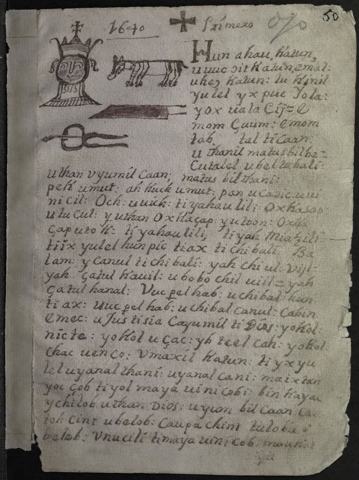
"The one god" of Yucatec Maya colonial texts — a name most scholars now read as a missionary translation for the Christian God, not an ancient Maya deity.
Also mentioned inKinich AhauThe Sarcophagus Lid of Pakal
Sources & Further Reading
- 1.Diego de Landa, Relacion de las cosas de Yucatan (c. 1566).
- 2.The Dresden Codex and the Madrid Codex (Postclassic Maya screenfolds).
- 3.The Books of Chilam Balam (colonial-era Yucatec Maya).
- 4.Taube, Karl. The Major Gods of Ancient Yucatan. Dumbarton Oaks, 1992.
- 5.Miller, Mary & Karl Taube. The Gods and Symbols of Ancient Mexico and the Maya. Thames & Hudson, 1993.
- 6.Sharer, Robert J. with Loa P. Traxler. The Ancient Maya, 6th edition. Stanford University Press, 2006.
Spot an error or have a source to suggest? Write to info@viseterna.com. We cite primary sources and modern scholarship, and we correct fast.