
Ometeotl (Aztec Dual God)
The "supreme dual god" of Leon-Portilla's Aztec philosophy, throned in Omeyocan — and the later critique that the god was substantially his own invention.
Tonacacihuatl and Tonacatecuhtli, the primordial couple, Codex Fejervary-Mayer (pre-Columbian ritual manuscript) · Public domain · source
Two-God
Ometeotl is built from two Nahuatl pieces: ome, "two," and teotl, a word usually glossed as "god" but closer in range to "sacred force" or "the numinous" 4,5. Put together, the compound reads as "Two God" or "God of Duality" — and in the form scholars usually mean when they use it, it names not one being but a bound pair, male and female, self-begetting and self-begotten, standing at the root of everything else divine 1. The idea has become one of the most quoted concepts in popular accounts of Aztec religion. It is also one of the most contested in the scholarship behind those accounts.
Leon-Portilla's Supreme Dual God
The concept in its influential modern form comes from Miguel Leon-Portilla, first in Spanish in 1956 and then in the English Aztec Thought and Culture of 1963. Leon-Portilla argued that behind the crowded, sacrifice-heavy pantheon described by the conquest-era friars stood a more abstract current of Nahua thought, cultivated by the tlamatinime — "those who know things," a class of sages and philosophers — who understood the many named gods as manifestations of a single dual principle 1. That principle he called Ometeotl: self-created, genderless and both-gendered at once, dwelling in Omeyocan, the "Place of Duality," the highest of the thirteen heavens stacked above the earth in Nahua cosmology 1,4. In its two aspects it appears as Ometecuhtli and Omecihuatl, Two-Lord and Two-Lady, also called Tonacatecuhtli and Tonacacihuatl, "Lord and Lady of Our Sustenance" — the couple credited with begetting the other major gods 1,5.
What the Texts Actually Say
The textual anchor for this reading is real but narrow. Book 6 of Sahagun's Florentine Codex preserves the formal speeches Nahua midwives addressed to a newborn child, and these do invoke a pair of rulers, "Ome tecutli, Ome ciuatl," presiding over Omeyocan and sending the child's destiny down to earth 3. Painted books such as the Codex Borgia depict a comparable primordial couple — sometimes named Tonacatecuhtli and Tonacacihuatl, sometimes the diviners Oxomoco and Cipactonal — enthroned at the summit of the cosmos 6. What none of these sources does, critics point out, is use the single compound word "Ometeotl" as the proper name of a worshipped deity. The sources name a pair; the single fused god is Leon-Portilla's synthesis of them, not a name he found already attached to a cult 2.
Richard Haly's "Bare Bones"
That gap is the center of Richard Haly's 1992 article "Bare Bones: Rethinking Mesoamerican Divinity," the fullest published challenge to the Ometeotl reading. Haly argued that no temple, priesthood, feast day, or offering is recorded anywhere for a deity called Ometeotl — a striking absence in a religion whose major gods are otherwise documented down to the color of their face paint — and that Leon-Portilla had effectively built a Nahua monotheism by reading later, Christian-influenced philosophical categories back into sixteenth-century sources that don't support that weight 2. Haly pushed further, arguing that some of the "duality" vocabulary Leon-Portilla leaned on may rest on a confusion between ome, "two," and a similar-sounding root connected to omitl, "bone," in names like Omiteotl or Omitecuhtli, which he associated instead with the bone-and-ash imagery of death and re-creation rather than an abstract dual principle 2. Haly's own alternative readings have not gone unchallenged either, and the exchange is better read as two competing reconstructions than as a settled correction.
An Unresolved Argument
The debate has not closed. H. B. Nicholson's standard survey of Aztec religion keeps an "Ometeotl Complex" among his organizing categories, treating paired, complementary creation — visible elsewhere in figures like Quetzalcoatl and Tezcatlipoca acting together to shape the world — as a real structural pattern in Nahua thought, whatever the fate of the single compound name 4. Other scholars side closer to Haly, treating "Ometeotl" as substantially a twentieth-century philosophical construction, useful for teaching Aztec cosmology as a coherent system but not a name the Mexica themselves would have recognized as a proper noun for one god 2,5. The idea has also taken on a life outside academic debate entirely, becoming a central figure in modern Mexica-revivalist and Chicano spiritual movements, for whom "Ometeotl" functions as a genuine reclaimed deity regardless of how the philological argument comes out.
Omeyocan, at the Top of the World
Whatever one concludes about the name, Omeyocan itself is well attested as a cosmological address: the topmost of the thirteen heavens, the place from which every human destiny descends at conception and to which the dead of certain categories were said to travel 1,3. It sits at the opposite pole of the vertical Nahua cosmos from Mictlan, the cold northern underworld at the bottom of the same stacked universe — duality, at least, built into the map itself, whether or not a single god named Two sat enthroned at its summit 4,5.
Continue Exploring
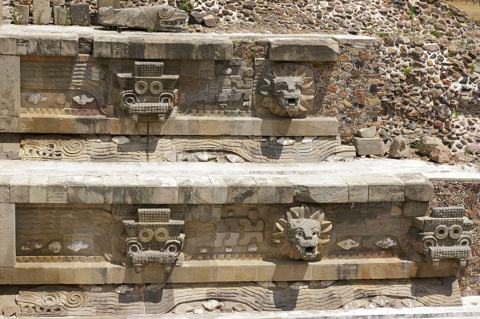
The Feathered Serpent — god of wind, learning, and creation, who stole humanity's bones from the land of the dead and gave people maize.
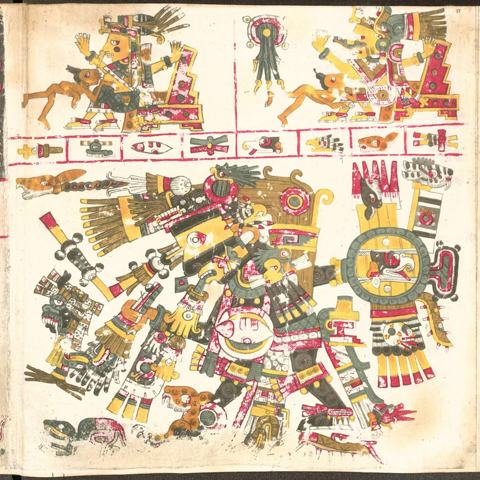
The Smoking Mirror — god of night, sorcery, kingship and fate, whose obsidian glass shows what men do in the dark and who owns them all as slaves.
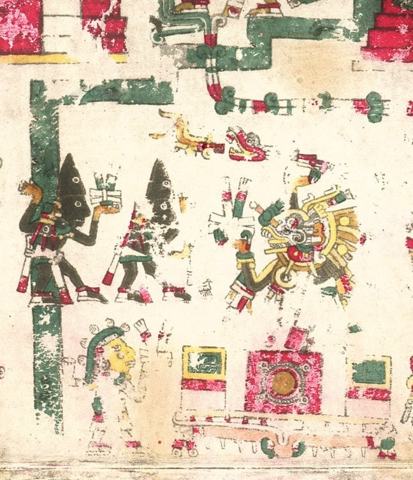
A pre-conquest screenfold of gods and days, painted for diviners to read fate — one of the few Mexican books that survived the conquest untouched.
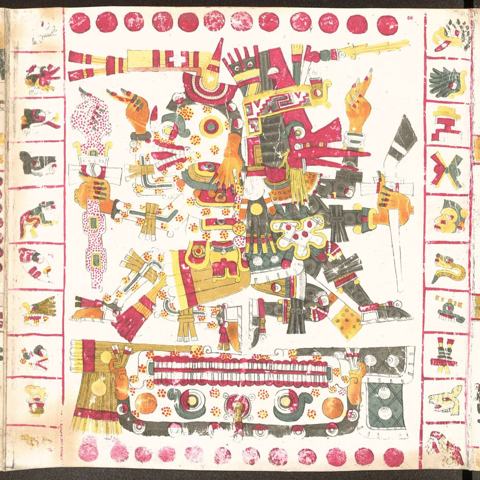
The Place of the Dead — a ninefold underworld reached by a four-year journey, where the ordinary dead arrive at last and simply cease.
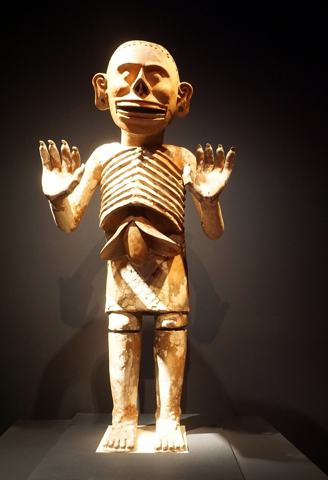
Lord of the Place of the Dead — the skeletal ruler of the ninefold underworld, keeper of humanity's bones and destination of everyone who dies ordinarily.
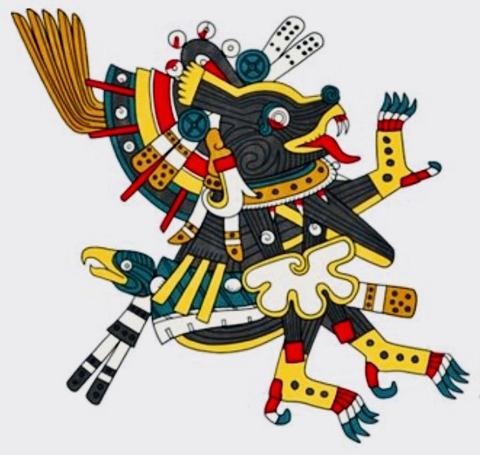
The dog-headed twin of Quetzalcoatl — evening star, guide of the dead through Mictlan, and the shapeshifter whose last disguise was the axolotl.
Sources & Further Reading
- 1.Leon-Portilla, Miguel. Aztec Thought and Culture — A Study of the Ancient Nahuatl Mind. Trans. Jack Emory Davis. University of Oklahoma Press, 1963.
- 2.Haly, Richard. "Bare Bones: Rethinking Mesoamerican Divinity." History of Religions 31, no. 3 (1992), 269-304.
- 3.Bernardino de Sahagun, Florentine Codex — General History of the Things of New Spain (c. 1547–1579), Book 6.
- 4.Nicholson, H. B. 'Religion in Pre-Hispanic Central Mexico.' Handbook of Middle American Indians, vol. 10. University of Texas Press, 1971.
- 5.Miller, Mary & Karl Taube. The Gods and Symbols of Ancient Mexico and the Maya. Thames & Hudson, 1993.
- 6.Codex Borgia (pre-Columbian ritual manuscript).
Spot an error or have a source to suggest? Write to info@viseterna.com. We cite primary sources and modern scholarship, and we correct fast.