
Huitzilopochtli
Hummingbird of the Left — the Mexica sun-and-war god, born fully armed on Serpent Mountain and enthroned atop the Great Temple of Tenochtitlan.
Huitzilopochtli, Codex Telleriano-Remensis, 16th century (Bibliotheque nationale de France) · Public domain · source
Hummingbird of the Left
Huitzilopochtli is Nahuatl huitzilin, hummingbird, joined to opochtli, left — and in a system of orientation where one faces the rising sun, the left hand is the south 5. Colonial writers render the name "left-handed hummingbird" or "hummingbird of the south"; both readings sit on the same word, and neither is a mistranslation so much as a different half of it 5,7.
The bird is not decorative. Mexica warriors who died in battle or on the stone were believed to accompany the sun from dawn to zenith and afterwards to return to the earth as hummingbirds and butterflies 1,5. The god's name therefore names his own soldiers.
He is the patron deity of the Mexica, the people who founded Tenochtitlan — not a god of the Nahua world in general. That distinction matters throughout: Tlaloc and Quetzalcoatl are ancient and widely shared across Mesoamerica, while Huitzilopochtli appears late, in one people's hands, and rises with their empire 5,7.
Born Armed on Serpent Mountain
The central myth is told in Book 3 of the Florentine Codex. On Coatepec, Serpent Mountain, the goddess Coatlicue is sweeping when a ball of feathers drifts down; she tucks it into her waistband and finds herself pregnant 1. Her daughter Coyolxauhqui takes the pregnancy as a disgrace and leads her four hundred brothers, the Centzon Huitznahua, up the mountain to kill their mother 1.
Huitzilopochtli is born at the instant of the attack, fully grown and armed. He takes up the Xiuhcoatl, the fire serpent, strikes Coyolxauhqui down, and her dismembered body falls to the foot of the mountain; the four hundred brothers are scattered and destroyed 1,5. Read against the sky, the episode is often understood as the daily victory of the sun over the moon and the stars, though the sources themselves do not spell the allegory out and the reading is a modern inference 5,7.
From Aztlan to the Eagle and the Cactus
The Mexica migration story makes Huitzilopochtli the author of their history. He speaks to his priests, the teomamaque or god-bearers, who carry his bundle out of Aztlan and lead the people through generations of wandering, told through place-signs in the Codex Boturini 3. He instructs them to take the name Mexica, and he promises a sign 2,3.
The sign is an eagle perched on a nopal cactus, and where they find it — on an island in the lake of Texcoco — they build Tenochtitlan 2,3. The famous detail of a serpent in the eagle's beak, now the emblem on the Mexican flag, is not present in every version: the frontispiece of the Codex Mendoza shows the eagle on the cactus without it, and the serpent enters through other colonial retellings 3. The migration account, like most of the corpus, was set down after the conquest and served imperial self-justification as much as memory 2,7.
The Great Temple
The Templo Mayor of Tenochtitlan carried two shrines on one platform: Tlaloc's on the north side and Huitzilopochtli's on the south, rain and war sharing a single mountain 6. Excavations begun in 1978, after electrical workers struck a carved monolith at the site, exposed the successive building stages and thousands of buried offerings drawn from across the empire 6.
The monolith that started the project was the Coyolxauhqui stone: a great disc of the dismembered goddess, set at the foot of the stairway on the Huitzilopochtli side 6. Its placement makes the pyramid itself into Coatepec. Victims sacrificed at the summit were sent down the steps to come to rest where the defeated sister lay, so that the myth was performed on the building it explained 6.
Panquetzaliztli and the Debt of Blood
Huitzilopochtli's principal feast was Panquetzaliztli, "the raising of banners," the fifteenth of the twenty-day months 1. Sahagun's informants describe an image of the god modelled from amaranth-seed dough, dressed and paraded, and finally broken up and eaten by the participants — a detail that Spanish friars noted with some discomfort for its resemblance to communion 1.
The state theology attached to him held that the sun required chalchihuatl, "precious water," to keep moving, and that war existed to supply it 1,2. Duran and other colonial writers report that the xochiyaoyotl or flower wars were fought with neighbouring states largely to take captives for this purpose 2. How much of that reasoning is genuine Mexica doctrine and how much is post-conquest rationalisation — by indigenous elites explaining a fallen order, or by Spaniards justifying its destruction — remains actively debated 5,7.
A God of One People
What makes Huitzilopochtli unusual among major Mesoamerican deities is how little of him is old. He has no clear presence in the archaeology of Teotihuacan or the Classic Maya world, no evident Toltec ancestry, and only a thin footprint outside the Mexica sphere 5,7. Some scholars suspect a deified ancestor or migration leader behind him, absorbed into an existing solar-warrior complex; the evidence permits the suggestion but does not settle it 5,7.
That youth is itself the point. Within roughly two centuries the Mexica took a tutelary god of a marginal lake people and installed him beside the oldest rain deity in the highlands, at the exact centre of the empire's map 6,7.
Continue Exploring
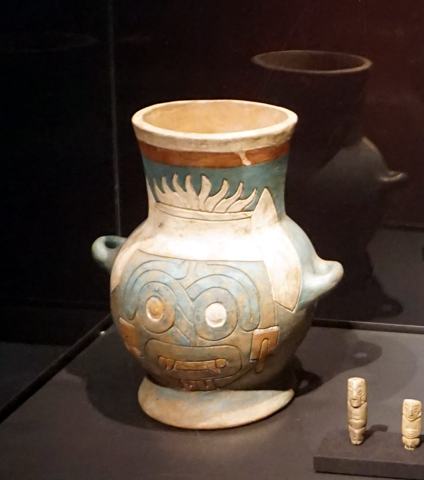
The goggle-eyed rain god who makes things sprout — giver of the storms that feed the maize, keeper of a green paradise, and taker of children.
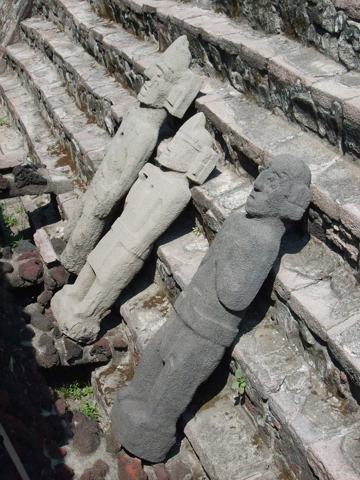
Tenochtitlan's twin pyramid to Huitzilopochtli and Tlaloc, demolished in 1521 and lost until 1978, when electrical workers struck the Coyolxauhqui stone.
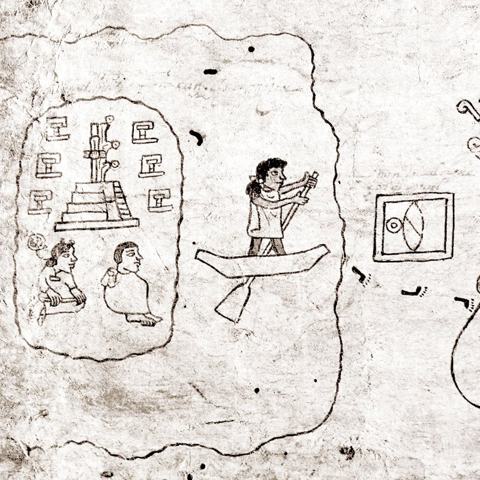
The island homeland the Mexica claimed to have left behind — a founding-migration legend whose real location no one has ever settled.
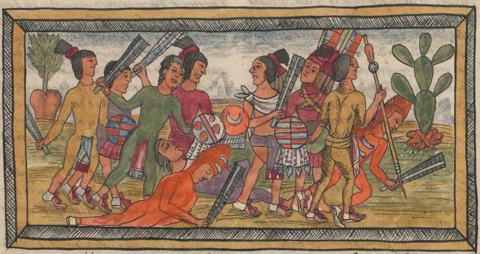
Ritualized battles between the Aztec Triple Alliance and its nearest unconquered neighbors, fought to take captives — and whose real purpose is still disputed.
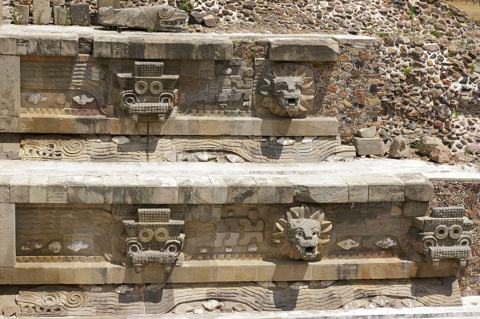
The Feathered Serpent — god of wind, learning, and creation, who stole humanity's bones from the land of the dead and gave people maize.
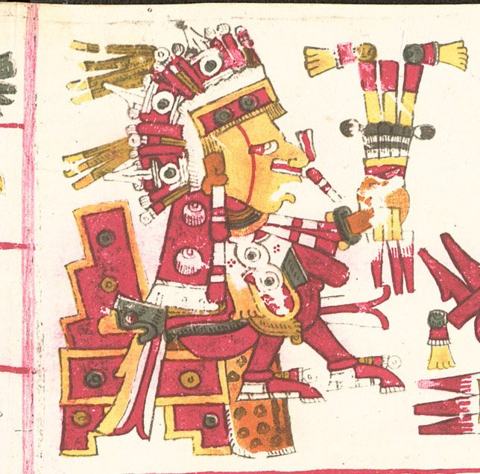
Our Lord the Flayed One — the Mesoamerican god of spring, seed and renewal, whose priests wore the skins of sacrificial victims for twenty days.
Also mentioned inCoatlicueCoyolxauhquiTezcatlipocaThe Florentine CodexXiuhtecuhtli (Aztec Fire Lord)
Sources & Further Reading
- 1.Bernardino de Sahagun, Florentine Codex — General History of the Things of New Spain (c. 1547–1579), Books 2, 3 and 12.
- 2.Diego Duran, Historia de las Indias de Nueva Espana e Islas de Tierra Firme (c. 1581) and Book of the Gods and Rites.
- 3.Codex Boturini (Tira de la Peregrinacion) and Codex Mendoza (c. 1541).
- 4.Historia de los Mexicanos por sus pinturas (16th century).
- 5.Miller, Mary & Karl Taube. The Gods and Symbols of Ancient Mexico and the Maya. Thames & Hudson, 1993.
- 6.Matos Moctezuma, Eduardo. The Great Temple of the Aztecs: Treasures of Tenochtitlan. Thames & Hudson, 1988.
- 7.Taube, Karl. Aztec and Maya Myths. British Museum Press / University of Texas Press, 1993.
Spot an error or have a source to suggest? Write to info@viseterna.com. We cite primary sources and modern scholarship, and we correct fast.