
The Codex Borgia
A pre-conquest screenfold of gods and days, painted for diviners to read fate — one of the few Mexican books that survived the conquest untouched.
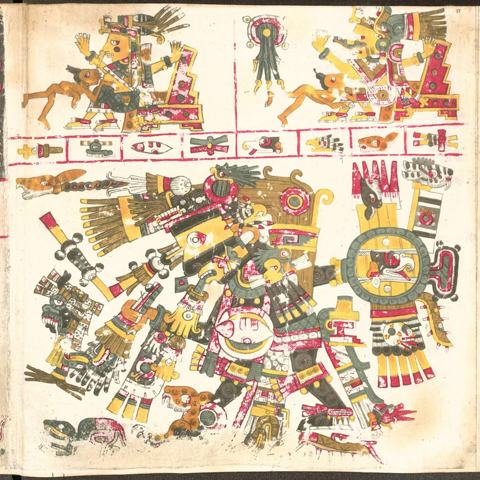
Codex Borgia, page 37 (Xolotl), Mixteca-Puebla style, Central Mexico, before 1521 (Vatican Apostolic Library, Borg.mess.1) · Public domain · source
A Book With No Name or Date
The Codex Borgia is a screenfold manuscript, 39 sheets of gessoed deerskin folded accordion-style into 76 painted pages, that unfolds to more than ten meters of continuous imagery 1,3. It carries no colophon, no date, and no signature: unlike a European book of the same age, it names neither its maker nor its patron, and everything scholars know about when and where it was painted comes from studying the style of the paintings themselves rather than from a written record 1,4. That style, and the deerskin support and painting technique it shares with a handful of related manuscripts, places it before the Spanish conquest of 1521, making it one of a small number of Mexican painted books that survived without any European content at all 1,3.
Days, Directions, and Gods
What survives is a divinatory almanac, built to organize the 260-day sacred count, the Tonalpohualli, and to lay out which gods governed which stretches of it 4. Whole sections are given to tables of day-signs paired with patron deities for each thirteen-day period, to marriage and agricultural auguries, and to a famous sequence of pages, usually numbered 29 through 46, that maps the four (or five) world directions with their associated trees, birds, and gods in a diagram Taube's survey of Mesoamerican myth treats as one of the most complete surviving statements of Central Mexican cosmology 4,6. Elizabeth Hill Boone's study of the whole surviving corpus of these books treats the Borgia as the most elaborate and best-preserved example of a genre made to be read aloud by a trained diviner sitting with a client, not browsed as literature 4.
Painters Without a Signature
The manuscript belongs to what is usually called the Mixteca-Puebla style, an artistic idiom shared across central and southern Mexico in the two centuries before the conquest, and it is grouped with four related screenfolds, the Codex Vaticanus B, Codex Cospi, Codex Fejervary-Mayer, and Codex Laud, collectively the Borgia Group, on the strength of shared iconography and layout 1,4. Exactly where within that shared style it was painted is not settled. The most common proposals put its origin in the Puebla-Tlaxcala valley, possibly near Cholula, a major pilgrimage and craft center; a Mixtec origin in Oaxaca has also been argued 1. The honest answer is that the codex is confidently placed within a regional painting tradition and not confidently pinned to one workshop or city 1,4.
Named for a Cardinal Who Nearly Lost It
The book takes its modern name from Cardinal Stefano Borgia, an eighteenth-century Italian churchman and collector who owned it before his death in 1804 1. Family tradition, repeated in the later literature though impossible to verify in full, holds that it had narrowly escaped being burned as an object of idolatry before it came into his hands 1. After Borgia's death the manuscript passed to the Congregation for the Propagation of the Faith (Propaganda Fide) in Rome, which held it for most of a century before it was transferred into the Vatican Library on 21 April 1902, cataloged today as Borg.mess.1 1. A facsimile, funded by the Duke of Loubat, appeared in 1898, and the German scholar Eduard Seler followed it with a page-by-page iconographic commentary published in three volumes between 1904 and 1909, a work still cited as the foundation of Borgia scholarship even where later specialists have revised individual readings 2,4.
Reading the Book Today
Modern facsimiles, including a full-color restoration published by Gisele Diaz and Alan Rodgers with an introduction by Bruce Byland, have made the codex's paintings widely available for study without a trip to the Vatican 3. What they show is a working diviner's manual: gods such as Quetzalcoatl, Tezcatlipoca, Tlaloc, and Xolotl, pictured here in one of his canine aspects presiding over a day-count table, appear again and again as patrons of particular days and directions, information a tonalpouhqui, a day-reader, would have used to tell a family whether a child born on a given day faced a hard life or an easy one 4,5. Because it predates the conquest entirely, the Borgia offers something the Florentine Codex cannot: religious content untouched by a Spanish friar's questions, though at the cost of having no accompanying text to say in words what the images meant, leaving even careful modern readings partly inferential 1,4.
What the Codex Doesn't Answer
Specialists disagree not only about where the Borgia was painted but about how directly it should be read as theology versus as a technical almanac, and about how far its imagery can be used to interpret the myths recorded later, in Nahuatl, at Tlatelolco 4. Treated cautiously, though, it remains the clearest surviving statement of how a pre-conquest ritual specialist actually used a book: not to tell a story from beginning to end, but to look up a day.
Continue Exploring
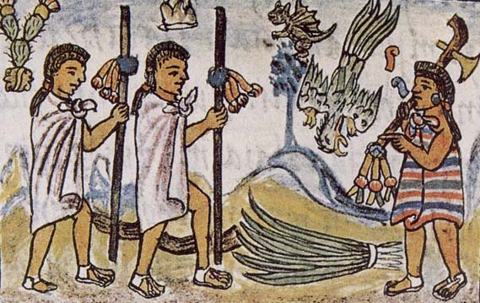
The 16th-century Nahuatl-Spanish encyclopedia of Aztec life and gods, compiled by a friar with Nahua scholars — the single richest source on Mexica myth.
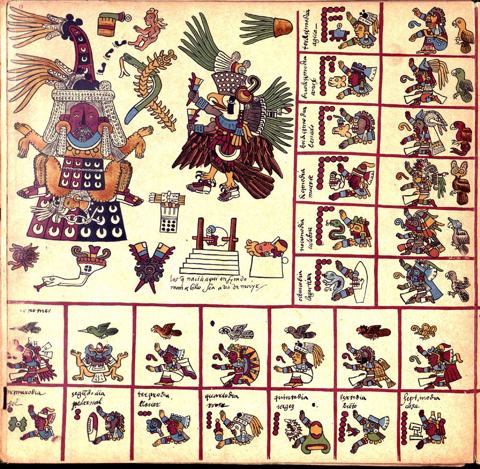
The 260-day sacred count that set every Aztec's birth-fate, built from 13 numbers and 20 day-signs, inherited from far older Mesoamerican tradition.
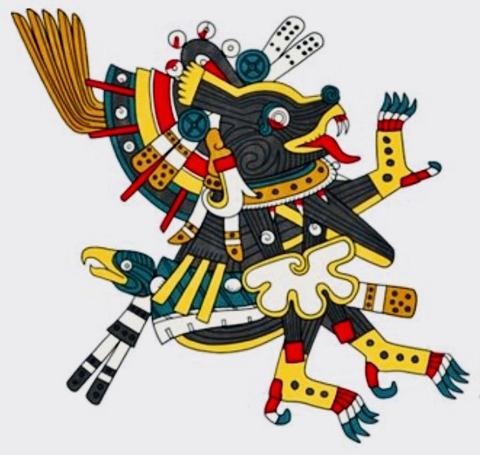
The dog-headed twin of Quetzalcoatl — evening star, guide of the dead through Mictlan, and the shapeshifter whose last disguise was the axolotl.
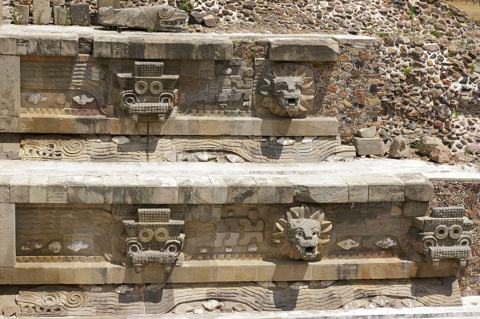
The Feathered Serpent — god of wind, learning, and creation, who stole humanity's bones from the land of the dead and gave people maize.
The Smoking Mirror — god of night, sorcery, kingship and fate, whose obsidian glass shows what men do in the dark and who owns them all as slaves.
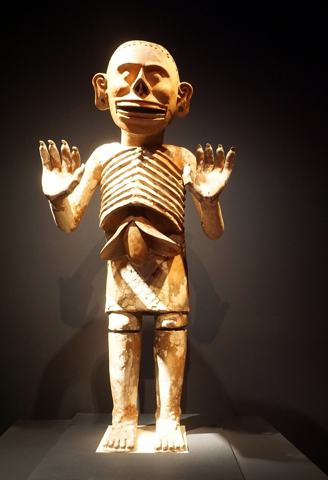
Lord of the Place of the Dead — the skeletal ruler of the ninefold underworld, keeper of humanity's bones and destination of everyone who dies ordinarily.
Also mentioned inOmeteotl (Aztec Dual God)
Sources & Further Reading
- 1.Codex Borgia (also called Codex Yoalli Ehecatl). Pre-Columbian pictorial manuscript, Mixteca-Puebla style, before 1521. Vatican Apostolic Library, Borg.mess.1.
- 2.Seler, Eduard. Codex Borgia: Eine altmexikanische Bilderschrift der Bibliothek der Congregatio de Propaganda Fide. 3 vols. Berlin, 1904-1909.
- 3.Diaz, Gisele & Alan Rodgers. The Codex Borgia — A Full-Color Restoration of an Ancient Mexican Manuscript. Introduction by Bruce E. Byland. Dover Publications, 1993.
- 4.Boone, Elizabeth Hill. Cycles of Time and Meaning in the Mexican Books of Fate. University of Texas Press, 2007.
- 5.Miller, Mary & Karl Taube. The Gods and Symbols of Ancient Mexico and the Maya. Thames & Hudson, 1993.
- 6.Taube, Karl. Aztec and Maya Myths. British Museum Press, 1993.
Spot an error or have a source to suggest? Write to info@viseterna.com. We cite primary sources and modern scholarship, and we correct fast.