
Tezcatlipoca
The Smoking Mirror — god of night, sorcery, kingship and fate, whose obsidian glass shows what men do in the dark and who owns them all as slaves.
Codex Borgia, page 17, central Mexico, pre-Conquest (Biblioteca Apostolica Vaticana) · Public domain · source
The Smoking Mirror
Tezcatlipoca means "smoking mirror" in Nahuatl — tezcatl, mirror, and poca, to smoke 5. Mesoamerican mirrors were discs of polished obsidian or pyrite, dark rather than silver, and what they returned was a clouded, shifting image 5,6. The god wears one at his temple and another in place of a missing foot, and through them he watches everything men do 1,5.
He is the deity of night and of the night sky, of sorcery and shape-shifting, of rulership and its removal, of conflict, and of the fortune that falls without explanation on the deserving and the undeserving alike 5,6,7. Among his many names are Titlacahuan, "we are his slaves," Yohualli Ehecatl, "night wind," and Moyocoyatzin, "the one who invents himself" 1,6.
The Foot and the Earth
Tezcatlipoca is almost always shown with one foot replaced by a mirror, a bone, or a serpent 3,5. The loss belongs to the creation of the world. In one account, he uses himself as bait to draw the earth-monster Tlaltecuhtli out of the primordial water, and she takes the foot; he and Quetzalcoatl then transform into serpents and tear her apart to make sky and earth from the halves 2,5.
He also governs the first of the cosmic ages, Nahui Ocelotl, Four Jaguar, whose people were devoured by jaguars when Quetzalcoatl struck him down into the sea — from which he rose as the jaguar constellation the Mexica saw in the night sky 2,5. The jaguar, a nocturnal spotted hunter, is his animal double throughout Mesoamerican art 5,6.
Four Tezcatlipocas
Some sixteenth-century accounts, notably the Historia de los Mexicanos por sus pinturas, arrange the creator gods as four Tezcatlipocas assigned to the four directions and their colours — the black Tezcatlipoca proper, a red one often identified with Xipe Totec, a white one identified with Quetzalcoatl, and a blue one identified with Huitzilopochtli 2,5.
This is a genuine indigenous scheme rather than a Spanish invention: the directional four-part cosmos structures pre-conquest manuscripts such as the Codex Fejervary-Mayer and the Codex Borgia 3,4,5. Even so, it should not be read as a tidy pantheon chart. The correspondences vary between sources, and Olivier's study argues that "Tezcatlipoca" functions less as a fixed individual than as an aspect that many deities can take on 6.
Lord of the Near and the Nigh
The formal Nahuatl prayers collected in Book 6 of the Florentine Codex are addressed to Tezcatlipoca more often than to any other god, and they show what he meant in practice 1. He is called Tloque Nahuaque, "lord of the near and the nigh," and Ipalnemoani, "he by whom we live" — titles that in these speeches carry something close to omnipresence 1,6.
Those prayers ask for the raising and the ruin of rulers, and they treat him as the source of both. He gives a lord his throne and takes it away on a whim; he sends slavery, poverty, disease and adultery as punishment; he is thanked for mercy and feared as a mocker 1,6. Olivier takes the title Titlacahuan — "we are his slaves" — as the hinge of the whole complex: the relationship is ownership, not affection 6.
He was the patron of the telpochcalli, the schools where ordinary young men were trained for war, as Quetzalcoatl was patron of the priestly calmecac 1,7. Kings were installed under his authority and addressed him at their accession 1,6.
The Feast of Toxcatl
The most extraordinary rite in the Mexica year belonged to him. For Toxcatl, in the fifth month, a captive youth was selected a full year in advance for his physical perfection and became the god's ixiptla, his living image 1. He was taught to play the flute and to carry himself as a lord, dressed in Tezcatlipoca's regalia, escorted through the city, honoured by everyone he met, and twenty days before the end given four young women as wives, bearing the names of goddesses 1.
At the feast he climbed a small temple alone, breaking his flutes on the steps as he went, and was sacrificed at the top 1. Sahagun's informants draw the moral out plainly: whoever has riches and pleasure in this life will end in poverty and torment 1. Toxcatl of 1520 is also the feast at which Spanish soldiers under Pedro de Alvarado attacked the dancers in the temple precinct, an act that helped push Tenochtitlan into open war 1.
The Antagonist of Quetzalcoatl
Tezcatlipoca's most famous role is as the ruin of another god. In the Tollan cycle he destroys Topiltzin Quetzalcoatl, the priest-king, by trickery — appearing as an old man with a mirror to show him his own aged face, then offering the drink that breaks his vows and drives him into exile 1,5,6.
The pairing is not simple good against evil, and reading it that way imports a framework the sources do not use. The two are collaborators in creation and antagonists in history, wind against night, the ordered priesthood against the unpredictable 5,6. Olivier notes how often Tezcatlipoca's aggression is also the engine of change: the god who takes away rule is the same god who confers it 6.
Continue Exploring
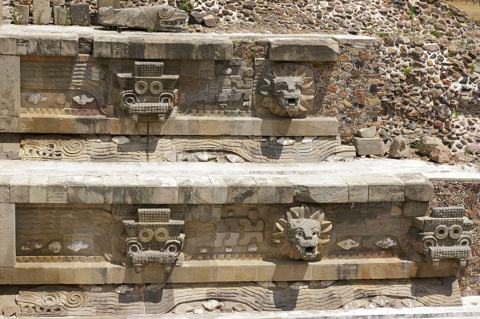
The Feathered Serpent — god of wind, learning, and creation, who stole humanity's bones from the land of the dead and gave people maize.
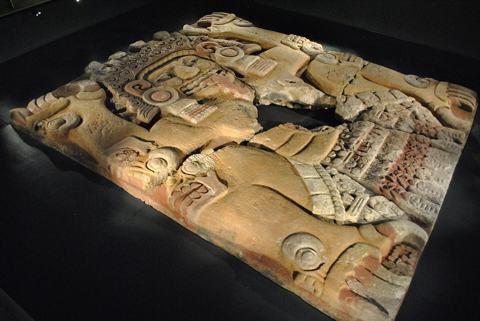
The crocodilian earth deity torn in two to make sky and ground — and the twelve-ton painted monolith of her unearthed at the Templo Mayor in 2006.
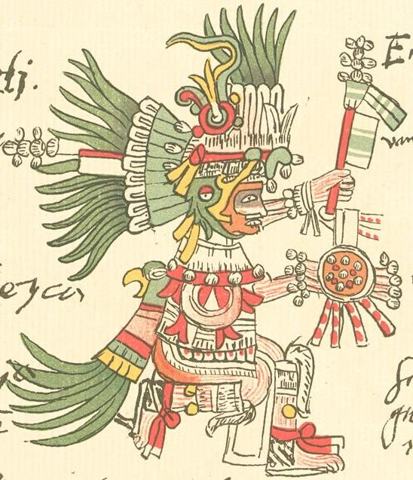
Hummingbird of the Left — the Mexica sun-and-war god, born fully armed on Serpent Mountain and enthroned atop the Great Temple of Tenochtitlan.
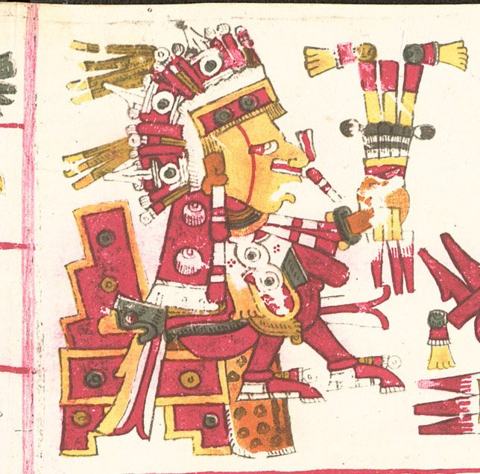
Our Lord the Flayed One — the Mesoamerican god of spring, seed and renewal, whose priests wore the skins of sacrificial victims for twenty days.
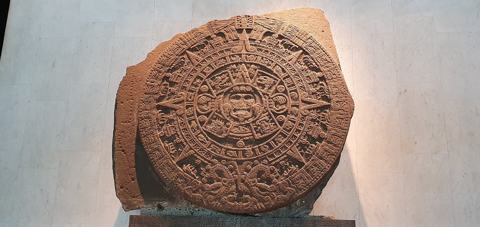
The Aztec myth of four ruined world-ages before this one, each ended by its own catastrophe, in an order and cast of gods the sources don't agree on.
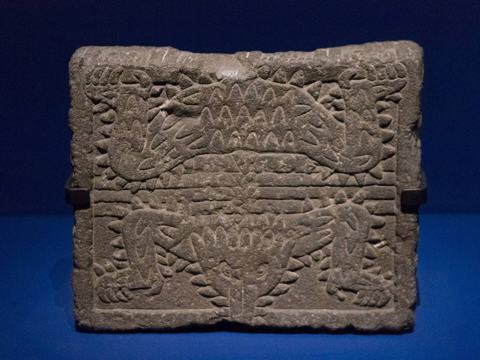
The primordial crocodilian monster torn apart to make earth and sky, and the creature whose name opens every 260-day count in the Aztec calendar.
Also mentioned inOmeteotl (Aztec Dual God)The Codex BorgiaTonalpohualli (the 260-Day Sacred Calendar)Xochiquetzal (Aztec Goddess of Flowers and Beauty)
Sources & Further Reading
- 1.Bernardino de Sahagun, Florentine Codex — General History of the Things of New Spain (c. 1547–1579), Books 2, 3 and 6.
- 2.Historia de los Mexicanos por sus pinturas (16th century).
- 3.Codex Borgia (pre-Columbian ritual manuscript).
- 4.Codex Fejervary-Mayer (pre-Columbian ritual manuscript).
- 5.Miller, Mary & Karl Taube. The Gods and Symbols of Ancient Mexico and the Maya. Thames & Hudson, 1993.
- 6.Olivier, Guilhem. Mockeries and Metamorphoses of an Aztec God: Tezcatlipoca, 'Lord of the Smoking Mirror'. University Press of Colorado, 2003.
- 7.Read, Kay Almere & Jason J. Gonzalez. Handbook of Mesoamerican Mythology. ABC-CLIO, 2000.
Spot an error or have a source to suggest? Write to info@viseterna.com. We cite primary sources and modern scholarship, and we correct fast.