
Tlaloc
The goggle-eyed rain god who makes things sprout — giver of the storms that feed the maize, keeper of a green paradise, and taker of children.
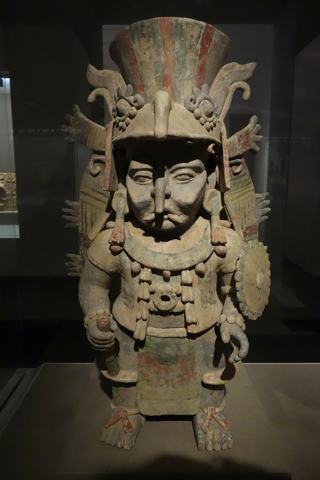
Tlaloc effigy vessel, Aztec, c. 1440-1469, Templo Mayor, Tenochtitlan (Museo del Templo Mayor, Mexico City) · CC BY-SA 4.0 · source
The Face You Cannot Mistake
Tlaloc is the rain god of the Mexica and of the wider Nahua world, and he is the easiest deity in Mesoamerica to identify on sight: enormous ringed eyes like goggles, a curling upper lip, and long fangs, the whole face assembled — in Karl Taube's reading of the iconography — from two serpents whose bodies loop into rings around the eyes and whose heads meet at the mouth 5.
The name is usually glossed from Nahuatl tlalli, earth, with a second element whose sense is disputed; sixteenth-century and modern readings run from "he who makes things sprout" to "he who is made of earth" and "the one lying on the earth" 5,7. No single etymology commands agreement, and it is safer to describe what he does than to lean on what he is called 5.
He governs rain, standing water, lightning, mountains, and the fertility they produce — and equally the hail, flood, drought, and lightning-strike that destroy it. He is not a benign figure with a violent exception; both faces are the same power 1,5,7.
A God Far Older Than the Aztecs
A storm deity with the same ringed eyes and fangs appears at Teotihuacan centuries before the Mexica existed, on mural paintings and on the vessels archaeologists label "Storm God" jars, and comparable rain-bringing figures run across Mesoamerica — the Maya Chaac, the Zapotec Cocijo, the Mixtec Dzahui 5. The visual continuity is not in doubt.
What that continuity means is a harder question. Scholars generally treat the Teotihuacan storm god as an ancestor of the Mexica Tlaloc rather than the same deity under a different name, since a shared mask across a thousand years does not guarantee shared myths, names, or functions 5,7. The convention of calling the Teotihuacan figure "Tlaloc" is a modern convenience and is increasingly avoided in scholarship 5.
The Tlaloque and the Mountains
Tlaloc is plural as much as singular. His helpers, the tlaloque, are small rain-bringers who live in the mountains and carry water in jars; when they smash a jar, thunder cracks and rain falls, and their lightning bolts are the axes and serpents they throw 1,5,7. Mountains in this cosmology are literally containers of water, hollow vessels holding the rain that will feed the valley — an idea Lopez Austin traces through both colonial sources and the beliefs of modern indigenous communities 7.
His consort is Chalchiuhtlicue, "jade her skirt," goddess of lakes, rivers and springs; some accounts make her his sister or his wife, and she governs the fourth cosmic age, which ends in a flood 1,4,5. A major shrine to Tlaloc stood on the summit of Mount Tlaloc east of the valley, one of the highest-altitude sanctuaries in the ancient Americas, visited by the rulers of the allied cities at the start of the rainy season 2,5.
Tlalocan, the Green Place
The dead who belonged to Tlaloc did not go to Mictlan. Those killed by drowning, lightning, or the water-related diseases — dropsy, gout, certain skin conditions — went instead to Tlalocan, described in Book 3 of the Florentine Codex as a place of unfailing summer where maize, squash, amaranth, chilli, tomato and beans grow without pause 1.
They were buried rather than cremated, with seed set in their faces and a digging stick in the hand 1. Lopez Austin's study argues that Tlalocan is best understood not as a reward but as a destination determined by manner of death: what mattered was which god had claimed you, not how you had behaved 7. A sixteenth-century mural at Teotihuacan long interpreted as a paradise scene has often been read into this tradition, though the identification is contested 5,7.
The Children of the Rain
The rites owed to Tlaloc are the hardest part of the record. Sahagun and Duran both describe the sacrifice of young children in the early-year festivals of Atlcahualo and Tozoztontli, carried in litters to mountain shrines and to a shrine in the lake, and both note that the children's tears were held to be a good omen for rain 1,2. Duran adds that they were bought from parents or drawn from particular households 2.
The archaeology corroborates the practice rather than the details: excavations at the Templo Mayor and at related offerings have recovered the remains of children accompanied by objects associated with the rain complex 6. Historians reading these accounts must weigh Spanish authors who had every incentive to emphasise the horror against indigenous informants describing a system that had already been destroyed 5,6.
Half of the Great Temple
The Templo Mayor of Tenochtitlan carried two shrines side by side on one platform. The northern one, painted blue and white, was Tlaloc's; the southern was Huitzilopochtli's 6. Rain and war, the two things the empire ran on, stood at exactly equal height at the centre of the city 6.
Matos Moctezuma's excavations, begun in 1978, found the Tlaloc side rich in offerings drawn from the sea and from distant tribute provinces: coral, shells, sawfish rostra, greenstone, and a well-preserved painted chacmool figure at an early stage of the north shrine 6. The distribution of the deposits — marine and watery goods to the north, weapons and fire to the south — reads as a deliberate statement about which god held which half of the world 6.
Continue Exploring
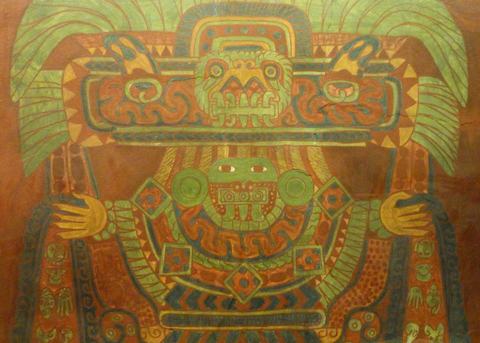
The rain god's paradise of unfailing summer, reserved for those the water took — and the name modern scholars gave a debated mural at Teotihuacan.
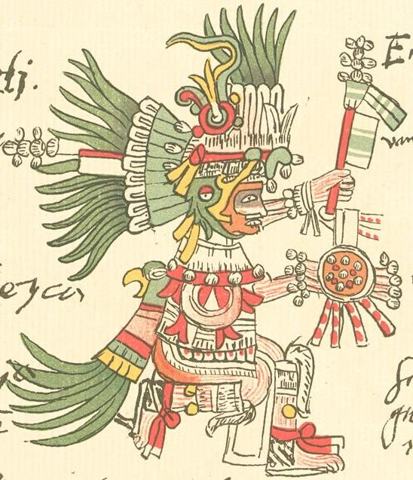
Hummingbird of the Left — the Mexica sun-and-war god, born fully armed on Serpent Mountain and enthroned atop the Great Temple of Tenochtitlan.
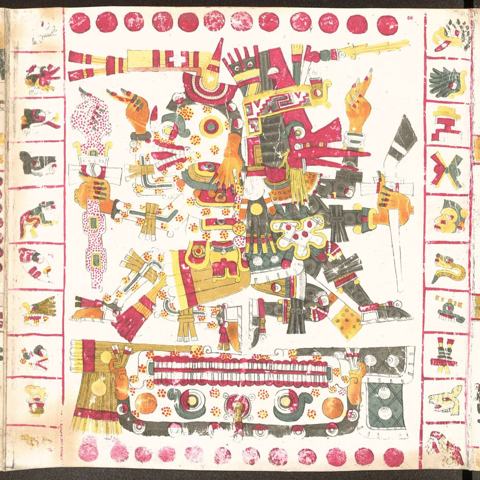
The Place of the Dead — a ninefold underworld reached by a four-year journey, where the ordinary dead arrive at last and simply cease.
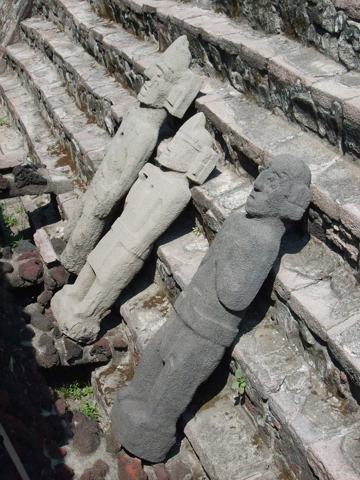
Tenochtitlan's twin pyramid to Huitzilopochtli and Tlaloc, demolished in 1521 and lost until 1978, when electrical workers struck the Coyolxauhqui stone.
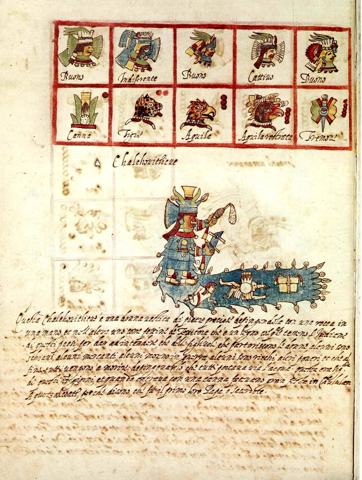
Tlaloc's consort and goddess of lakes and rivers, who ruled the Fourth Sun that ended in flood, and whom midwives invoked to bathe every newborn child.
The rain god who splits the clouds with a lightning axe — one god and four, the most frequently depicted deity in the surviving Maya books.
Also mentioned inAhuizotl (the Water Creature)MictlantecuhtliQuetzalcoatlThe Codex BorgiaThe Five Suns (Aztec Creation Myth)The Florentine CodexXipe TotecXochiquetzal (Aztec Goddess of Flowers and Beauty)
Sources & Further Reading
- 1.Bernardino de Sahagun, Florentine Codex — General History of the Things of New Spain (c. 1547–1579), Books 1, 2, 3 and 7.
- 2.Diego Duran, Book of the Gods and Rites and The Ancient Calendar (c. 1574–1579).
- 3.Codex Borgia (pre-Columbian ritual manuscript).
- 4.Historia de los Mexicanos por sus pinturas (16th century).
- 5.Miller, Mary & Karl Taube. The Gods and Symbols of Ancient Mexico and the Maya. Thames & Hudson, 1993.
- 6.Matos Moctezuma, Eduardo. The Great Temple of the Aztecs: Treasures of Tenochtitlan. Thames & Hudson, 1988.
- 7.Lopez Austin, Alfredo. Tamoanchan, Tlalocan: Places of Mist. University Press of Colorado, 1997.
Spot an error or have a source to suggest? Write to info@viseterna.com. We cite primary sources and modern scholarship, and we correct fast.