
Tonalpohualli (the 260-Day Sacred Calendar)
The 260-day sacred count that set every Aztec's birth-fate, built from 13 numbers and 20 day-signs, inherited from far older Mesoamerican tradition.
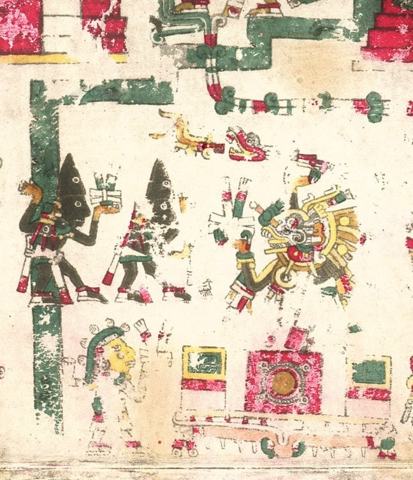
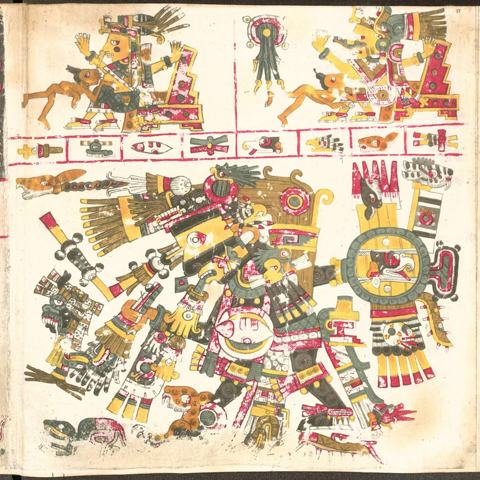
Codex Borbonicus, page 13, a trecena of the tonalpohualli, Mexica, early 16th century (facsimile edition, 1899) · Public domain · source
Two Counts, Turning Together
The tonalpohualli, literally "day-count" in Nahuatl, was the 260-day sacred cycle that governed Aztec divination, naming, and ritual timing 1,3. It was built from two smaller cycles running at once: a sequence of thirteen numbers, one through thirteen, and a sequence of twenty named day-signs, among them Cipactli (Crocodile), Ehecatl (Wind), Coatl (Serpent), Ocelotl (Jaguar), Ollin (Movement), and Xochitl (Flower) 3,4. Every day carried both a number and a sign, and because thirteen and twenty share no common factor, the combination did not repeat until all 260 pairings had been used, at which point the count began again 3,4. Modern writers often illustrate this as two interlocking gears or wheels; the Mexica themselves recorded it as tables and lists in painted books, not as a physical wheel 3.
Weeks of Thirteen Days
The 260 days were also grouped into twenty trecenas, blocks of thirteen days each, and every trecena had its own pair of patron deities and its own reputation, good, mixed, or dangerous, recorded in painted almanacs called tonalamatl, "books of days" 2,4. The Codex Borbonicus page shown here is one such trecena, laying out its ruling deities beside a column of the days that fell within it, each marked by its sign and a row of dots for its number 2,6. Related, though not identical, systems of day-count almanacs survive in the pre-conquest Codex Borgia, which Elizabeth Hill Boone's survey of the whole surviving corpus of these books treats as the most fully worked-out example of the genre 2.
Reading a Newborn's Fate
The count's central use was divinatory. Specialists called tonalpouhque, "day-readers," consulted the tonalamatl to tell parents what kind of life a child born on a given day-sign could expect, to choose auspicious dates for marriage, war, and planting, and to warn against days considered unlucky 1,2. Sahagun's informants, recorded in Books 4 and 5 of the Florentine Codex, list day-by-day and sign-by-sign judgments in detail, some signs read as favorable regardless of the number attached, others as fundamentally cursed no matter what a family did to counteract them 1. Alfonso Caso's foundational study of the pre-Hispanic calendars treats this fatalistic reading of the day-sign, more than the number, as the count's defining feature, distinguishing it from a simple timekeeping device 3.
Where 260 Came From
Why the cycle ran to exactly 260 days, rather than some other length, is genuinely unresolved. Proposed explanations include a rough match to the human gestation interval, a numerological pairing of the sacred numbers thirteen and twenty significant across Mesoamerica, and links to agricultural or astronomical intervals in some regions; Anthony Aveni's survey of Mesoamerican skywatching lays out the competing arguments without endorsing one as settled 4. What is clear is that the count is far older than the Aztec state that used it. Related 260-day cycles under different names are attested among the Zapotec, Mixtec, and Maya, and the system's origins trace back well over a thousand years before the Mexica arrived in the Basin of Mexico, making the tonalpohualli an inherited tradition rather than an Aztec invention 3,4.
Paired With the Solar Year
The tonalpohualli ran alongside, but independently of, a 365-day count of eighteen twenty-day months plus five unlucky days, used to schedule the year's agricultural and civic festivals 3,4. The two cycles realigned to the same starting pair only once every 52 years, the span Nahuatl speakers treated as a full "century" and marked with the New Fire Ceremony, at which a failure to rekindle the fire was feared as an ending of the world 1,3. Deities such as Quetzalcoatl and Tezcatlipoca carry calendar names drawn directly from this count, evidence of how thoroughly it saturated Mexica religious language beyond divination alone 3,5.
After the Conquest
Spanish missionaries treated the tonalamatl books as instruments of idolatry, and most were destroyed in the decades after 1521, which is why the Codex Borgia and Codex Borbonicus, among the few that survive largely or wholly intact, carry such outsized evidential weight in modern scholarship 2. The count itself did not vanish everywhere: variants of the same 260-day tradition are documented among some Indigenous communities in Oaxaca and highland Guatemala into the twentieth and twenty-first centuries, maintained by day-keepers whose practice descends from the same pan-Mesoamerican system the Mexica inherited rather than invented 3,4.
Continue Exploring
A pre-conquest screenfold of gods and days, painted for diviners to read fate — one of the few Mexican books that survived the conquest untouched.
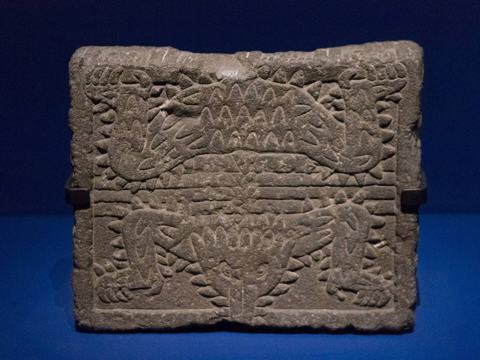
The primordial crocodilian monster torn apart to make earth and sky, and the creature whose name opens every 260-day count in the Aztec calendar.
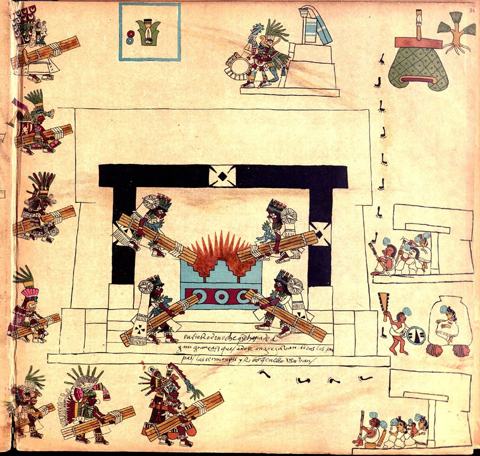
The Aztec rite that closed every 52-year cycle by dousing every fire in the realm and rekindling the world on a sacrificed captive's chest.
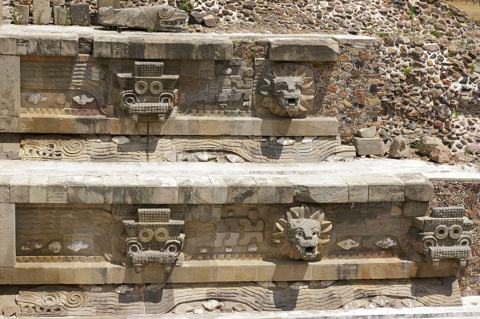
The Feathered Serpent — god of wind, learning, and creation, who stole humanity's bones from the land of the dead and gave people maize.
The Smoking Mirror — god of night, sorcery, kingship and fate, whose obsidian glass shows what men do in the dark and who owns them all as slaves.
The 16th-century Nahuatl-Spanish encyclopedia of Aztec life and gods, compiled by a friar with Nahua scholars — the single richest source on Mexica myth.
Also mentioned inCenteotl (Aztec Maize God)CihuateteoThe Aztec Sun StoneTlazolteotlXiuhtecuhtli (Aztec Fire Lord)Xochiquetzal (Aztec Goddess of Flowers and Beauty)
Sources & Further Reading
- 1.Bernardino de Sahagun, Florentine Codex — General History of the Things of New Spain (c. 1547-1579), Books 4 and 5.
- 2.Boone, Elizabeth Hill. Cycles of Time and Meaning in the Mexican Books of Fate. University of Texas Press, 2007.
- 3.Caso, Alfonso. Los calendarios prehispanicos. Universidad Nacional Autonoma de Mexico, 1967.
- 4.Aveni, Anthony F. Skywatchers of Ancient Mexico. University of Texas Press, 1980.
- 5.Miller, Mary & Karl Taube. The Gods and Symbols of Ancient Mexico and the Maya. Thames & Hudson, 1993.
- 6.Codex Borbonicus. Pictorial manuscript, Mexica, early 16th century. Bibliotheque de l'Assemblee Nationale, Paris.
Spot an error or have a source to suggest? Write to info@viseterna.com. We cite primary sources and modern scholarship, and we correct fast.