
Teotihuacan
A vast city already ancient when the Aztecs found it, mythologised by them as the place where the gods sacrificed themselves to make the Fifth Sun.
Pyramid of the Sun, Teotihuacan; photograph by Peachseltzer, 2023 · CC BY-SA 4.0 · source
A Ruin Before the Aztecs Arrived
Teotihuacan is a name the Aztecs gave to a city that was already ancient when they found it. Built by a civilization unrelated to the Mexica, whose own language and ethnic identity are still not settled by scholars, it grew into one of the largest cities in the world of its time, at its height home to a population most often estimated at well over 100,000, with some reconstructions running past 200,000, laid out on a rigid grid along a central avenue and dominated by the Pyramid of the Sun and Pyramid of the Moon 2,3. Its major building and growth ran roughly from the first to the sixth century CE, and its central monuments were burned in an episode of internal upheaval around 550-650 CE, some six hundred years before the Mexica people entered the Basin of Mexico at all 3.
Naming a City That Named Itself Something Else
By the time Aztec-period Nahuatl speakers encountered the ruins, no living tradition remembered what its builders had called it. "Teotihuacan," a Nahuatl name usually parsed as something close to "place where one becomes a god" or "city of the gods," is their name for it, not its own 5,6. Sahagun's informants, describing it in Book 10 of the Florentine Codex, treated it as the burial place of rulers and, more strikingly, as the very spot where the gods gathered in the dark to remake the sun 1. That belief is the fullest surviving account of the myth told in this Codex's Five Suns entry: after the fourth world's ruin, the gods convened at Teotihuacan, and two of them, Tecuciztecatl and the humble, sore-covered Nanahuatzin, threw themselves into a sacrificial fire to rise as sun and moon 1,5.
A Pilgrimage Site Inside an Empire
The Mexica did not just tell stories about Teotihuacan; they went there. Sixteenth-century accounts and the archaeological record together indicate that Aztec-period visitors, including rulers, made pilgrimages to the ruined pyramids, leaving offerings at structures that had stood empty and eroding for centuries by the time of the empire's height 1,5. Folding a pre-existing, monumental, unmistakably sacred ruin into their own cosmology let the Mexica claim continuity with a deep, prestigious past that was not actually their own inheritance, a pattern art historians have traced in Aztec use of other older sites and objects as well 5,6.
What the Excavations Found
Modern archaeology has recovered a city considerably stranger and more violent than the peaceful ceremonial center older scholarship sometimes imagined. Rene Millon's Teotihuacan Mapping Project, conducted between 1962 and 1970 using aerial photography and systematic ground survey, plotted more than 2,000 residential compounds across roughly 20 square kilometers, establishing the city's full extent and grid for the first time 2. Decades later, excavations at the Feathered Serpent Pyramid within the Ciudadela compound, a temple whose facade of stacked serpent heads later Nahuatl speakers would read as an image of Quetzalcoatl, led by George Cowgill and Saburo Sugiyama, uncovered the remains of close to 200 people, many in military dress, sacrificed in a single dedicatory episode when the pyramid was built 3,4. That find reshaped scholarly understanding of the city's politics, showing a state willing to stage mass sacrifice at its most sacred building, deliberately, as part of construction ritual rather than as a marginal practice 4.
Collapse Without a Single Explanation
Why Teotihuacan's core burned and its central authority collapsed around the mid-sixth century is still argued over. Proposals include internal revolt against an increasingly unequal elite, drought and agricultural stress, and pressure from outside groups, and Cowgill's synthesis treats the evidence as compatible with several of these acting together rather than pointing to one decisive cause 3. What is not disputed is that the city never recovered its former scale, and that by the time Nahuatl-speaking migrants reached the Basin of Mexico in the thirteenth century, they found only its skeleton 3.
The Site Today
Teotihuacan was heavily restored in the early twentieth century, most consequentially by Leopoldo Batres ahead of Mexico's 1910 centennial celebrations, work that gave the Pyramid of the Sun much of its present outer form and that later archaeologists have criticized for altering the original structure in the process of exposing it 3. It is now a UNESCO World Heritage Site and one of Mexico's most visited archaeological zones, and excavation continues: tunnels beneath the Ciudadela, first entered in the twenty-first century, have turned up further offerings and are still being studied 3,4. Unlike the empire's own ceremonial center at the Templo Mayor, built and destroyed within Mexica memory, Teotihuacan was already a ruin the Mexica had to interpret rather than a monument they controlled. The city that the Aztecs mythologized as the birthplace of their own sun remains, in the strict archaeological sense, someone else's capital.
Continue Exploring
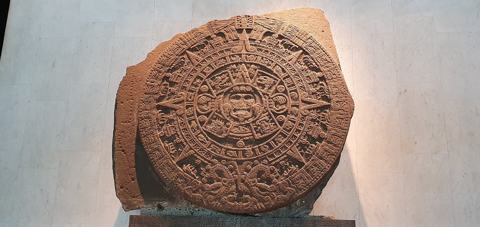
The Aztec myth of four ruined world-ages before this one, each ended by its own catastrophe, in an order and cast of gods the sources don't agree on.
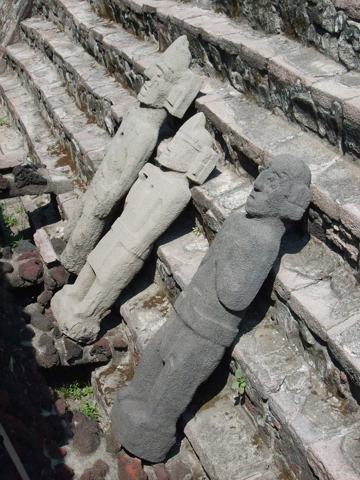
Tenochtitlan's twin pyramid to Huitzilopochtli and Tlaloc, demolished in 1521 and lost until 1978, when electrical workers struck the Coyolxauhqui stone.
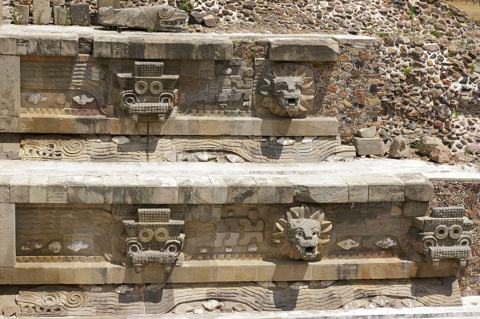
The Feathered Serpent — god of wind, learning, and creation, who stole humanity's bones from the land of the dead and gave people maize.
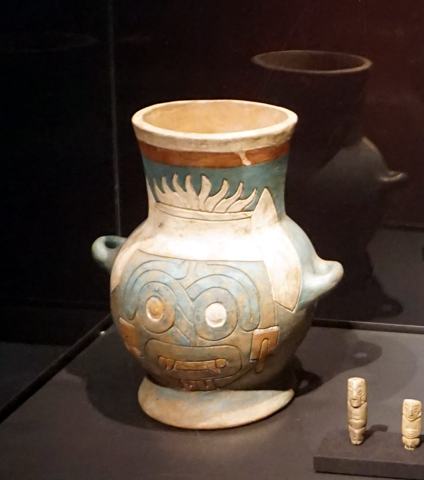
The goggle-eyed rain god who makes things sprout — giver of the storms that feed the maize, keeper of a green paradise, and taker of children.
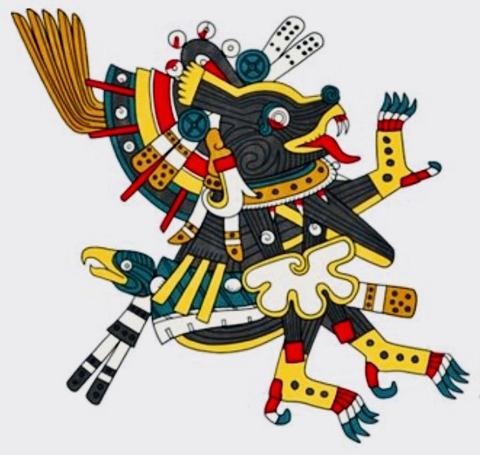
The dog-headed twin of Quetzalcoatl — evening star, guide of the dead through Mictlan, and the shapeshifter whose last disguise was the axolotl.
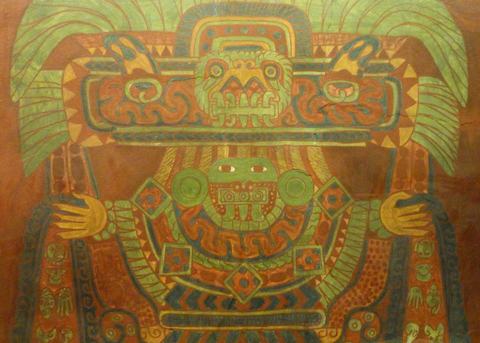
The rain god's paradise of unfailing summer, reserved for those the water took — and the name modern scholars gave a debated mural at Teotihuacan.
Sources & Further Reading
- 1.Bernardino de Sahagun, Florentine Codex — General History of the Things of New Spain (c. 1547-1579), Book 10.
- 2.Millon, Rene. Urbanization at Teotihuacan, Mexico, Volume 1: The Teotihuacan Map. University of Texas Press, 1973.
- 3.Cowgill, George L. Ancient Teotihuacan: Early Urbanism in Central Mexico. Cambridge University Press, 2015.
- 4.Sugiyama, Saburo. Human Sacrifice, Militarism, and Rulership: Materialization of State Ideology at the Feathered Serpent Pyramid, Teotihuacan. Cambridge University Press, 2005.
- 5.Nicholson, H. B. 'Religion in Pre-Hispanic Central Mexico.' Handbook of Middle American Indians, vol. 10. University of Texas Press, 1971.
- 6.Miller, Mary & Karl Taube. The Gods and Symbols of Ancient Mexico and the Maya. Thames & Hudson, 1993.
Spot an error or have a source to suggest? Write to info@viseterna.com. We cite primary sources and modern scholarship, and we correct fast.