
The Five Suns (Aztec Creation Myth)
The Aztec myth of four ruined world-ages before this one, each ended by its own catastrophe, in an order and cast of gods the sources don't agree on.
Aztec sun stone, Mexica, late 15th-early 16th century, photograph by Jose Luiz, 2024 (Museo Nacional de Antropologia, Mexico City) · CC BY-SA 4.0 · source
Four Worlds, Then This One
Central Mexican cosmology, as Spanish friars and their Nahua informants recorded it in the sixteenth century, agreed on one basic point: the world now standing is not the first. Four earlier creations had come and gone before it, each with its own sun, its own population, and its own catastrophic end 1,2. The fullest surviving version of the sequence is a Nahuatl manuscript history called the Leyenda de los Soles, the Legend of the Suns, bound together with the Anales de Cuauhtitlan in what is now known as the Codex Chimalpopoca and translated in full by John Bierhorst 2. Related but not identical tellings survive in the Spanish-language Historia de los Mexicanos por sus pinturas, in the French Histoyre du Mechique — a translation of a lost Spanish treatise attributed to the Franciscan Andres de Olmos — and in Book 7 of Bernardino de Sahagun's Florentine Codex 1,3,4. None of these was written to agree with the others, and they don't.
An Order the Sources Can't Agree On
The Leyenda de los Soles and the Historia de los Mexicanos both destroy their first four worlds in the same sequence of forces — earth, wind, fire, water — and both assign each ruined age a span of years adding up to 2,028. But the two texts distribute those years differently between the ages, and they don't agree on how long each one lasted even though the total matches 3. Sahagun's Book 7 tells substantially the same set of catastrophes in a different arrangement again, and the Histoyre du Mechique frames the whole sequence around a separate story — the dismemberment of the earth by Tezcatlipoca and Quetzalcoatl — that the Nahuatl sources don't foreground the same way 1,4. H. B. Nicholson's survey of the sources treats a "basic cosmological sequential pattern" as recoverable across them, but he is cataloguing a family of related accounts, not reconstructing a single lost original 7. Anyone who states the order of the suns as settled fact is smoothing over a real and unresolved disagreement in the sixteenth-century record.
Four Ruined Suns
With that caveat, the Leyenda de los Soles is the version most often quoted, and it runs as follows. The first age, 4-Jaguar, was ruled by Tezcatlipoca and ended when jaguars devoured its people. The second, 4-Wind, belonged to Quetzalcoatl and ended in a hurricane that turned its people into monkeys. The third, 4-Rain, belonged to Tlaloc and ended in a rain of fire. The fourth, 4-Water, belonged to Tlaloc's consort Chalchiuhtlicue and ended when the sky itself came down and the world drowned, its people turned to fish 2,5. Other sources swap which god presides over which disaster, and some later retellings add that Chalchiuhtlicue's flood was an act of anger at Tlaloc — a dramatic motive the earliest Nahuatl text does not actually supply 2,3.
Building the Fifth Sun at Teotihuacan
The present age, the fifth, begins with a council of gods at Teotihuacan in darkness, needing a new sun. Two candidates offer themselves to the sacrificial fire: the proud, wealthy Tecuciztecatl, who hesitates four times before jumping, and the poor, sore-covered Nanahuatzin, who jumps without flinching. Both burn and both rise into the sky, and the gods must dim the second light — the moon — by throwing a rabbit into its face, which is why a rabbit is still said to be visible on the moon's surface 1,2,6. The new sun then refuses to move until the assembled gods sacrifice themselves to feed it; one god present at the slaughter, Xolotl, Quetzalcoatl's canine double, tries to run rather than die, fleeing into a maguey plant and a corn stalk before being caught and killed in the form of a salamander, the axolotl 2. Only after that mass sacrifice does the wind of Quetzalcoatl, in his aspect as Ehecatl, blow the reluctant sun into its first motion across the sky 1,2. This fifth age carries the calendar name 4-Movement, Nahui Ollin — a name that is also a warning, since movement is exactly what is expected to end it, in earthquakes 2,5.
The Stone in the Plaza
The best-known monument to this scheme is the so-called Aztec Sun Stone, or Calendar Stone, a basalt disc nearly twelve feet across, carved with day-signs and cosmological bands around a central face, unearthed under Mexico City's main plaza in December 1790 during repairs to the cathedral 5. The eighteenth-century scholar Antonio de Leon y Gama argued successfully against reburying it and published the first study identifying it as calendrical 5. What the central face actually represents is not settled: it is usually read as the sun god Tonatiuh, but a substantial body of scholarship reads it instead as Tlaltecuhtli, the earth, framed by the glyphs of the four prior suns that failed before this one 5,6. Either reading fits the stone's evident purpose, which was public and ceremonial rather than a working almanac — a monumental statement of the world's fragile place in a sequence of four failures.
What the Disagreement Means
That the sources disagree — on order, on duration, on which god ruled which catastrophe, even on how many suns preceded this one — is not a flaw to be corrected by picking a favourite version. It reflects a genuinely plural sixteenth-century record: different Nahua communities, different informants, different friars asking the questions, at least two clearly distinct written traditions in two languages 3,4,7. The honest way to tell the myth is the way the manuscripts actually tell it — as a family of related but competing accounts of how the world now standing came to be the fifth attempt, not the first.
Continue Exploring
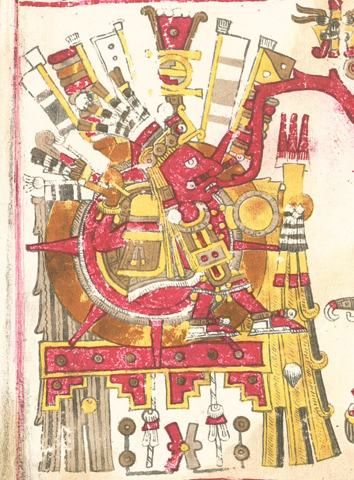
The Aztec sun of the present age, born from a beggar-god's leap into fire and kept moving only by the daily payment of human hearts and blood.
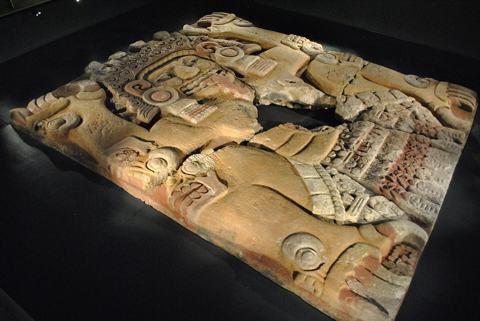
The crocodilian earth deity torn in two to make sky and ground — and the twelve-ton painted monolith of her unearthed at the Templo Mayor in 2006.
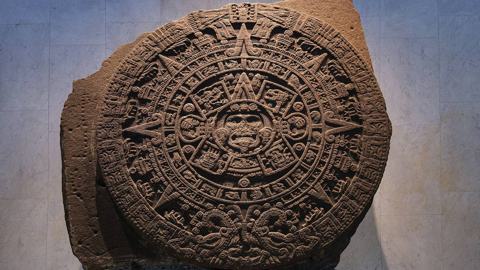
A 24-ton basalt disc unearthed in 1790 under Mexico City, long called the Aztec Calendar even though it was never used to track a single day.
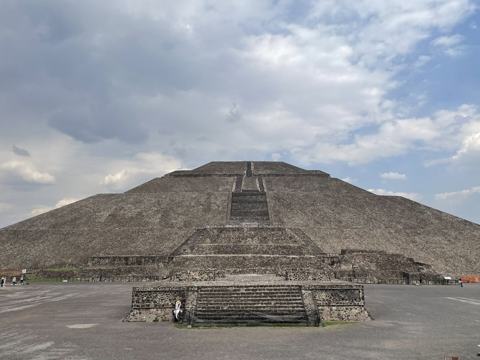
A vast city already ancient when the Aztecs found it, mythologised by them as the place where the gods sacrificed themselves to make the Fifth Sun.
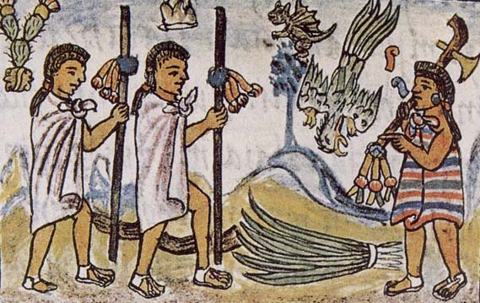
The 16th-century Nahuatl-Spanish encyclopedia of Aztec life and gods, compiled by a friar with Nahua scholars — the single richest source on Mexica myth.
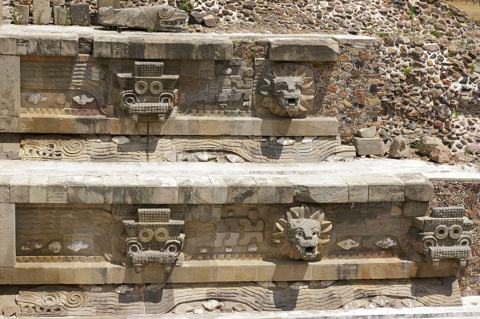
The Feathered Serpent — god of wind, learning, and creation, who stole humanity's bones from the land of the dead and gave people maize.
Also mentioned inChalchiuhtlicue (Aztec Water Goddess)Mayahuel (Aztec Goddess of Maguey and Pulque)The New Fire Ceremony
Sources & Further Reading
- 1.Bernardino de Sahagun, Florentine Codex — General History of the Things of New Spain (c. 1547–1579), Book 7.
- 2.Bierhorst, John, trans. History and Mythology of the Aztecs — The Codex Chimalpopoca. University of Arizona Press, 1992.
- 3.Historia de los Mexicanos por sus pinturas (16th century).
- 4.Histoyre du Mechique, Andre Thevet's French translation of a lost Spanish treatise attributed to Andres de Olmos (c. 1543/1553).
- 5.Miller, Mary & Karl Taube. The Gods and Symbols of Ancient Mexico and the Maya. Thames & Hudson, 1993.
- 6.Taube, Karl. Aztec and Maya Myths. British Museum Press, 1993.
- 7.Nicholson, H. B. 'Religion in Pre-Hispanic Central Mexico.' Handbook of Middle American Indians, vol. 10. University of Texas Press, 1971.
Spot an error or have a source to suggest? Write to info@viseterna.com. We cite primary sources and modern scholarship, and we correct fast.