
Cihuacoatl (Snake Woman)
The Aztec goddess of childbirth and earth who helped shape humanity, lent her name to Tenochtitlan's second-in-command, and wept an omen before the conquest.
Cihuacoatl statue, Mexica, 1325-1521 CE, found at Cuernavaca (Museo Nacional de Antropologia) · CC BY 3.0 · source
Snake Woman
Cihuacoatl — Nahuatl cihuatl, woman, and coatl, serpent — is one of the most prominent goddesses of the Mexica pantheon and one of the hardest to hold apart from her nearest relatives 4,7. She is also called Quilaztli in several sources, and colonial writers routinely blur her identity with Coatlicue, Toci "our grandmother," and Tonantzin "our revered mother" — a cluster modern scholarship generally treats as overlapping aspects of one earth-mother complex rather than as fully distinct persons 4,7.
She governs childbirth and midwifery specifically, and was closely tied to the temazcalli sweat baths where Mexica midwives worked and where women prepared for and recovered from labor 4,5.
Grinding the Bones of the Dead
Cihuacoatl has a direct hand in the creation of the present humanity. In several tellings, when Quetzalcoatl descends into Mictlan to steal the bones of the peoples who died in earlier ages, it is Cihuacoatl who grinds those bones in a jade bowl and mixes the resulting meal with blood drawn from the gods' own bodies, kneading the paste from which the first man and woman of the present age are shaped 2,4. The Historia de los Mexicanos por sus pinturas gives her this role directly rather than treating her as an assistant to a male creator acting alone, and Read and Gonzalez note that the episode makes Cihuacoatl, not Quetzalcoatl, the one whose hands physically make the human body 2,5.
The Women Who Died Like Warriors
Mexica belief compared childbirth to combat, and a woman who died delivering a child was honored with nearly the status of a warrior killed in battle. Her death was announced with war cries, and her spirit joined a company called the cihuateteo, the "divine women," pictured with skeletal faces like Cihuacoatl's own 1,4. Alongside the sun's warrior dead, the cihuateteo carried Tonatiuh through the western half of the sky each afternoon, a share of the sun's daily maintenance owed, in Mexica reckoning, as much to the women's hall of the dead as to the men's 1,4.
Sahagun's informants also record a darker reputation attached to the cihuateteo: like Cihuacoatl herself, they were believed to haunt crossroads after dark and could bring sickness, especially to children, if not properly propitiated with offerings left at their wayside shrines 1,5.
Second in Command
Confusingly, Cihuacoatl was also the title of a real, living, male official in Tenochtitlan — the ruler's second-in-command, roughly a prime minister, who governed internal administration and justice, could command armies, and acted as the tlatoani's ceremonial stand-in 5,6. The most famous holder of the office, Tlacaelel, served under four successive Mexica rulers in the fifteenth century and is credited by the colonial chronicler Diego Duran, among others, with reshaping much of Tenochtitlan's imperial ideology 3,5,6. Kellogg reads the shared name as no accident: the male official took the goddess's title because his office was explicitly modeled on her fused authority over civil order and its violent enforcement 6.
An Omen Before the Conquest
Cihuacoatl's darker aspect surfaces again in the omens Sahagun's informants said had preceded the Spanish arrival. Among the eight portents recorded in Book 12 of the Florentine Codex is a woman's voice heard repeatedly at night, weeping and crying out that her children must flee because there was nowhere left safe for them — a voice later informants identified with Cihuacoatl herself 1,7. Whether this omen was genuinely remembered from before 1519 or read back into the past after the conquest, by informants who already knew how the story ended, is a question the source itself cannot settle 1,7.
A Modern Echo, Hedged
That weeping omen is often connected by modern popular writers to La Llorona, "the Weeping Woman," the far better known Mexican legend of a mother who drowned her children and now wanders searching for them. The comparison is worth naming, since both figures share a wailing woman, endangered or dead children, and a nocturnal haunting, and some folklorists have proposed a real continuity between them 5. It should be treated as exactly that, a proposed comparison rather than a demonstrated inheritance: the earliest clearly documented tellings of La Llorona as a distinct legend are colonial or later, the centuries of transmission in between are not evidenced text by text, and nothing in the sixteenth-century sources calls the conquest-era omen by that name 5. The two stories may be genuinely related, or may simply be independent versions of a very old and very common folk motif; honesty about the record means resisting the urge to turn a likely resemblance into a proven bloodline.
Continue Exploring
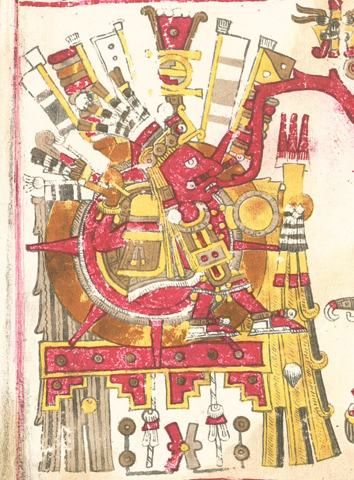
The Aztec sun of the present age, born from a beggar-god's leap into fire and kept moving only by the daily payment of human hearts and blood.
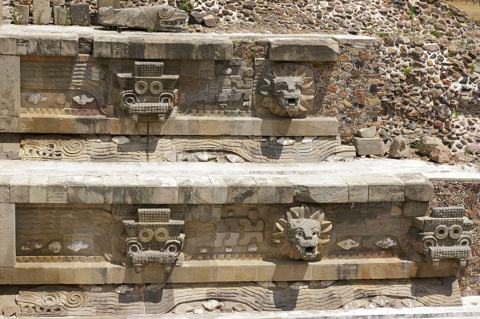
The Feathered Serpent — god of wind, learning, and creation, who stole humanity's bones from the land of the dead and gave people maize.
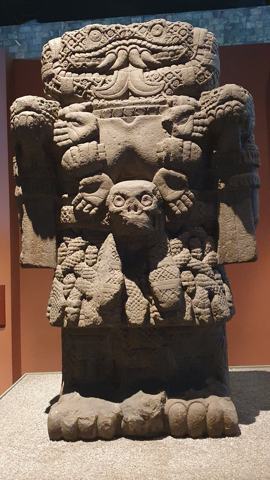
She of the Serpent Skirt — the Mexica earth mother who conceived Huitzilopochtli from a ball of feathers, and the colossal monolith that carries her name.
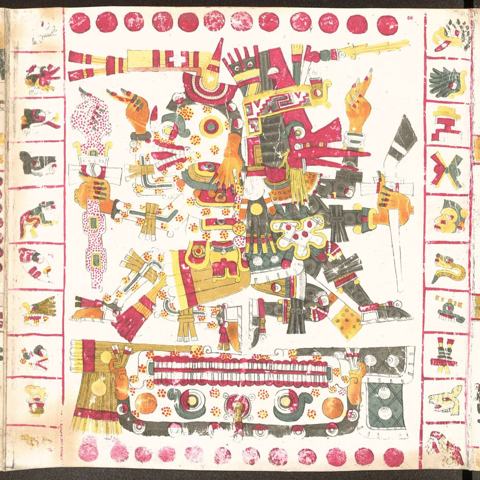
The Place of the Dead — a ninefold underworld reached by a four-year journey, where the ordinary dead arrive at last and simply cease.
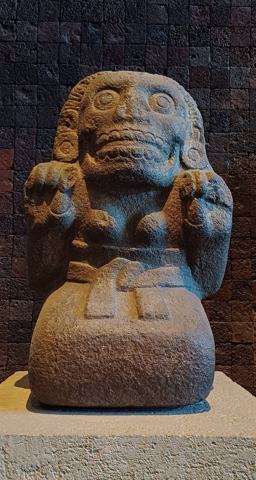
Deified spirits of women who died in childbirth, honored as fallen warriors by day and feared as child-stealing ghosts on certain nights.
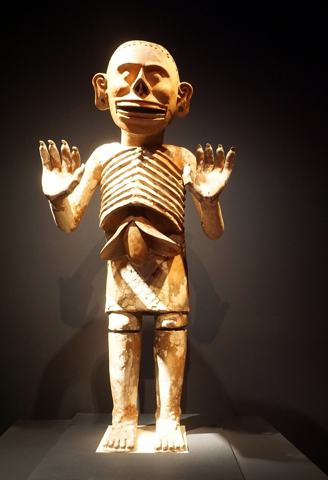
Lord of the Place of the Dead — the skeletal ruler of the ninefold underworld, keeper of humanity's bones and destination of everyone who dies ordinarily.
Sources & Further Reading
- 1.Bernardino de Sahagun, Florentine Codex — General History of the Things of New Spain (c. 1547-1579), Books 1, 6, and 12.
- 2.Historia de los Mexicanos por sus pinturas (16th century).
- 3.Diego Duran, Book of the Gods and Rites and The Ancient Calendar (c. 1574-1579).
- 4.Miller, Mary & Karl Taube. The Gods and Symbols of Ancient Mexico and the Maya. Thames & Hudson, 1993.
- 5.Read, Kay Almere & Jason J. Gonzalez. Handbook of Mesoamerican Mythology. ABC-CLIO, 2000.
- 6.Kellogg, Susan. 'The Woman's Room: Some Aspects of Gender Relations in Tenochtitlan in the Late Pre-Hispanic Period.' Ethnohistory, 1995.
- 7.Nicholson, H.B. 'Religion in Pre-Hispanic Central Mexico', Handbook of Middle American Indians vol. 10. University of Texas Press, 1971.
Spot an error or have a source to suggest? Write to info@viseterna.com. We cite primary sources and modern scholarship, and we correct fast.