
Cipactli
The primordial crocodilian monster torn apart to make earth and sky, and the creature whose name opens every 260-day count in the Aztec calendar.
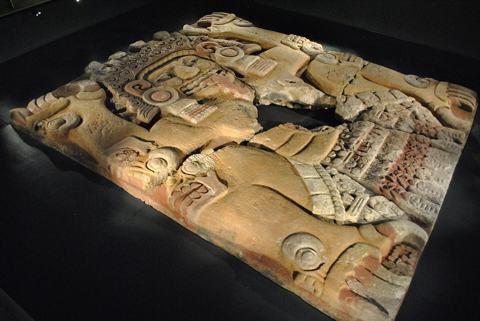
Carved panel with the body of Cipactli, pre-Columbian Mesoamerica · CC BY 4.0 · source
The First Crocodile
Cipactli is the primordial monster Mexica cosmology places in the waters before the present world existed: a hybrid creature combining the features of a crocodile, a fish, and a toad, its body studded with extra mouths and eyes at every joint, endlessly hungry 1,5. The Historia de los Mexicanos por sus pinturas gives the fullest surviving description of her, and the Spanish word its compiler reaches for, again and again, is simply "the earth" — Cipactli is not a monster living in the world so much as the raw material the world would eventually be made from 1,6.
She floats alone on a sea that, in this telling, existed before sky, before land, and before any other being except the handful of creator gods looking down from above 1,2.
Bait for the Earth
The gods wanted solid ground, and Cipactli was in the way. In the best-known version, Tezcatlipoca lowers his own foot into the water as bait; Cipactli bites it off, and the two gods, Tezcatlipoca and Quetzalcoatl, transform themselves into enormous serpents, drag her up out of the sea, and tear her in two 1,5. One half becomes the sky and its heavenly bodies; the other becomes the visible earth people would walk on 1,5. Mexica religion did not treat this as guiltless: the other gods, troubled by the violence, decreed that everything living would grow from Cipactli's torn body, and that she would go on demanding hearts and blood before she consented to bear fruit, the origin logic behind the sacrificial economy of Mexica state religion 1.
Later scholarship generally gives this dismembered figure, once she is fixed in place as the visible ground itself, a separate name, Tlaltecuhtli, "earth lord" — a label the sixteenth-century sources apply far less consistently than modern books do. Cipactli and Tlaltecuhtli are best read as the same monster under two names for two different moments of one story, the hunting and the settled aftermath, rather than as two distinct beings 1,5.
The First Day of the Count
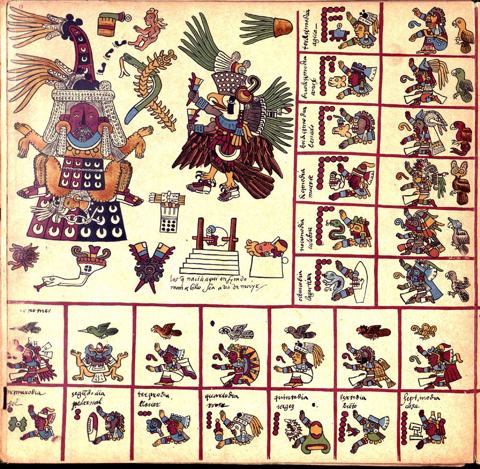
Cipactli's other major role has nothing to do with creation and everything to do with counting time. She gives her name to the very first of the twenty day-signs in the 260-day tonalpohualli, the Crocodile day that opens each cycle of thirteen, and Mexica tradition credited a figure called Cipactonal, "Cipactli sign," as the first diviner, the legendary originator of the whole divinatory art built on her calendar 3,6,7. Boone's study of the Mexican books of fate treats this opening position as more than decoration: a calendar that begins with the same monster the earth itself was cut from quietly restates, on every count, that time and matter share one violent origin 7.
An Earth Still Restless
Some sources connect Cipactli's continuing hunger to the physical instability of the land itself, reading earthquakes and volcanic tremors as the buried monster stirring beneath a world that is, after all, still made of her body 5,6. A structurally similar figure appears independently across Mesoamerica in Maya tradition, where the Popol Vuh names a boastful, mountain-raising crocodilian, Zipacna, defeated by the Hero Twins (it is Zipacna's brother Cabrakan, not Zipacna himself, whom the same text names as the one who shakes mountains down); the resemblance in name and general form is striking, but the two traditions developed the figure differently enough that scholars treat the parallel as a shared regional motif rather than a single borrowed story 6.
Cipactli in Myth and Craft
Cipactli's image recurs throughout the surviving ritual manuscripts, most often as a long, toothed, clawed body bent into the shape the day-sign glyph requires, sometimes floating on stylized water, sometimes framing the edge of an entire painted almanac page as though the book itself sat on her back 3,4. She was not confined to painted books. This entry's own image, a carved stone panel showing her segmented, clawed body worked in low relief, reproduces the same monster on the kind of everyday elite object, a chest or box fitting, that rarely survives — evidence that her image circulated through Mexica material culture well beyond the small number of screenfold codices that happen to have come down to us 5.
Continue Exploring
The 260-day sacred count that set every Aztec's birth-fate, built from 13 numbers and 20 day-signs, inherited from far older Mesoamerican tradition.
The crocodilian earth deity torn in two to make sky and ground — and the twelve-ton painted monolith of her unearthed at the Templo Mayor in 2006.
The Feathered Serpent — god of wind, learning, and creation, who stole humanity's bones from the land of the dead and gave people maize.
The Smoking Mirror — god of night, sorcery, kingship and fate, whose obsidian glass shows what men do in the dark and who owns them all as slaves.
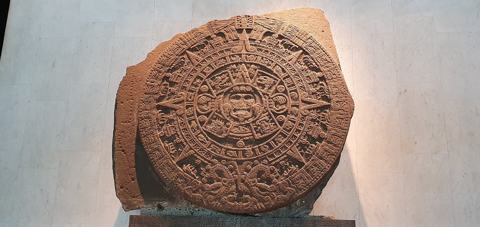
The Aztec myth of four ruined world-ages before this one, each ended by its own catastrophe, in an order and cast of gods the sources don't agree on.
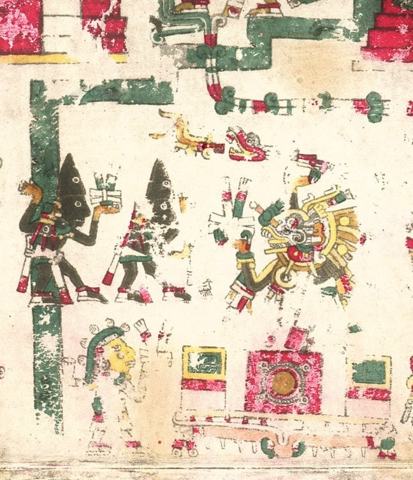
A pre-conquest screenfold of gods and days, painted for diviners to read fate — one of the few Mexican books that survived the conquest untouched.
Sources & Further Reading
- 1.Historia de los Mexicanos por sus pinturas (16th century).
- 2.Leyenda de los Soles (Codex Chimalpopoca, 1558).
- 3.Codex Borgia (pre-Columbian ritual manuscript).
- 4.Codex Fejervary-Mayer (pre-Columbian ritual manuscript).
- 5.Miller, Mary & Karl Taube. The Gods and Symbols of Ancient Mexico and the Maya. Thames & Hudson, 1993.
- 6.Read, Kay Almere & Jason J. Gonzalez. Handbook of Mesoamerican Mythology. ABC-CLIO, 2000.
- 7.Boone, Elizabeth Hill. Cycles of Time and Meaning in the Mexican Books of Fate. University of Texas Press, 2007.
Spot an error or have a source to suggest? Write to info@viseterna.com. We cite primary sources and modern scholarship, and we correct fast.