
Mictlan
The Place of the Dead — a ninefold underworld reached by a four-year journey, where the ordinary dead arrive at last and simply cease.
Codex Borgia, page 56, central Mexico, pre-Conquest (Biblioteca Apostolica Vaticana) · Public domain · source
The Place of the Dead
Mictlan is Nahuatl for "the place of the dead" — mic-, from the verb to die, with the locative -tlan 5. It lies to the north and downward, and it is ruled by Mictlantecuhtli and his consort Mictecacihuatl in its deepest level, sometimes named Chicunauhmictlan, the ninth Mictlan 1,5.
The essential thing to grasp about it is that it was the destination of most people. Mexica cosmology assigned the afterlife by manner of death, not by conduct, and only a few deaths qualified for anywhere else 1,6,7. Dying in bed of old age or fever routed you here.
The Four-Year Road
The appendix to Book 3 of the Florentine Codex preserves the fullest indigenous-language account of the journey, framed as instructions spoken to the corpse at the funeral 1. The dead were told they faced four years of travel and were equipped for it: dressed, given paper ornaments, bundled, and cremated with the goods and the water they would need 1.
The obstacles named there are physical rather than moral. Two mountains that clash together and must be passed between; a serpent guarding the way; a great green lizard; eight deserts and eight hills; a place called Itzehecayan where an obsidian wind blows so cold and sharp it cuts, and where the clothing and possessions burned at the funeral were understood to protect the traveller 1,7. There is no interrogation and nothing to confess.
The Dog at the River
The last barrier is a wide river, Chiconahuapan, "nine waters," which cannot be crossed alone 1. A dog carries or guides the dead across — which is why a dog, often specified as one of a particular colour, was cremated with the body 1,5.
Sahagun's informants add a piece of practical theology that is easy to miss: the dog had to be the right colour. A white dog would refuse, saying it had just washed; a black dog would refuse, saying it was already stained; only a reddish or yellow dog would carry the dead over 1. The Mexica hairless dog, the xoloitzcuintli, is associated with this role, and its patron Xolotl is the canine double of Quetzalcoatl 5.
On the far bank the traveller reached Mictlantecuhtli, presented the offerings brought for him, and there the account ends. The soul does not persist in torment or bliss; it arrives and is finished 1,6,7.
The Nine Levels
Most modern lists of Mictlan's nine named levels descend from a single document: the Codex Vaticanus A, a colonial manuscript with Italian commentary, which lays the underworld out in tiers 2. Its authority is real but limited. The glossator was interpreting an indigenous pictorial source through a European frame and plainly at times through a Dantean one, and the tidy numbered schema he produced is not corroborated in that form by the Nahuatl-language sources 2,5.
Lopez Austin's analysis treats Mesoamerican vertical cosmology as a set of overlapping ideas about layered worlds rather than a fixed map, and warns against reconstructing a single official diagram out of documents that disagree 6. The safest statement is that the underworld was understood as multi-levelled, deep, cold, and northward, and that nine is the number most often attached to it — including in the count of the Nine Lords of the Night in the divinatory manuscripts 4,5,6.
The Other Afterlives
Mictlan was not the only destination, and the alternatives explain what kind of place it was by contrast 1,7.
Tlalocan, the green paradise of Tlaloc, received those taken by water, lightning, or the diseases attributed to the rain gods; those dead were buried rather than burned, and were described as living in perpetual summer among growing crops 1,6. Tonatiuh ilhuicac, the sun's heaven, received warriors who died in battle or on the sacrificial stone, who escorted the sun from dawn to noon and afterwards returned as hummingbirds and butterflies 1,5. Women who died in childbirth — counted as fallen warriors — escorted the sun from noon to sunset and became the cihuateteo, feared spirits who descended on certain days 1,5. The Codex Vaticanus A also describes Chichihualcuauhco, a tree that drips milk, where infants who died before weaning waited 2,7.
None of these is earned by virtue. Each is a consequence of how a person happened to die 1,6,7.
Reading Mictlan Honestly
Colonial writers translated Mictlan as infierno and its lord as the devil, and that equation has shaped how the realm is described ever since 1,5. It fits badly. There is no judge, no scale, no register of sins, no rescue, and no eternity of pain — the journey is arduous and the arrival is an ending 1,7.
The tone of the sources is worth noticing too. The funerary orations recorded by Sahagun are not triumphant or terrified; they are plain, addressed to the dead as travellers being sent off properly equipped, with the survivors making offerings on their behalf at the eighty-day intervals and over the four years of the road 1,7.
Continue Exploring
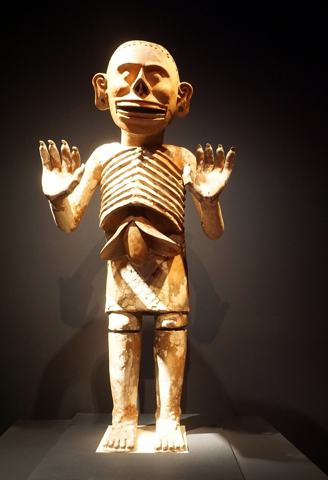
Lord of the Place of the Dead — the skeletal ruler of the ninefold underworld, keeper of humanity's bones and destination of everyone who dies ordinarily.
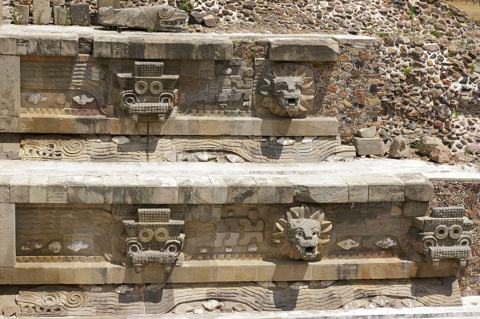
The Feathered Serpent — god of wind, learning, and creation, who stole humanity's bones from the land of the dead and gave people maize.
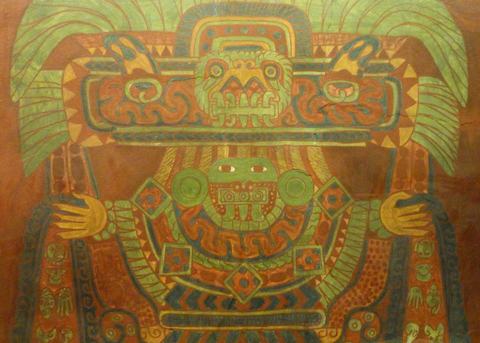
The rain god's paradise of unfailing summer, reserved for those the water took — and the name modern scholars gave a debated mural at Teotihuacan.
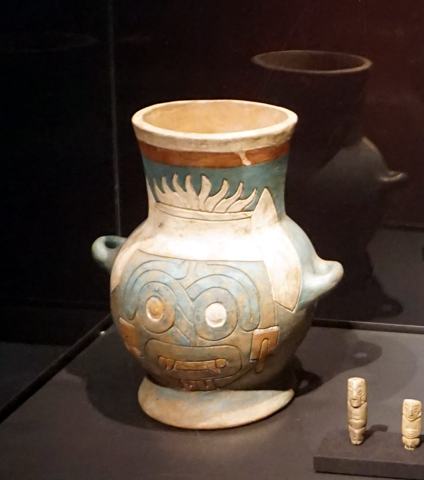
The goggle-eyed rain god who makes things sprout — giver of the storms that feed the maize, keeper of a green paradise, and taker of children.
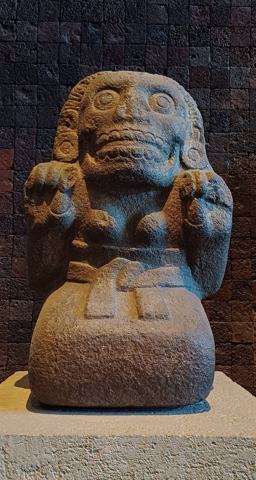
Deified spirits of women who died in childbirth, honored as fallen warriors by day and feared as child-stealing ghosts on certain nights.
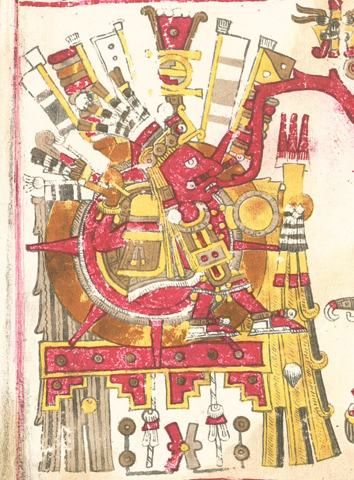
The Aztec sun of the present age, born from a beggar-god's leap into fire and kept moving only by the daily payment of human hearts and blood.
Also mentioned inCihuacoatl (Snake Woman)Ometeotl (Aztec Dual God)XibalbaXolotl
Sources & Further Reading
- 1.Bernardino de Sahagun, Florentine Codex — General History of the Things of New Spain (c. 1547–1579), Book 3 (appendix) and Book 10.
- 2.Codex Vaticanus A (Codex Rios, c. 1570).
- 3.Leyenda de los Soles and Anales de Cuauhtitlan (Codex Chimalpopoca, 1558/1570).
- 4.Codex Borgia (pre-Columbian ritual manuscript).
- 5.Miller, Mary & Karl Taube. The Gods and Symbols of Ancient Mexico and the Maya. Thames & Hudson, 1993.
- 6.Lopez Austin, Alfredo. Tamoanchan, Tlalocan: Places of Mist. University Press of Colorado, 1997.
- 7.Read, Kay Almere & Jason J. Gonzalez. Handbook of Mesoamerican Mythology. ABC-CLIO, 2000.
Spot an error or have a source to suggest? Write to info@viseterna.com. We cite primary sources and modern scholarship, and we correct fast.