
Tonatiuh (Aztec Sun God)
The Aztec sun of the present age, born from a beggar-god's leap into fire and kept moving only by the daily payment of human hearts and blood.
Tonatiuh, Codex Borgia, pre-Conquest central Mexico (Biblioteca Apostolica Vaticana) · Public domain · source
Movement of the Sun
Tonatiuh comes from the Nahuatl verb tona, to shine or give off warmth, and is usually rendered "he who goes forth shining" or simply "the sun." His calendar name is Nahui Ollin, 4 Movement — the day-sign of the present cosmic age, and a name the Mexica read as a warning as much as a title 1,5. He is the sun of the fifth and current creation, the one Tenochtitlan's priests addressed directly in prayer and fed with the central rite of their state religion 1,6.
He is painted red or gold, crowned with an eagle-feather headdress and a turquoise-banded solar disc, and shown gripping clawed talons that carry captured human hearts toward his open mouth — his standard attribute across the surviving ritual manuscripts 4,5.
A Sun Bought With Suicide
Tonatiuh's origin is inseparable from the story told in The Five Suns. At Teotihuacan, in total darkness, the gods needed a new sun after four earlier worlds had already failed. Two candidates offered themselves to the sacrificial fire: the wealthy Tecuciztecatl, who flinched and hesitated four times, and the poor, sore-covered Nanahuatzin, who jumped without hesitation and rose from the flames transformed into Tonatiuh 2,3.
But the new sun refused to move. Fixed on the horizon, he announced through a messenger that he would climb only once the rest of the gods gave him their own hearts and blood — the same price he would keep demanding from Tenochtitlan every day afterward 2,3. The assembled gods submitted to sacrifice, Xolotl last and most reluctantly of all, fleeing through a series of disguises before he was caught; only then did the wind of Quetzalcoatl, in his aspect as Ehecatl, push the new sun into its first motion across the sky 2,3.
Feeding a God Who Is Also a Debt
That founding demand shaped Mexica state religion at its root. Every sacrifice performed in Tenochtitlan's temples was explained, at some level, as continuing payment on the debt the gods incurred when they died to set Tonatiuh in motion — a debt inherited by everyone descended from beings who had not, themselves, volunteered to die 1,6. The wars fought specifically to take live captives for the altar, the so-called flower wars, were justified in exactly this register: the sun's daily crossing required fuel, and fuel meant hearts 1,6.
Warriors killed in battle or on the sacrificial stone, and merchants who died on distant trading roads, were promised a specific reward for their part in that economy: four years escorting the sun from dawn to its zenith in a paradise called Tonatiuhichan, the House of the Sun, before returning to earth as hummingbirds 1,7. At noon the sun passed to a second honor guard, the cihuateteo — women who had died in childbirth, the retinue of Cihuacoatl — who carried him down toward dusk, since the Mexica reckoned childbirth the female equivalent of taking a captive in war 1,7. Between the two companies, no death judged to be in Tonatiuh's service, male or female, went unrewarded in the myth, whatever it cost the living.
A Face Still in Dispute
Tonatiuh's best-known image is not a painting but a monument: the central face on the so-called Aztec Sun Stone, framed by Nahui Ollin's own calendar glyph and by clawed hands gripping human hearts 4,5. That identification is the traditional and popular one, but it is not the only reading scholarship allows — a substantial body of specialists argues the same face is instead Tlaltecuhtli, the earth, an identification this Codex's own Sun Stone entry treats as genuinely open rather than a popular error awaiting correction 5.
An Ending Written Into His Name
Nahui Ollin is a warning built directly into the calendar. The Mexica believed the fifth sun, like the four before it, was fated to end eventually — this time in earthquakes, ollin's own sign — and nothing in the sources suggests they expected human effort to prevent that ending forever, only to postpone it 3,6. Brundage reads the whole architecture of Mexica warfare and sacrifice through that anxiety: a state that fed its sun daily because its own myths had already shown it what a sun looks like when nobody feeds it — motionless on the horizon, useless, and eventually extinguished 6.
Continue Exploring
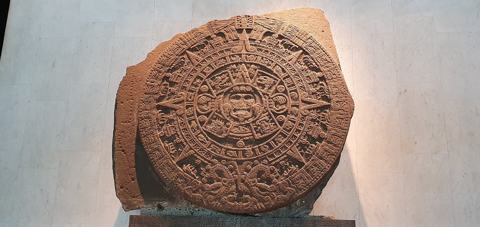
The Aztec myth of four ruined world-ages before this one, each ended by its own catastrophe, in an order and cast of gods the sources don't agree on.
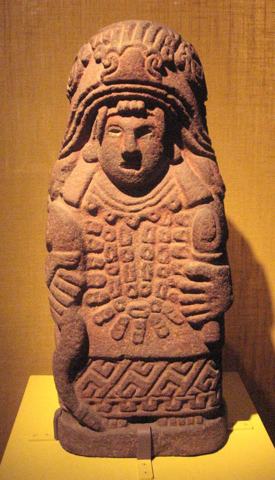
The Aztec goddess of childbirth and earth who helped shape humanity, lent her name to Tenochtitlan's second-in-command, and wept an omen before the conquest.
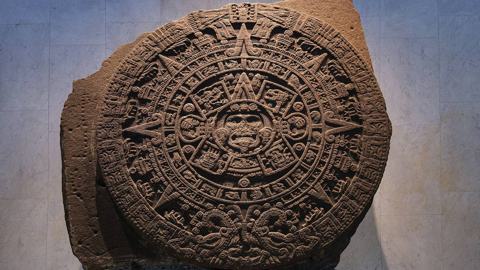
A 24-ton basalt disc unearthed in 1790 under Mexico City, long called the Aztec Calendar even though it was never used to track a single day.
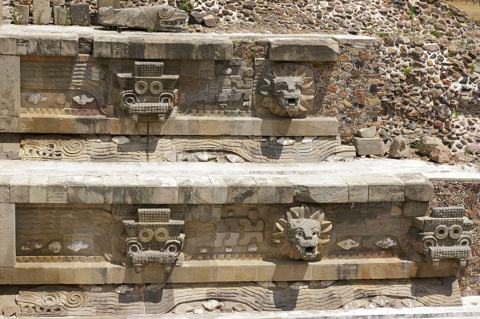
The Feathered Serpent — god of wind, learning, and creation, who stole humanity's bones from the land of the dead and gave people maize.
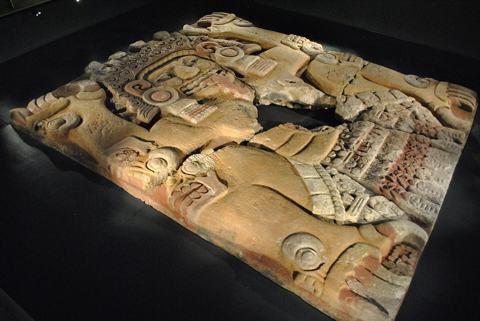
The crocodilian earth deity torn in two to make sky and ground — and the twelve-ton painted monolith of her unearthed at the Templo Mayor in 2006.
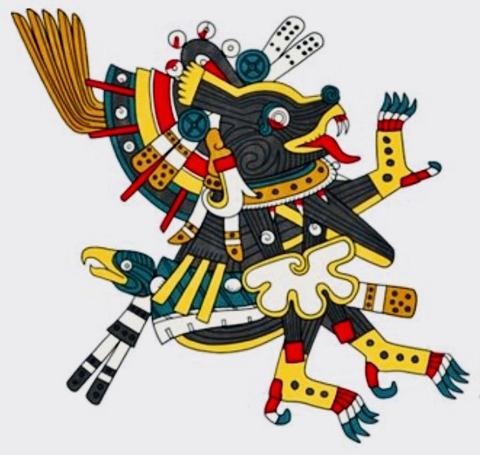
The dog-headed twin of Quetzalcoatl — evening star, guide of the dead through Mictlan, and the shapeshifter whose last disguise was the axolotl.
Also mentioned inMictlan
Sources & Further Reading
- 1.Bernardino de Sahagun, Florentine Codex — General History of the Things of New Spain (c. 1547-1579), Books 2 and 7.
- 2.Historia de los Mexicanos por sus pinturas (16th century).
- 3.Leyenda de los Soles (Codex Chimalpopoca, 1558).
- 4.Codex Borgia (pre-Columbian ritual manuscript).
- 5.Miller, Mary & Karl Taube. The Gods and Symbols of Ancient Mexico and the Maya. Thames & Hudson, 1993.
- 6.Brundage, Burr Cartwright. The Fifth Sun: Aztec Gods, Aztec World. University of Texas Press, 1979.
- 7.Nicholson, H.B. 'Religion in Pre-Hispanic Central Mexico', Handbook of Middle American Indians vol. 10. University of Texas Press, 1971.
Spot an error or have a source to suggest? Write to info@viseterna.com. We cite primary sources and modern scholarship, and we correct fast.