
Xolotl
The dog-headed twin of Quetzalcoatl — evening star, guide of the dead through Mictlan, and the shapeshifter whose last disguise was the axolotl.
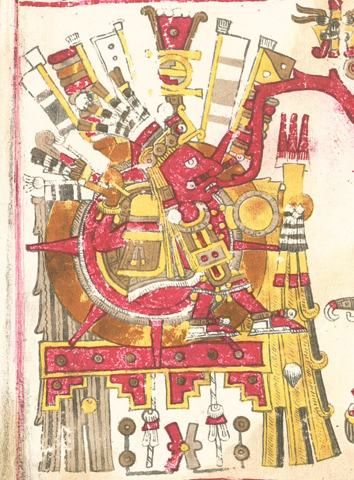
Xolotl, Codex Borgia, pre-conquest central Mexico (Biblioteca Apostolica Vaticana) · Public domain · source
A Name That Means Several Things at Once
The Nahuatl word xolotl carries a bundle of senses: servant or page, twin, and something malformed or monstrous 5,7. All three attach to the god. He is the attendant who does the difficult errand, the double of a more famous brother, and the patron of twins, dwarfs and the physically irregular — categories the Mexica treated as marked and dangerous rather than merely unfortunate 5,7.
The word is also the root of two familiar creatures. The axolotl is atl-xolotl, "water xolotl", the salamander of the lakes of the Valley of Mexico that never leaves its larval form; and the hairless xoloitzcuintli dog is xolotl joined to itzcuintli, dog 5. Neither is a coincidence of language. Both animals sit exactly where the god sits, at the point where a thing refuses to finish its expected transformation.
He should not be confused with the Chichimec ruler also called Xolotl who appears in the Texcocan histories and gives his name to the Codex Xolotl; that is a separate, human figure 7.
The Twin of Quetzalcoatl
Xolotl is consistently paired with Quetzalcoatl as his twin, and the pairing is astronomical. The Mexica, like other Mesoamerican peoples, tracked Venus closely and understood its morning and evening appearances as two faces of one body: Quetzalcoatl in his aspect of Tlahuizcalpantecuhtli, "lord of the dawn house", is the morning star, and Xolotl is the evening star that follows the sun down 3,5,7.
That division of labour explains the rest of him. The morning star announces the sun's arrival; the evening star goes with it into the dark. Xolotl is therefore the one who accompanies the sun through the underworld between dusk and dawn and brings it out again, a nightly journey the ritual manuscripts show him making 4,5.
He is painted with the head of a dog, ragged or torn ears, and often with a wind jewel or the sectioned conch of his brother at his chest; some images give him reversed or backward feet, a conventional sign for the inverted, underworld version of a thing 4,5. In the Codex Borgia and related books he appears repeatedly in scenes of descent, dismemberment and darkness 4.
Guide of the Dead
Dogs carried the dead in central Mexican belief. The soul travelling to Mictlan had to cross a wide river, and the standard account has a dog — often specified as a reddish one — carry its owner over; dogs were accordingly buried with the dead, and the archaeology of central Mexican graves bears the practice out 3,5. Xolotl is the divine form of that escort, the psychopomp of the system whose lord is Mictlantecuhtli 5,7.
The role recurs in creation. When Quetzalcoatl descends into Mictlan to steal the bones of the previous humanity and grind them into the substance of the present one, several sources place Xolotl at his side, or fold the two together as one traveller under two names 1,2,5. The doubling is the point: the god who leads souls down is the one best equipped to bring something back up.
The Fifth Sun and the Flight
His most vivid appearance is at the birth of the present world. In the Leyenda de los Soles and related accounts, the gods gather at Teotihuacan in darkness; two of them throw themselves into a fire to become the sun and the moon, but the new sun stands still in the sky and demands the blood of the rest before it will move 1,2. The gods submit and are sacrificed by Ehecatl, the wind.
Xolotl refuses. He weeps until his eyes fall out of their sockets — a detail the codices preserve in images of a dog-headed figure with empty eyes — and runs, changing shape as he goes: first into a doubled maize plant, which is called xolotl; then into a doubled maguey, mexolotl; and finally into the salamander in the water, the axolotl. There the wind catches him and kills him anyway, and the sun begins to move 1,2,5. The three transformations are all doubled or arrested forms, which is a tidy piece of storytelling around the meanings already carried in the name 5,6.
The account is not universal. It survives in a small number of sixteenth-century Nahuatl and Spanish compilations, each with its own agenda, and variants disagree about who died first and in what order; scholars treat the versions as related tellings rather than a single canonical text 6,7.
The Ballcourt and the Twin Sun
Xolotl also stands over the ritual ball game, whose court is itself a model of the underworld passage, and over the patolli board game — both contests in which a thing goes down and may come back 5,7. The connection between twinship, the game and the passage of the sun runs across Mesoamerica, and reappears in a wholly different language and literature in the Maya story of the Hero Twins, where two brothers play ball against the lords of the dead and rise as sun and moon 5,6.
Whether those parallels reflect a shared inheritance or convergent thinking about the same night sky is not settled 6,7. What can be said is that Xolotl occupies a position the Mexica clearly found necessary: not a god of death, but the one who goes into the dark on purpose and knows the way out.
Continue Exploring
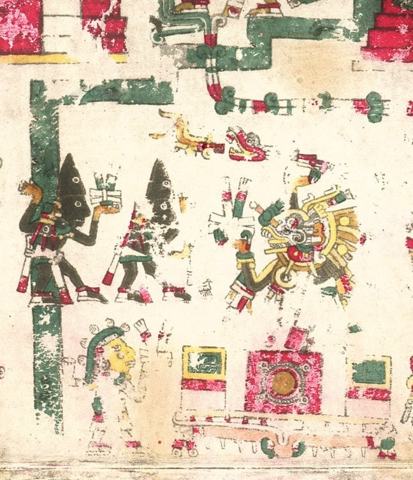
A pre-conquest screenfold of gods and days, painted for diviners to read fate — one of the few Mexican books that survived the conquest untouched.
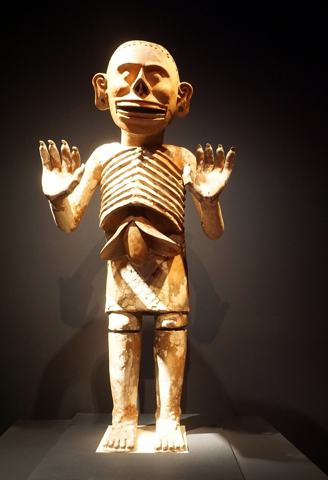
Lord of the Place of the Dead — the skeletal ruler of the ninefold underworld, keeper of humanity's bones and destination of everyone who dies ordinarily.
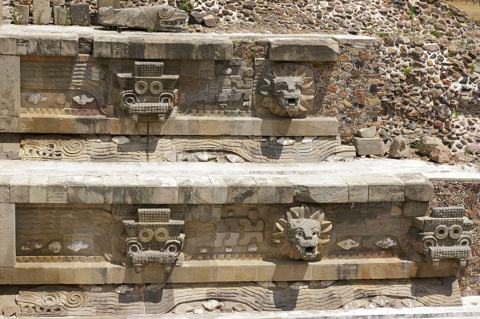
The Feathered Serpent — god of wind, learning, and creation, who stole humanity's bones from the land of the dead and gave people maize.
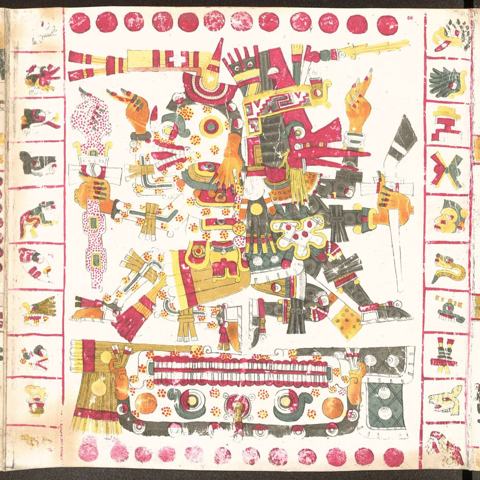
The Place of the Dead — a ninefold underworld reached by a four-year journey, where the ordinary dead arrive at last and simply cease.
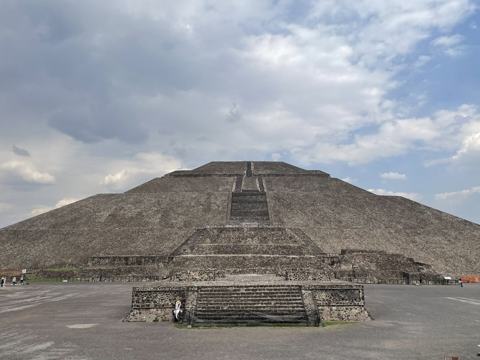
A vast city already ancient when the Aztecs found it, mythologised by them as the place where the gods sacrificed themselves to make the Fifth Sun.
The Aztec sun of the present age, born from a beggar-god's leap into fire and kept moving only by the daily payment of human hearts and blood.
Sources & Further Reading
- 1.Leyenda de los Soles (Codex Chimalpopoca, 1558).
- 2.Historia de los Mexicanos por sus pinturas (16th century).
- 3.Bernardino de Sahagun, Florentine Codex — General History of the Things of New Spain (c. 1547–1579), Books 3, 7 and 11.
- 4.Codex Borgia, Codex Fejervary-Mayer and Codex Vaticanus B (pre-conquest ritual manuscripts).
- 5.Miller, Mary & Karl Taube. The Gods and Symbols of Ancient Mexico and the Maya. Thames & Hudson, 1993.
- 6.Taube, Karl. Aztec and Maya Myths. British Museum Press / University of Texas Press, 1993.
- 7.Nicholson, H.B. 'Religion in Pre-Hispanic Central Mexico', Handbook of Middle American Indians vol. 10. University of Texas Press, 1971.
Spot an error or have a source to suggest? Write to info@viseterna.com. We cite primary sources and modern scholarship, and we correct fast.