
Aphrodite
Born from sea foam or fathered by Zeus — the goddess of desire, whose power over gods and mortals starts wars as easily as marriages.
The Birth of Venus, William-Adolphe Bouguereau, 1879 (Musee d'Orsay, Paris) · Public domain · source
Two Births
The Greeks told two incompatible stories about where Aphrodite came from, and never troubled to reconcile them. In Hesiod she has no mother and no ordinary father: when Cronus castrates Ouranos and throws the severed genitals into the sea, white foam gathers around them, and out of it rises a goddess who first touches land at Cythera and then at Cyprus 1. Hesiod derives her name from aphros, "foam" — a folk etymology that modern linguists do not accept, though no better derivation commands agreement 1,7.
Homer knows nothing of this. In the Iliad Aphrodite is simply the daughter of Zeus and the shadowy goddess Dione, and when Diomedes wounds her hand she runs weeping to her mother's lap on Olympus, bleeding the thin ichor of the gods 2. Plato's Symposium later turned the doubled genealogy into philosophy, distinguishing a celestial Aphrodite Ourania from a common Aphrodite Pandemos — a distinction that also existed in real cult, though not with Plato's moral loading 6,7.
Most scholars now hold that Aphrodite's cult reached Greece through Cyprus and the Levant, and that she owes a great deal to Near Eastern goddesses of love and war such as Inanna-Ishtar and Phoenician Astarte. Her Cypriot titles, her armed forms, and the astral associations all point that way, though the degree of borrowing is still debated 7,8.
Power over Gods and Men
Aphrodite's domain is eros itself — the compulsion, not the sentiment. The Homeric Hymn to her opens by declaring that she bends the minds of all gods and mortals and even the beasts, and that only three goddesses resist her: Athena, Artemis and Hestia 4. Zeus, tired of being made a fool of, turns her own power on her and makes her fall for the Trojan herdsman Anchises; she comes to him disguised as a mortal girl, sleeps with him, then reveals herself and tells him he will father Aeneas — and warns him never to boast of it 4.
Her most famous object is the kestos himas, the embroidered band or strap she lends to Hera in Iliad 14, in which "are fashioned all beguilements" — longing, sweet talk, and the persuasion that steals the wits of the sensible. Hera borrows it under false pretences and uses it to seduce her own husband to sleep so the war can turn 2.
Marriage, Ares, and the Net
She is married to Hephaestus, the lame smith, and takes Ares as her lover. The bard Demodocus sings the story in Odyssey 8: Helios sees them, Hephaestus forges chains finer than spider silk, snares the pair in bed, and calls the gods in to look and laugh — while Apollo and Hermes agree that the shame would be worth it 3. It is the only overtly comic scene of adultery in early Greek epic, and it is told about the two Olympians least burdened with dignity.
Her children spread across the pantheon and the heroic world: Harmonia, Deimos and Phobos by Ares; Aeneas by Anchises; Hermaphroditus and, in some accounts, Priapus by Hermes or Dionysus; and Eros, who in Hesiod is a primordial force older than she is but in later poetry becomes her son and attendant 1,4,6.
The Judgment of Paris
The war at Troy begins with her. At the wedding of Peleus and Thetis, Eris throws down a golden apple "for the fairest"; Hera, Athena and Aphrodite each claim it, and Zeus sends them to the Trojan prince Paris. Hera offers rule over Asia, Athena offers victory in war, Aphrodite offers the most beautiful woman alive — and Paris chooses, which is why Helen leaves Sparta and a thousand ships follow her 2,6.
Through the Iliad Aphrodite is Troy's partisan, snatching Paris out of a duel he is losing and wrapping him in mist, then browbeating Helen back into his bedroom with a threat that shows the ugly face of the goddess of desire 2.
Adonis and Cult
The Adonis story, Cypriot and Levantine in colour, has Aphrodite conceal the beautiful youth in a chest and entrust him to Persephone, who refuses to give him back; Zeus divides his year between them, and Adonis is finally killed by a boar. Athenian women mourned him each summer on the rooftops with quick-withering "gardens of Adonis" in potsherds — a rite that stood deliberately apart from the civic calendar 6,7.
Her sanctuaries were varied and often unexpected. Aphrodite Ourania was worshipped at Athens; Aphrodite Pandemos was linked to the civic body rather than to prostitution, despite the later slur; at Sparta and Corinth she appeared armed; at Acrocorinth stood a temple whose association with sacred prostitution, long repeated on the authority of Strabo, is now widely doubted by specialists 7,8. Sappho's first fragment, a prayer for the goddess to come again as an ally in love, remains the most personal address to any Greek deity to survive 5.
To the Romans she was Venus, ancestress of the Julian house through Aeneas — see Venus — and it is largely through Roman art and poetry that her image reached the Renaissance and the modern world 6,7.
Continue Exploring
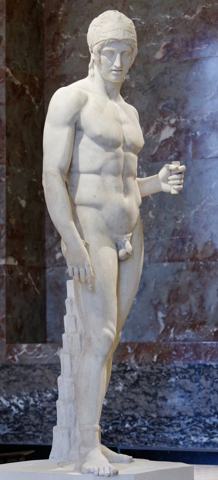
The Greek god of war as slaughter rather than strategy — hated by his own father, beaten by Athena, and worshipped anyway on the edges of the Greek world.
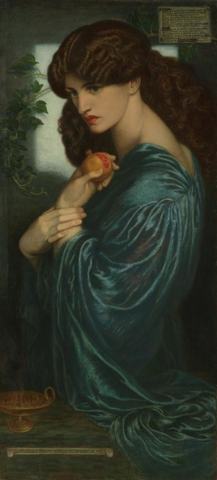
The girl carried off in a chariot and the dread queen of the dead. Persephone divides her year between the grain above and the throne below.
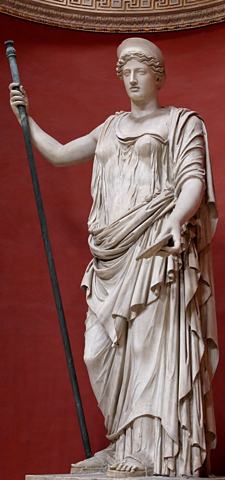
Queen of the gods. Zeus's sister, wife and most dangerous opponent — goddess of marriage in cult, and in Homer the one Olympian he is genuinely wary of.
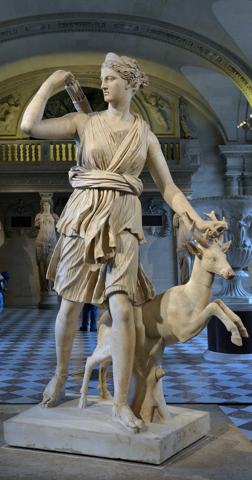
Virgin huntress, mistress of animals, twin of Apollo. Protector of the young and the wild — and a goddess whose arrows kill without warning.
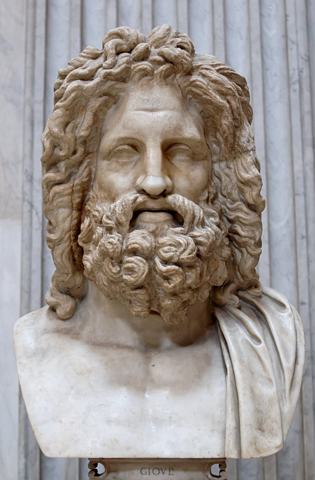
King of the gods and lord of the sky, thunder and justice. He overthrew his own father, divided the universe by lot, and guaranteed the laws of hospitality.
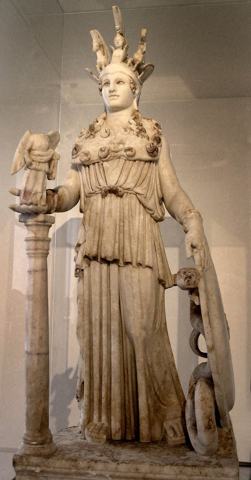
Goddess of wisdom, strategy and craft, born fully armed from the head of Zeus. Patron of Athens, of heroes, and of Odysseus above all.
Also mentioned inPandoraThe IliadThe Titans
Sources & Further Reading
- 1.Hesiod, Theogony (c. 700 BC).
- 2.Homer, Iliad — Books 3, 5 and 14 (c. 8th-7th century BC).
- 3.Homer, Odyssey — Book 8, the song of Demodocus (c. 8th-7th century BC).
- 4.Homeric Hymn 5, To Aphrodite (c. 7th century BC).
- 5.Sappho, fragment 1 and related fragments (c. 600 BC).
- 6.Apollodorus, Bibliotheca (Library), 1st-2nd century AD, and Pausanias, Description of Greece (c. AD 160-180).
- 7.Burkert, Walter. Greek Religion. Trans. John Raffan. Harvard University Press, 1985.
- 8.Budin, Stephanie L. The Origin of Aphrodite. CDL Press, 2003.
Spot an error or have a source to suggest? Write to info@viseterna.com. We cite primary sources and modern scholarship, and we correct fast.