
The Lernaean Hydra
The regenerating, poison-blooded serpent of the Lernaean swamp that Heracles killed with fire in his second labor — and that ancient writers already doubted.
Hercules Vanquishing the Hydra of Lerna, Guido Reni, c. 1620 (Musee du Louvre, Paris) · Public domain · source
Born of Monsters
The Hydra's family is the worst in Greek myth by design. Hesiod lists her among the monstrous children of Typhon and Echidna, alongside Cerberus and the Chimera, and says Hera raised the creature herself specifically to become a future trial for Heracles — making the labor, from its origin, an act of divine spite rather than an accident of geography. Ogden groups her with the wider Greek family of guardian serpents that also includes the dragon watching the Golden Fleece at Colchis, monsters whose whole role is to be defeated by someone 1,5.
The Swamp at Lerna
Lerna, on the coast a few miles from Argos, was a real and specific place, not a vague swamp of legend — a spring-fed wetland already tied in Greek religion to the Danaids and to rites connected with Demeter and Dionysus, including a supposedly bottomless lake the locals called the Alcyonian, through which Dionysus was said to have descended to the underworld to retrieve his mother Semele. The Hydra's lair sits inside this already-loaded landscape, coiled around a plane tree by a spring, guarding nothing in particular except the ground itself 2,4.
The Second Labor
Eurystheus assigns the Hydra as the second of Heracles' labors, and Heracles brings his nephew Iolaus along as charioteer, which turns out to matter more than expected. Every time Heracles cuts off one of the Hydra's heads, two grow back from the stump, and Hera, still working against him, sends a giant crab to bite at his heel while he fights. The fix is Iolaus's: as Heracles severs each head, Iolaus sears the open wound shut with a burning torch before it can regrow, and the two of them work through the heads this way until only the last, immortal one remains, which Heracles cuts off and buries, still alive, under a massive boulder beside the road 2,3.
Poison for Later Use
Heracles does not walk away empty-handed. He dips his arrows in the Hydra's poisonous blood or gall before leaving Lerna, and that single decision echoes through the rest of his story: Hydra-poisoned arrows kill the centaur Nessus later on, and it is Nessus's own poisoned blood, given to Heracles' wife Deianira as a supposed love charm, that eventually kills Heracles himself — meaning the venom from his second labor is, several labors later, indirectly responsible for his death 2,6.
A Labor That Almost Didn't Count
Eurystheus tried to strike the whole labor from the record. Apollodorus reports that he refused to count the Hydra among the canonical ten because Heracles had accepted his nephew's help rather than finishing the task alone, forcing Heracles to complete two additional labors beyond the number originally agreed — the same objection Eurystheus later raised about the Augean stables, where Heracles was paid for the work rather than performing it as a free feat of strength 2.
Doubts, Ancient and Modern
How many heads the Hydra actually had was never settled, even in antiquity. Apollodorus gives nine, with the middle one immortal; other ancient authors, competing to make the monster more impressive, claimed fifty or a hundred. Pausanias, visiting Lerna in the second century CE, passes on a still older and more skeptical tradition: that the poet Peisander of Kameiros was the first to give the Hydra multiple heads at all, for dramatic effect, implying that earlier local memory or poetry had known a more modest single-headed serpent before literature inflated it 4. Modern scholarship treats the growing head-count less as a factual puzzle than as a record of poets competing with each other across centuries, each version needing to be a little more monstrous than the last to stay impressive 4,5,6.
Continue Exploring
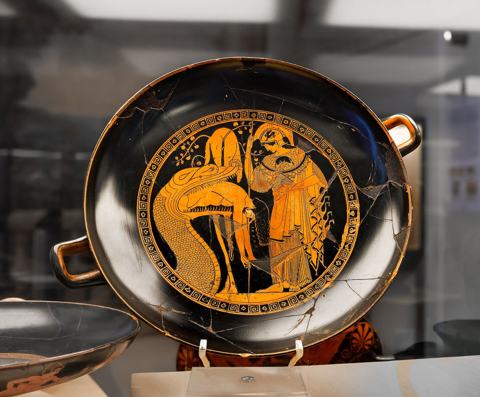
The pelt of a winged golden ram, hung in a grove sacred to Ares and guarded by a sleepless dragon, that Jason sailed to the edge of the world to steal.
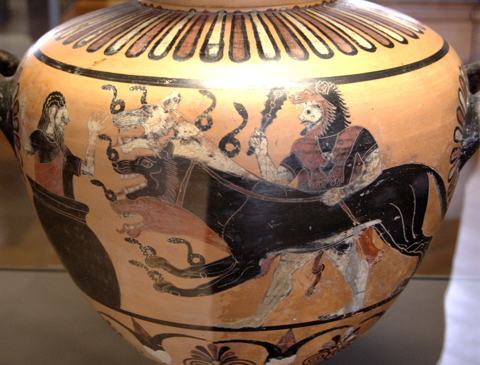
The many-headed hound who guards the gates of the underworld. He fawns on everyone who enters and devours anyone who tries to leave.
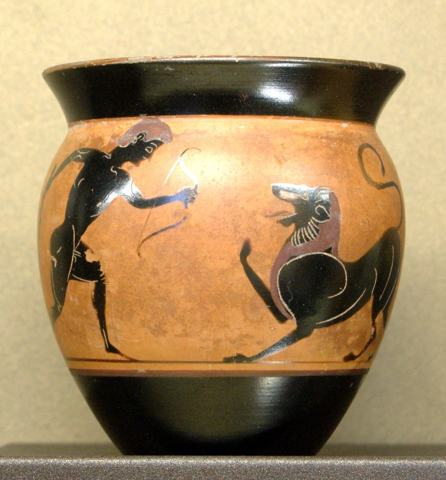
Zeus's mortal son, driven mad by Hera and set twelve impossible labours as penance - the strongest man in Greek myth, who died in agony and rose to Olympus.
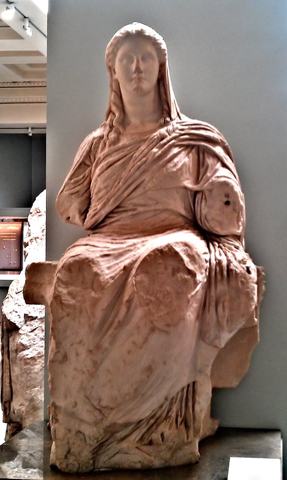
Goddess of grain and the mother who stopped the world's harvest to get her daughter back. Founder of the Eleusinian Mysteries.
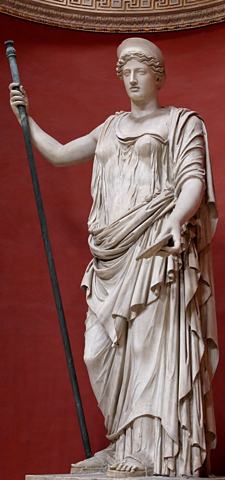
Queen of the gods. Zeus's sister, wife and most dangerous opponent — goddess of marriage in cult, and in Homer the one Olympian he is genuinely wary of.
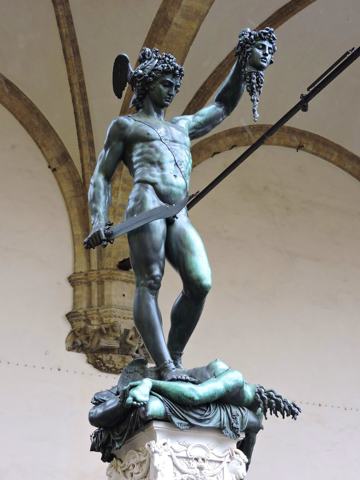
The hero who beheaded the Gorgon Medusa with borrowed weapons, rescued Andromeda from a sea-monster, and fulfilled the prophecy he spent his life escaping.
Sources & Further Reading
- 1.Hesiod, Theogony (c. 700 BCE), lines 313-318.
- 2.Apollodorus, Bibliotheca (1st-2nd century CE), 2.5.1-2.5.2.
- 3.Diodorus Siculus, Library of History (1st century BCE), 4.11.5-6.
- 4.Pausanias, Description of Greece (c. 150-180 CE), 2.37.4.
- 5.Ogden, Daniel. Drakon — Dragon Myth and Serpent Cult in the Greek and Roman Worlds. Oxford University Press, 2013.
- 6.Gantz, Timothy. Early Greek Myth — A Guide to Literary and Artistic Sources. Johns Hopkins University Press, 1993.
Spot an error or have a source to suggest? Write to info@viseterna.com. We cite primary sources and modern scholarship, and we correct fast.