
Juno
Queen of the gods — Rome's guardian of women, childbirth and the state, whose sacred geese warned the Capitol and whose temple gave us the word money.
Juno Sospita, Roman marble, 2nd c. AD (Vatican Museums); photo Carole Raddato, CC BY-SA 2.0 · CC BY-SA 2.0 · source
What the Romans Meant by Iuno
The Latin Iuno is probably built on the same root as iuvenis, "young," and carries a sense of vital force rather than of marriage or motherhood as such 7. That helps explain the sheer range of her cult titles, which do not obviously belong to a single personality: Lucina at childbirth, Regina on the Capitol, Moneta on the citadel, Curitis with the spear, Sospita in armour and a goatskin, Caprotina under a wild fig tree 5,7.
Roman religion did not require them to add up. Each Juno had her own temple, festival and priesthood, and Romans addressed the one whose competence fitted the occasion 8. Reading her as a single character with a biography is a Greek habit, not a Roman one.
The Capitoline Queen
Her highest public form is Juno Regina, worshipped in the great Capitoline temple alongside Jupiter Optimus Maximus and Minerva as the Capitoline Triad, the three deities at the constitutional centre of the Roman state 1,7.
Livy records how she got a second home in Rome, and it is one of the most revealing rituals in Roman religion. Besieging the Etruscan city of Veii in 396 BCE, the dictator Camillus performed an evocatio: he formally invited Veii's own Juno to abandon her city and accept a better cult at Rome 1. When the city fell, her image was carried to the Aventine and installed in a new temple. Romans did not think of this as looting a statue. They thought of it as the goddess changing sides, and of Roman victory as the proof 1,7.
The state consulted her in crises too. After the disasters of the Second Punic War the Senate ordered expiatory processions in which twenty-seven maidens sang a hymn to Juno Regina through the streets, a rite Livy describes in unusual detail because it was unusual 1,7.
Lucina, the Matronalia, and Women's Rites
The Juno most Romans dealt with personally was Juno Lucina, who brought children into the light. Her festival, the Matronalia on 1 March, belonged to married women: husbands gave gifts and prayers for their wives, and worshippers approaching the goddess were expected to wear nothing knotted or bound, since knots were thought to obstruct a birth 2,6. Ovid also assigns the Kalends of every month to Juno's care, which put her name on the Roman calendar twelve times a year 2.
There is a deeper layer here. Just as every Roman man was accompanied by his genius, every Roman woman had her own iuno — a personal life-spirit sharing the goddess's name and honoured on her birthday 7,8. Juno was, in that sense, less the patroness of women than the divine form of what a woman was.
The Nonae Caprotinae of 7 July was stranger still: a festival under a wild fig tree in which female slaves took a leading part, feasting and mock-fighting, which Plutarch reports as a memorial of a wartime stratagem in which slave women disguised as free matrons saved the city 6.
Moneta and the Geese
On the Arx, the northern summit of the Capitoline, stood the temple of Juno Moneta, vowed during the wars with the Aurunci in 345 BCE 1. Romans derived the name from monere, "to warn," and connected it to the most famous animal story in their history: when Gauls scaled the Capitol by night in 390 BCE, the geese kept sacred to Juno raised the alarm and the garrison drove the attackers off — while the watchdogs, who had slept, were ritually punished every year afterwards 1.
The temple later housed Rome's mint, which is why Latin moneta came to mean coinage, and why English has both "money" and "mint" from a goddess's warning 1,7.
Sospita of Lanuvium
Rome absorbed neighbouring Latin cults wholesale, and one of the most striking was Juno Sospita, "Juno the Saviour," of Lanuvium, whose worship became a Roman state obligation after 338 BCE 7. Cicero describes her costume with amusement: a goatskin cloak, a spear and shield, and shoes with upturned toes — an armoured, archaic figure quite unlike the matronly Juno of the poets 4.
Her sanctuary kept a sacred snake in a cave, fed by a girl chosen for the purpose. The Romans read the outcome as an annual verdict on the community: if the snake accepted the food, the year would be fertile 4,7. Consuls sacrificed at Lanuvium on entering office, and prodigies reported there were treated as state business 1,7.
Juno and the Greek Hera
Roman writers equated Juno with Hera, and once the equation was made, Greek stories about Zeus's jealous wife attached themselves to her without difficulty 3,4. Ovid and the mythographers give us the familiar catalogue of persecuted rivals, and Cicero, writing as a sceptic, treats such tales as the inventions of poets rather than anything a serious Roman should believe about the gods 4.
Virgil made the identification carry political weight. In the Aeneid Juno is the driving antagonist: she loves Carthage, hates the Trojans, and spends eleven books trying to prevent Rome from existing at all 3. The poem resolves this in a bargain rather than a defeat — she consents to the Trojan settlement on condition that the new people keep the Latin name, language and dress, and only then does she become Rome's protector 3.
That is the distinctively Roman note. The Greek Hera is a wife in a myth. The Roman Juno is a treaty partner: a power to be evoked, bargained with, satisfied, and kept on the city's side 3,7,8.
Continue Exploring
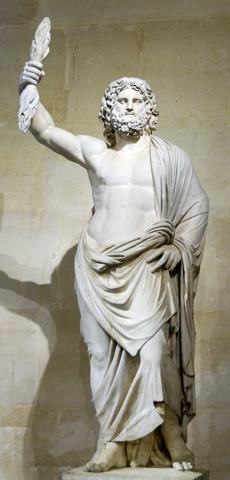
King of the gods and of the Roman state — lord of the bright sky, hurler of the lightning bolt, and the guarantor behind every oath and treaty.
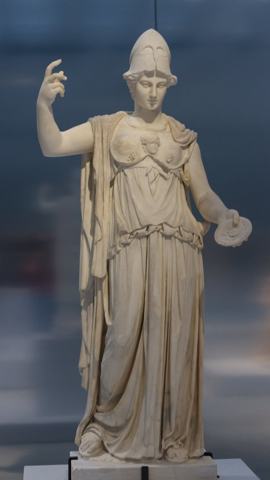
Goddess of wisdom and the crafts — third of the Capitoline Triad, and Rome's patron of every skilled trade from weaving and teaching to medicine.
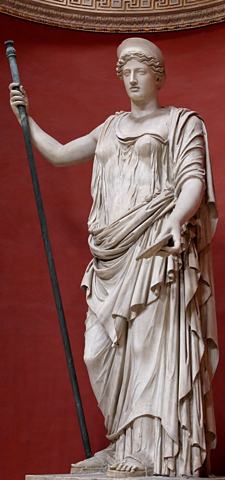
Queen of the gods. Zeus's sister, wife and most dangerous opponent — goddess of marriage in cult, and in Homer the one Olympian he is genuinely wary of.
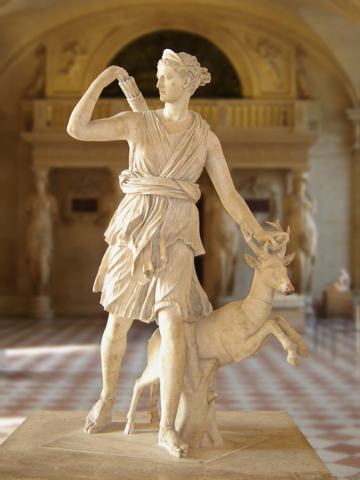
Roman goddess of the hunt, wild places and the moon, whose oldest sanctuary at Lake Nemi was guarded by a priest who held office by killing his predecessor.
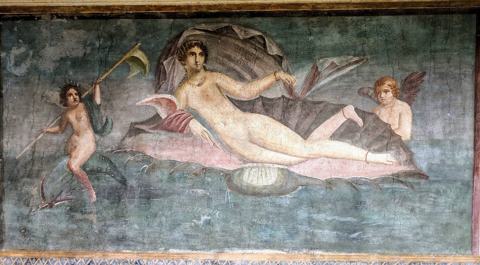
Goddess of love and desire — and the divine ancestress of Rome itself, mother of Aeneas and the claimed forebear of the family of Julius Caesar.

The two-faced Roman god of doors, beginnings and endings, named first in every prayer, whose gates in the Forum stood open only while Rome was at war.
Also mentioned inFortuna (Roman Goddess of Luck)
Sources & Further Reading
- 1.Livy, Ab Urbe Condita (c. 27 BCE) — esp. Books 5, 21–22, 27.
- 2.Ovid, Fasti (c. 8 CE).
- 3.Virgil, Aeneid (29–19 BCE).
- 4.Cicero, De Natura Deorum (45 BCE).
- 5.Varro, De Lingua Latina (1st century BCE).
- 6.Plutarch, Roman Questions (Moralia, 1st–2nd century CE).
- 7.Beard, Mary, John North & Simon Price. Religions of Rome, Volume 1: A History. Cambridge University Press, 1998.
- 8.Scheid, John. An Introduction to Roman Religion. Edinburgh University Press, 2003.
Spot an error or have a source to suggest? Write to info@viseterna.com. We cite primary sources and modern scholarship, and we correct fast.