
Heracles (Hercules)
Zeus's mortal son, driven mad by Hera and set twelve impossible labours as penance - the strongest man in Greek myth, who died in agony and rose to Olympus.
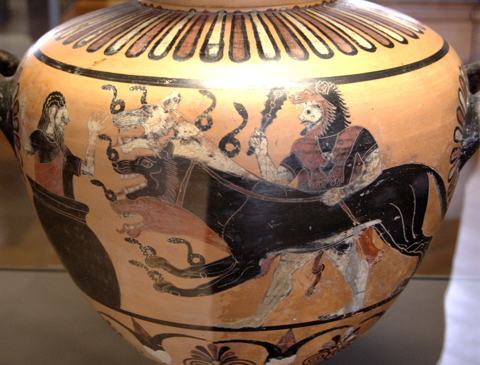
Herakles and the Nemean Lion, Attic black-figure vase, Musee du Louvre F167 · Public domain · source
Born Under a Curse
Heracles was born in Thebes to Alcmene, wife of the general Amphitryon, after Zeus visited her in her husband's shape on the same night Amphitryon himself returned from war, so that Alcmene bore twins by two fathers: Heracles by Zeus and Iphicles by Amphitryon 1. Even his name is an irony. It means something like "glory of Hera," the goddess who spent his whole life trying to destroy him, furious at Zeus's infidelity and at the child's existence 7. Pindar tells the first proof of what he would become: Hera sent two serpents into the infant's cradle, and the baby throttled one in each fist while his nurses screamed 4.
Hera's persecution did not stop at the crib. Apollodorus records the tradition that Heracles, married to Megara of Thebes and father to several children, was struck with a madness Hera sent, in which he killed his own sons, and in some accounts Megara as well, mistaking them for enemies 1. Euripides's tragedy Heracles stages the same horror in the opposite order, placing the slaughter after the labours rather than before it, as one more cruelty heaped on a man who has already suffered enough 3. Gantz reads the disagreement as evidence that the family tragedy and the labour-cycle were separate story elements that different authors spliced together in different orders, not chapters of one fixed biography 7.
Twelve Impossible Tasks
Whichever order caused it, the penance was the same: the Delphic oracle sent Heracles to serve his cousin Eurystheus, king of Tiryns and Mycenae, performing whatever labours Eurystheus set, and it was the oracle, in Apollodorus's account, that renamed him Heracles in place of his birth-name Alcides 1. Eurystheus, afraid of him and eager to see him fail, escalated the assignments past anything a mortal should survive: strangle the invulnerable Nemean lion and wear its hide; kill the many-headed, poison-blooded Hydra of Lerna and dip his arrows in its venom; capture alive the sacred Ceryneian hind and the ferocious Erymanthian boar; clean the vast, dung-choked stables of King Augeas in a single day by diverting two rivers through them; drive off the man-eating Stymphalian birds; capture the rampaging Cretan bull; tame the flesh-eating Mares of Diomedes; win the war-belt of the Amazon queen Hippolyta; herd home the cattle of the triple-bodied giant Geryon from the western edge of the world; steal the golden apples guarded in the garden of the Hesperides; and finally, hardest of all, bring the hound Cerberus up from the underworld using no weapon at all 1,6. Diodorus Siculus treats the sequence as a connected heroic biography rather than a list of separate folktales, and it is largely his ordering that later tradition settled on 6.
Beyond Eurystheus's Service
The labours were not the whole of his career. Fetching the apples of the Hesperides took him through the Caucasus, where, by Apollodorus's account, he shot the eagle that daily devoured the liver of the chained Prometheus and freed him, with Zeus's own consent 1. Earlier still he had sailed partway with Jason and the Argonauts on the hunt for the Golden Fleece before the expedition left him behind, searching the coast for his lost companion Hylas 1,6. He sacked Troy once, a generation before the war of the Iliad, after King Laomedon cheated him of a promised reward for rescuing the city's princess from a sea-monster 1,6. Pindar treats him less as a folktale figure than as the model of the athlete-hero, credited in tradition with founding the Olympic Games at Elis after a quarrel with Augeas over unpaid wages 4.
A Poisoned Robe
His death, like his birth, came from a woman's jealousy triggered by another's malice. Sophocles's Trachiniae tells it fullest: Heracles's second wife, Deianira, is given a supposed love-charm by the dying centaur Nessus, whom Heracles had shot for assaulting her. Nessus's blood, mixed with the Hydra's poison still on Heracles's arrow, is in fact a virulent poison, and Nessus takes his revenge from beyond death by tricking Deianira into believing otherwise 2. She soaks a robe in it and sends it to Heracles as a gift meant to renew his love; the poison fuses to his skin, and he cannot tear the burning cloth free without tearing his own flesh with it 2. Realising what has happened, he has himself carried to a pyre on Mount Oeta and asks to be burned alive rather than endure the pain, a request none of his companions will grant until, in most versions, the hero Poeas, father of Philoctetes, finally lights it 1,2.
Fire into Godhead
What happens next separates Heracles from every other Greek hero: he does not simply die. Hesiod's Theogony records that once the fire had burned away his mortal portion, inherited from Alcmene, what remained of him ascended to Olympus, where the gods reconciled him with Hera and gave him Hebe, goddess of youth, as a bride 5. Galinsky traces how ancient religion made room for the paradox by worshipping him with two different kinds of ritual at once: as a hero, owed the graveside offerings due the dead, and as a god, owed the burnt sacrifices due Olympus, a double cult status almost unique to him in Greek practice 8.
The Strongman's Afterlife
The Romans took him over wholesale as Hercules, and the name outlasted the religion. His club and lion-skin became the most recognisable costume in classical art, his name marks the Strait of Gibraltar as the Pillars of Hercules, and the philosophical fable of "Hercules at the Crossroads," choosing the hard road of Virtue over the easy road of Vice, made him a moral exemplar for centuries after anyone still sacrificed to him 8. Galinsky's study follows the theme from Homer's passing references through Renaissance painting and beyond, and finds the same core underneath every era's version: a hero whose strength is inseparable from suffering, and whose suffering is, uniquely, rewarded 8.
Continue Exploring
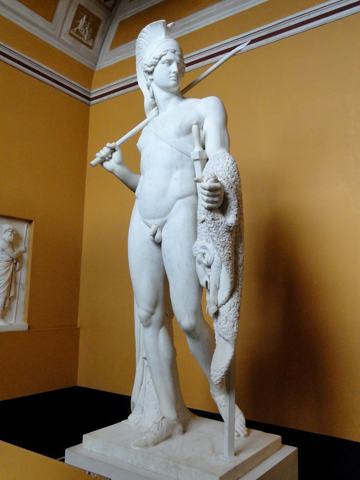
Jason and his crew of heroes sailed the Argo to the edge of the world for the Golden Fleece, and paid for it with a debt to the sorceress who made it possible.
The many-headed hound who guards the gates of the underworld. He fawns on everyone who enters and devours anyone who tries to leave.
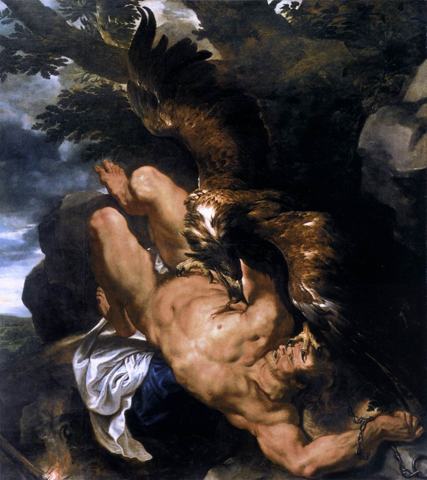
The Titan who tricked Zeus, stole fire for humanity, and paid with an eagle sent daily to eat his regenerating liver - freed, in the end, by Heracles.
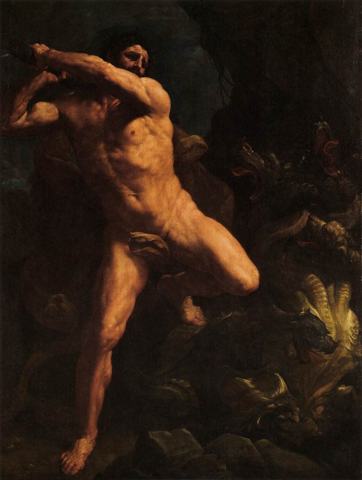
The regenerating, poison-blooded serpent of the Lernaean swamp that Heracles killed with fire in his second labor — and that ancient writers already doubted.
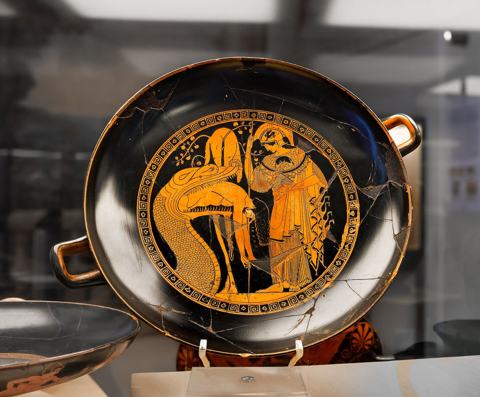
The pelt of a winged golden ram, hung in a grove sacred to Ares and guarded by a sleepless dragon, that Jason sailed to the edge of the world to steal.
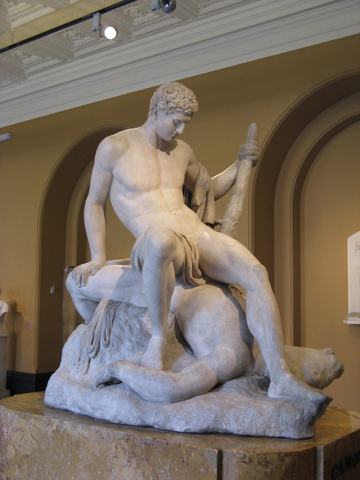
Athens's founding hero - slayer of the Minotaur, unifier of Attica, and the man whose forgotten sail cost his own father's life.
Also mentioned inPerseus
Sources & Further Reading
- 1.Apollodorus, Bibliotheca (Library), 2.4-2.7 and Epitome 2.1-7 (1st-2nd century CE).
- 2.Sophocles, Trachiniae (Women of Trachis) (5th century BCE).
- 3.Euripides, Heracles (5th century BCE, c. 416 BCE).
- 4.Pindar, Nemean 1, Isthmian 4, and Olympian 10 (5th century BCE).
- 5.Hesiod, Theogony, lines 950-955 (c. 700 BCE).
- 6.Diodorus Siculus, Bibliotheca Historica, Book 4 (1st century BCE).
- 7.Gantz, Timothy. Early Greek Myth: A Guide to Literary and Artistic Sources. Johns Hopkins University Press, 1993.
- 8.Galinsky, G. Karl. The Herakles Theme: The Adaptations of the Hero in Literature from Homer to the Twentieth Century. Basil Blackwell, 1972.
Spot an error or have a source to suggest? Write to info@viseterna.com. We cite primary sources and modern scholarship, and we correct fast.