
Etemenanki (the Ziggurat of Babylon)
Babylon's great stepped temple tower to Marduk, rebuilt by Nebuchadnezzar II, ruined to a flooded pit, and read for centuries as the Tower of Babel.
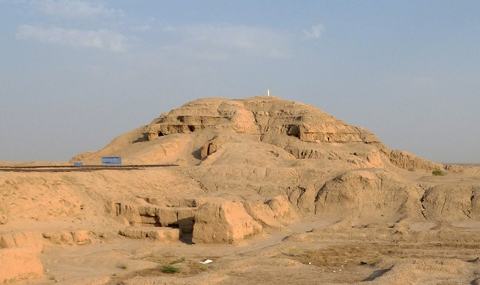
Remains of the foundations of the Etemenanki ziggurat (photograph by Marjon Verburg, 2012) · CC0 · source
A Name and a Claim
Etemenanki is Sumerian for "temple of the foundation of heaven and earth," and the name is itself a piece of theology: this stepped brick tower in the heart of Babylon was built to be the point where the divine and human worlds physically met 2,6. It stood inside the sacred precinct beside Esagila, the temple of Marduk, Babylon's patron god, and cuneiform building accounts treat ziggurat and temple as a single religious complex rather than two separate monuments 2,5. No single king built it from nothing; George's study of the cuneiform building texts argues the tower as later generations knew it took shape gradually over centuries, destroyed and rebuilt more than once, so that "the" Etemenanki is really a sequence of Etemenankis on the same footprint 5.
What the Esagila Tablet Says
The most detailed ancient description is not a myth but an engineer's memorandum. The Esagila Tablet, a cuneiform text copied in 229 BCE and now in the Louvre, gives the ground plan of the Esagila-Etemenanki complex and states the tower's footprint and height in cubits, describing a base roughly 91 meters on a side rising in receding stages to a similar total height 2. Modern engineers who have tried to translate those figures into a physical building have balked: a mudbrick core of that height, faced only with a shell of fired brick, would have been under enormous structural strain, and reconstructions since Koldewey's own have argued for a shorter, broader tower than a literal reading of the tablet implies 4,6. The disagreement matters because the tablet is effectively the only technical source for a building that no longer exists in any recoverable form above its footings 2,6.
Destroyed and Rebuilt, More Than Once
Documented history for the tower begins with destruction: the Assyrian king Sennacherib sacked Babylon in 689 BCE and, by his own inscriptions, tore down its temples in reprisal for repeated rebellion 5. Restoration began under the Assyrian vassal-king Esarhaddon and continued under the Babylonian king Nabopolassar, but it was Nabopolassar's son Nebuchadnezzar II who completed the version of Etemenanki most often described in later sources, work he commemorated on inscribed clay cylinders buried in the structure's foundations as a record for future kings and gods alike 5,6. That cycle of ruin and rebuilding is precisely why no single "original" ziggurat can be pointed to: every phase overwrote the last, and Koldewey's excavation found only Nebuchadnezzar's final foundation intact enough to plan 4,5.
Herodotus, and What He Probably Never Saw
Writing a little over a century after Nebuchadnezzar, the Greek historian Herodotus describes a Babylonian tower of eight stacked stages reached by an external spiral ramp, with a shrine at the summit tended, he says, by a single woman chosen by the god and containing no cult image 3. His account is the most vivid ancient description of the tower in action, but scholars treat it cautiously: nothing confirms Herodotus visited Babylon in person rather than relying on informants, and his numbers do not square easily with the Esagila Tablet's 3,6. Seymour's survey of Babylon's reception treats Herodotus less as an eyewitness report than as the first in a long line of outsiders describing the tower through the expectations they brought with them, a pattern that continues into the modern era 7.
The Tower of Babel
The book of Genesis describes the people of "Shinar" building a city and "a tower with its top in the heavens," an act of united human ambition that God answers by scattering the builders and confusing their language, an episode traditionally called the Tower of Babel 1. Babylon's own name in Akkadian, Bab-ili, "gate of the god," and Etemenanki's height and religious claim to bridge heaven and earth make it the leading candidate behind the story's imagery, though the biblical text names no specific structure and was almost certainly composed centuries after Etemenanki's Neo-Babylonian rebuilding, drawing on Babylon's general reputation for imposing temple towers rather than on direct knowledge of any one of them 1,5,7. It is best treated as legend shaped by a real monument's fame rather than as a record of that monument's construction.
What Is Left
Alexander the Great, occupying Babylon in the 320s BCE, is said to have ordered the ruined tower cleared for rebuilding; ancient sources report his workforce spent months hauling away rubble before his death ended the project, and it was never restored 5,6. What Koldewey's team found in 1913 and later seasons was a rectangular pit some ninety meters on a side, its mudbrick core largely quarried away by later builders scavenging fired brick, and that pit, now waterlogged and ringed by palm trees near modern Hillah, is essentially all that remains on the ground today 4,6. Everything taller than a foundation trench survives only in cuneiform description and in the imagination the Genesis story gave it.
Continue Exploring
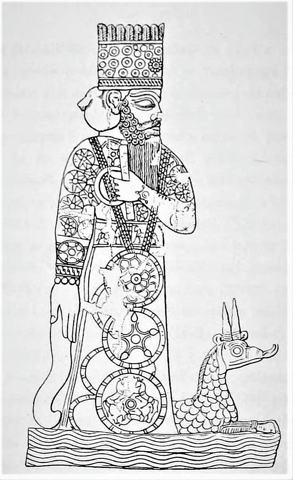
Champion of the gods — Babylon's patron, who killed the sea-dragon Tiamat, built heaven and earth out of her body, and was crowned king over all the gods.
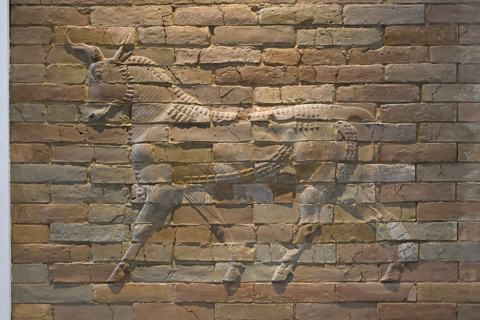
Nebuchadnezzar II's glazed-brick gate to Ishtar, dug out of a Babylonian ruin mound and rebuilt whole in Berlin's Pergamon Museum.
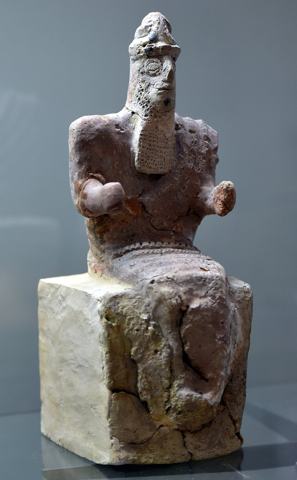
Lord of the moving air — the Sumerian executive of the gods, whose word carried out destinies, who split heaven from earth and sent the Flood.
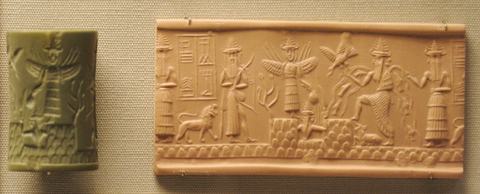
God of wisdom and the sweet water under the ground — the craftsman-trickster who made humankind, taught the crafts, and warned one man about the Flood.
Father of the gods — the Mesopotamian sky, whose written sign meant "god" itself; the source of all authority, and almost never the one who uses it.
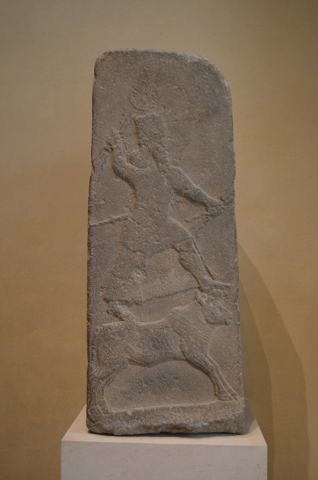
The Mesopotamian storm god who could drown the land in flood or bless it with rain, worshipped as Ishkur in Sumer and Adad across Babylonia and Assyria.
Sources & Further Reading
- 1.Genesis 11:1-9 (Hebrew Bible).
- 2.The Esagila Tablet (Seleucid era, 229 BCE; Louvre AO 6555).
- 3.Herodotus, Histories 1.181-183 (5th century BCE).
- 4.Koldewey, Robert. The Excavations at Babylon. Translated by Agnes S. Johns. Macmillan and Co., 1914.
- 5.George, Andrew R. "The Tower of Babel: Archaeology, History and Cuneiform Texts." Archiv fur Orientforschung 51 (2005/2006), 75-95.
- 6.Schmid, Hans-Jorg. Der Tempelturm Etemenanki in Babylon. Philipp von Zabern, 1995.
- 7.Seymour, Michael. Babylon: Legend, History and the Ancient City. I.B. Tauris, 2014.
Spot an error or have a source to suggest? Write to info@viseterna.com. We cite primary sources and modern scholarship, and we correct fast.