
Enuma Elish
The Babylonian creation epic — seven tablets recited each New Year, telling how Marduk defeated Tiamat and became king of the gods.
Enuma Elish tablet fragment, Kish, Neo-Assyrian period, c. 700 BCE (Ashmolean Museum, AN1926.373) · CC BY-SA 4.0 · source
"When on High" — Text and Shape
Enuma Elish — "When on high," the poem's opening words — is the Babylonian epic of creation: roughly a thousand lines of Akkadian verse across seven clay tablets, each originally holding somewhere between about 115 and 170 lines 1. It tells how the universe began from two mingled waters, how the younger gods came to fight their own ancestress, and how the god Marduk of Babylon ended that war and organized the cosmos as his reward 1,4. Tablet V is by far the poem's worst-preserved section, and even the reconstructed text still leans on parallels drawn from elsewhere in the poem to fill its gaps 3.
Found in a King's Library, Read by Accident
The poem survives at all because the Assyrian king Ashurbanipal assembled a library of cuneiform tablets at Nineveh in the seventh century BCE, and copies of Enuma Elish were among the tens of thousands of texts buried there when the city fell in 612 BCE 1,3. British excavators recovered the ruins in the 1850s, and the self-taught Assyriologist George Smith began publishing translations of the Assyrian creation fragments in the 1870s, presenting the material to a startled Victorian public under the title The Chaldean Account of Genesis 2. Reconstruction has continued in slow stages ever since, as further fragments from Assur, Babylon, and Kish have been matched to the recension line by line 3,7.
A Late, Deliberate Argument
For much of the twentieth century, the poem was treated as archaic, roughly contemporary with Hammurabi's Babylon in the eighteenth century BCE. Wilfred Lambert's philological study reopened the question and argued for a far later date: the poem's elevation of Marduk to supreme kingship fits best with the twelfth century BCE, after King Nebuchadnezzar I recovered Marduk's captured cult statue from Elam and Babylonian theology needed a text that made his supremacy look inevitable 3. On this reading Enuma Elish is not a naive cosmogony but a work of applied politics, composed to argue a specific and fairly recent claim 3,4.
What Happens, Briefly
The story opens before names exist, when the fresh water Apsu and the salt water Tiamat mingle and produce the first gods 1. Their noisy descendants provoke Apsu to plan their destruction; Enki kills him first, and Marduk is born on the site of his corpse 1. Provocation and grief turn Tiamat hostile in her own turn: she raises an army of monsters, gives command to her consort Qingu, and fastens the Tablet of Destinies to his chest, the document that fixes the fates of gods and things 1,7. Marduk accepts the gods' call to fight her only on the condition that his word outrank theirs forever; he kills her, splits her body into sky and earth, and is crowned afterward with fifty names that absorb the powers of the older pantheon into himself 1,3.
Not Genesis's Ancestor
Tiamat's name shares a Semitic root with Hebrew tehom, the watery "deep" of Genesis 1, and the resemblance was noticed as soon as the poem became known to Western scholars 2,4. Lambert warned against treating Enuma Elish as the literary parent of the biblical account: both draw on a much older and wider Near Eastern stock of language for the primeval waters, and dating the Babylonian poem itself to the twelfth century BCE makes a direct line of descent chronologically awkward in any case 3. The poem remains the fullest surviving example of the Chaoskampf pattern, a storm god's combat with the sea, that recurs from Ugarit's Baal and Yamm to the later Leviathan, but exactly how these tellings relate to one another is still debated rather than settled 3,4.
Recited Aloud at the New Year
The poem's fullest documented use was liturgical, not literary. A Seleucid-period ritual tablet for Babylon's Akitu, the spring new year festival, directs that Enuma Elish be recited in full before Marduk's statue on the fourth day of the rite, read aloud by the high priest with no one else present in the sanctuary 1,7. Reciting the poem at the year's turn re-performed the founding of cosmic and royal order every time it was renewed, which is a strong argument for treating the text as working temple liturgy rather than as a private literary composition meant only to be read 7.
Editions Since Smith
Modern access to the poem runs through a handful of standard editions. Lambert's critical text superseded the earlier partial editions and remains the reference edition; Talon produced a parallel Akkadian-and-translation edition aimed at students of Assyrian scribal culture; and Dalley's and Foster's English translations, aimed at classroom and general readers respectively, are the versions most often quoted outside specialist Assyriology 3,4,5,6. None of them claims the text is complete. New joins to Tablet V in particular remain, in Lambert's own phrase, a standing invitation to whatever fragment turns up next 3.
Continue Exploring
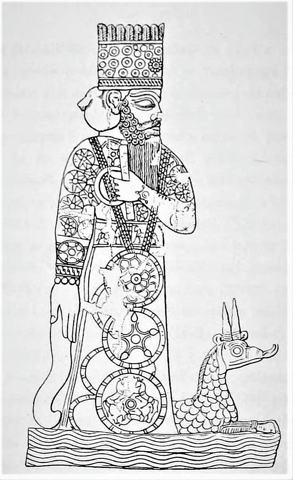
Champion of the gods — Babylon's patron, who killed the sea-dragon Tiamat, built heaven and earth out of her body, and was crowned king over all the gods.
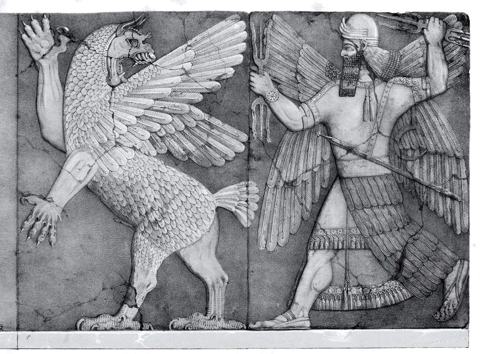
The primordial salt sea — the first mother of the gods, who turned on her children and whose split body became the sky and the earth above us.
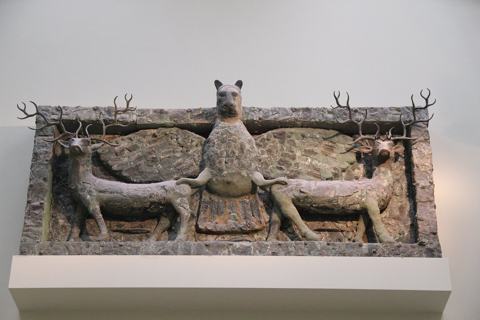
The cuneiform tablet that fixes the fates of gods and things — fought over by Marduk and Tiamat, stolen by the bird-demon Anzu, always worth a war.
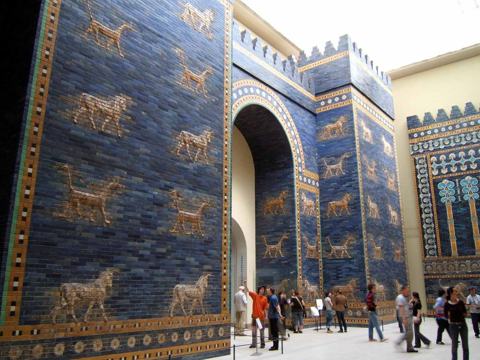
Babylon's spring festival, when Enuma Elish was recited, the king was ritually slapped, and a claimant to the throne had to take the hand of Bel.
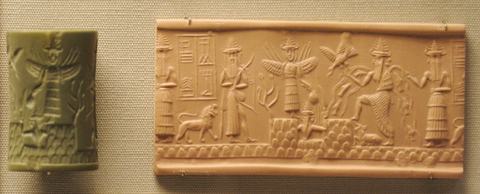
God of wisdom and the sweet water under the ground — the craftsman-trickster who made humankind, taught the crafts, and warned one man about the Flood.
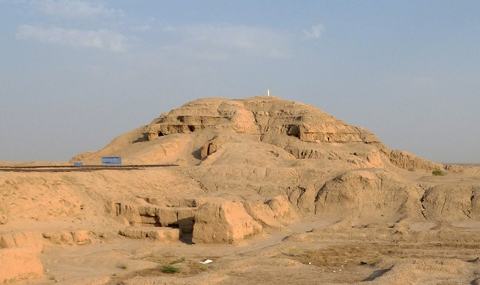
Father of the gods — the Mesopotamian sky, whose written sign meant "god" itself; the source of all authority, and almost never the one who uses it.
Sources & Further Reading
- 1.Enuma Elish (the Babylonian Epic of Creation), Standard Babylonian recension, Tablets I-VII.
- 2.George Smith. The Chaldean Account of Genesis. Sampson Low, Marston, Searle & Rivington, 1876.
- 3.Lambert, Wilfred G. Babylonian Creation Myths. Mesopotamian Civilizations 16. Eisenbrauns, 2013.
- 4.Dalley, Stephanie. Myths from Mesopotamia: Creation, the Flood, Gilgamesh and Others. Rev. ed., Oxford University Press, 2000.
- 5.Talon, Philippe. The Standard Babylonian Creation Myth: Enuma Elish. State Archives of Assyria Cuneiform Texts IV. Neo-Assyrian Text Corpus Project, 2005.
- 6.Foster, Benjamin R. Before the Muses: An Anthology of Akkadian Literature. 3rd ed., CDL Press, 2005.
- 7.Black, Jeremy & Anthony Green. Gods, Demons and Symbols of Ancient Mesopotamia: An Illustrated Dictionary. British Museum Press, 1992.
Spot an error or have a source to suggest? Write to info@viseterna.com. We cite primary sources and modern scholarship, and we correct fast.