
Akitu
Babylon's spring festival, when Enuma Elish was recited, the king was ritually slapped, and a claimant to the throne had to take the hand of Bel.
Reconstructed Ishtar Gate, Pergamon Museum, Berlin, from the gate built under Nebuchadnezzar II · CC BY 2.0 · source
Twelve Days at the Year's Turn
The Akitu is Mesopotamia's New Year festival, and the version best documented today is the twelve-day rite held at Babylon in the month of Nisannu, around the spring equinox, centered on the god Marduk and his temple Esagila 1,4. Its roots run much deeper than any surviving description: Sumerian cities were already holding a seasonal akiti festival in the third millennium BCE, and Ur's own version is attested centuries before Babylon's rite took the shape the sources describe 3,4. The single fullest account is, ironically, very late: a ritual instruction tablet copied in the Seleucid period, centuries after Alexander, describing a ceremony its own scribes clearly understood as ancient tradition rather than recent invention 1,3.
What the Ritual Tablet Prescribes
The Seleucid ritual text lays out the first several days in detail: purification of the sanctuary, prayers before dawn, and on the fourth day, the high priest reciting Enuma Elish in its entirety before Marduk's statue with no one else in the room 1,2. The following day brings the festival's strangest surviving episode: the king is brought before the god's statue, stripped of his crown, scepter, and mace, and struck across the face by the high priest; if his eyes fill with tears it is read as a favorable sign, and he then makes a formal declaration of innocence, that he has not neglected the god or oppressed the city, before his regalia is restored to him 1,4,5.
Taking the Hand of Bel
The festival's deepest political function is bound up in a single ritual phrase: shabat qat Bel, "taking the hand of Bel," Bel, "Lord," being Marduk's everyday title 6. A king had to physically take the hand of Marduk's cult statue at the Akitu to be recognized as Babylon's legitimate ruler, and Assyrian and later Persian kings who wanted authority over Babylon specifically, rather than merely military control of it, made a point of performing the rite; Cyrus the Great's own inscriptions boast of restoring proper Akitu observance after he took the city in 539 BCE 4,6. Jeremy Black's study of the phrase treats it as the ceremony's real center of gravity, with the rest of the theology and drama existing to stage this one moment of physical, public legitimation 6.
Gods on the Road
Later days of the festival brought other city gods to Babylon as honored guests, their cult statues transported in from Borsippa, Kish, and elsewhere to attend Marduk's court, before a grand procession carried his own statue out of the city along the Processional Way and through the great Ishtar Gate, built under Nebuchadnezzar II, to a separate festival house, the bit akitu, outside the walls 1,3. Some of the same ritual tablet's badly damaged final sections have been read as describing a sacred-marriage rite renewing the land's fertility, though how literally that element was performed, if at all, is a point on which Assyriologists still disagree 3,4.
Not Only Babylon's Festival
Babylon's version is the best documented, but it was never the only one. Sennacherib built a dedicated Akitu house outside the city of Assur in 683 BCE for his own city's rite, honoring the god Ashur rather than Marduk, and other akitu houses are attested at Nineveh and Uruk 4,7. The festival's reputation traveled further than its cult did: the Roman emperor Elagabalus, whose religious tastes ran toward the exotic, is said to have staged a version of the akitu procession in Italy in the early third century CE, centuries after Babylon's own temples had gone quiet 4.
Silence, Then Revival
Exactly when the ancient Akitu stopped being celebrated at Babylon is not precisely fixed in the sources; the last clear textual evidence comes from the Seleucid and early Parthian periods, in the last centuries BCE, after which Babylon's temple establishment gradually lost the resources to sustain a festival of this scale 3,4. The name did not disappear, however. Beginning in the 1960s, as part of a broader Assyrian cultural and national revival among Assyrian and Chaldean communities in Iraq and the diaspora, "Akitu" was readopted as the name for a spring new year celebration, now marked every April 1 with parades and traditional dress 4. It is a modern civic and ethnic commemoration rather than a continuation of the ancient temple cult; no statue is taken from a temple, and no king is struck across the face, and the distinction between the two is worth keeping clear even as the modern festival draws its name and its date directly from the one the cuneiform tablets describe 3,4.
Continue Exploring
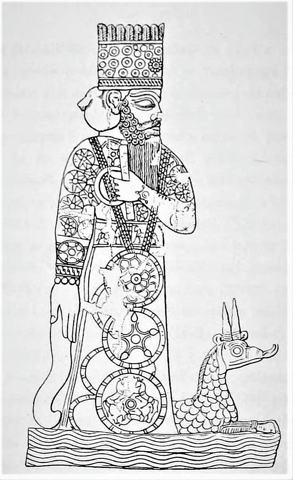
Champion of the gods — Babylon's patron, who killed the sea-dragon Tiamat, built heaven and earth out of her body, and was crowned king over all the gods.
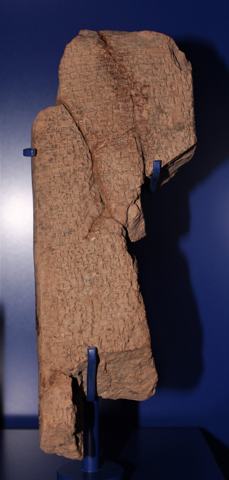
The Babylonian creation epic — seven tablets recited each New Year, telling how Marduk defeated Tiamat and became king of the gods.
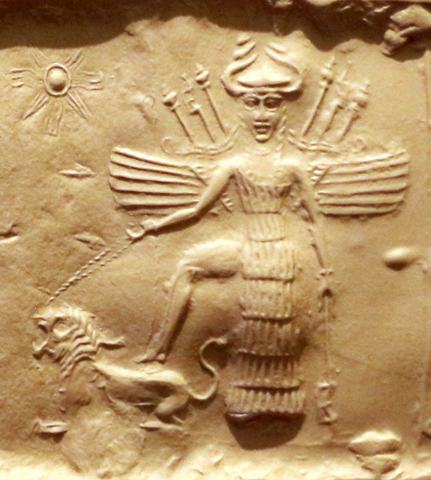
Queen of Heaven — Sumerian goddess of love, war, and the planet Venus, who walked into the land of the dead and was the only one to walk back out.
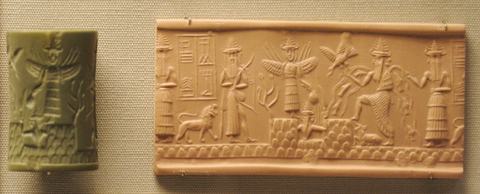
God of wisdom and the sweet water under the ground — the craftsman-trickster who made humankind, taught the crafts, and warned one man about the Flood.
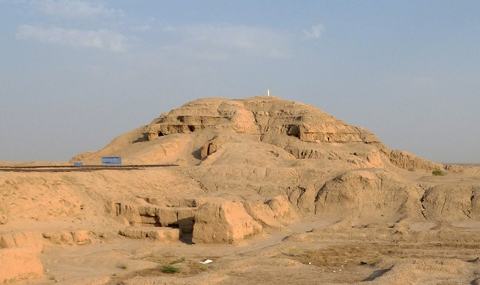
Father of the gods — the Mesopotamian sky, whose written sign meant "god" itself; the source of all authority, and almost never the one who uses it.
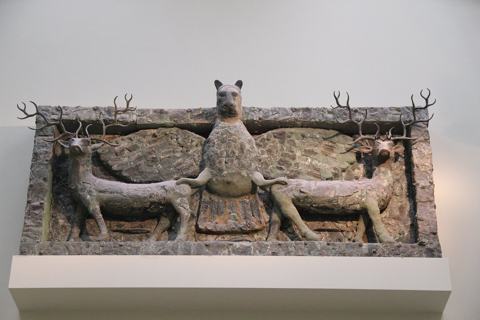
The cuneiform tablet that fixes the fates of gods and things — fought over by Marduk and Tiamat, stolen by the bird-demon Anzu, always worth a war.
Sources & Further Reading
- 1.The Babylonian Akitu Ritual, Seleucid-period tablet, ed. Francois Thureau-Dangin, Rituels Accadiens. Paris, 1921.
- 2.Enuma Elish (the Babylonian Epic of Creation), Standard Babylonian recension.
- 3.Pallis, Svend A. The Babylonian Akitu Festival. Det Kgl. Danske Videnskabernes Selskab, 1926.
- 4.Bidmead, Julye. The Akitu Festival: Religious Continuity and Royal Legitimation in Mesopotamia. Gorgias Press, 2004.
- 5.Sachs, Abraham. 'Akkadian Rituals,' in Ancient Near Eastern Texts Relating to the Old Testament, 3rd ed., ed. James B. Pritchard. Princeton University Press, 1969.
- 6.Black, Jeremy A. 'The New Year Ceremonies in Ancient Babylon: "Taking Bel by the Hand" and a Cultic Picnic.' Religion 11 (1981), 39-59.
- 7.Black, Jeremy & Anthony Green. Gods, Demons and Symbols of Ancient Mesopotamia: An Illustrated Dictionary. British Museum Press, 1992.
Spot an error or have a source to suggest? Write to info@viseterna.com. We cite primary sources and modern scholarship, and we correct fast.