
Tiamat
The primordial salt sea — the first mother of the gods, who turned on her children and whose split body became the sky and the earth above us.
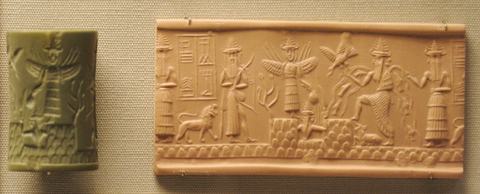
'Chaos Monster and Sun God', Assyrian cylinder seal impression, Nimrud, 9th-8th century BCE · Public domain · source
Salt Water and Sweet
Enuma Elish begins before names exist. There is Apsu, the sweet water, and Tiamat, the salt water, and their waters mingle as one body; from that mingling the first gods are born 1. The Akkadian word tiamtu or tâmtu simply means "sea," and Tiamat is the sea personified — not a monster at the outset but the primordial female principle, the mother of everything divine 6.
Her name belongs to a Semitic root shared with Hebrew tehom, the "deep" over which darkness lies in the opening of Genesis, and the resemblance has been discussed for well over a century 3,6. Lambert cautioned against reading the Babylonian poem straight into the biblical text, and argued that Enuma Elish is a late, deliberately composed work of Babylonian theology rather than the ancestral form of Near Eastern cosmogony 3.
The Killing of Apsu
The trouble starts with noise. The young gods are boisterous, and Apsu, unable to rest, proposes to destroy them; Tiamat objects and asks how they can bear to wipe out what they themselves created 1. Apsu proceeds anyway, is put to sleep by a spell of Enki/Ea, and is killed, with his vizier Mummu bound and led away by a nose-rope 1. Ea then builds his own dwelling on top of the dead Apsu and there fathers Marduk 1.
Only afterwards, urged on by gods who accuse her of having done nothing while her consort was murdered, does Tiamat turn hostile 1. Her transformation is caused, in the poem's own telling, by an act of violence and by the goading of her children — a detail the story does not hide 1,5.
The Eleven and the Tablet of Destinies
Tiamat's answer is to give birth to an army: the horned serpent, the mushhushshu, the lahmu, the great lion, the mad dog, the scorpion man, the fish man, the bull man, and the rest — eleven kinds of creature, filled with venom instead of blood and given a terror that makes them like gods 1. She raises Qingu to be her consort and commander, and fastens the Tablet of Destinies to his chest, transferring the authority to fix fates 1.
That transfer, not the monsters, is what makes the crisis absolute. Whoever holds the Tablet decides what will happen, so the war is fought over the constitutional order of the universe rather than over territory 1,3. It is also why the young gods' price for a champion is that Marduk's decree should henceforth outrank theirs 1.
The Duel
Ea and Anu both go out to face her and turn back; Marduk goes armed 1. His equipment is meteorological: bow and arrow, mace, lightning, a flame around his body, and a net held open at the four corners by the winds his grandfather Anu gave him, plus seven storm-winds he creates himself, including the Imhullu, the Evil Wind 1.
The kill is precise. He casts the net around her, and when she opens her mouth to swallow him, he drives the Evil Wind in so that her jaws cannot close and her belly distends; then he shoots the arrow that splits her heart 1. Jacobsen read the whole sequence as the imagery of a specific natural event — the spring storm driving the flood water of the marshy south back and dispersing it — a reading that treats the duel as weather made into theology 4.
The World Made From a Body
Marduk splits the corpse in two "like a drying fish." One half he raises to make the sky, bolts it in place, and posts a guard to keep her waters from leaking out 1. Her breasts become the mountains; her spittle becomes cloud, rain, and mist; and the Tigris and Euphrates are set flowing from her eyes 1. Her tail becomes the cosmic bond, her crotch the support of the sky 1.
The passage is the reason Tiamat matters beyond her own story. The Babylonian universe is not made from nothing and not made from raw material; it is made from a dismembered opponent, and the sky is permanently something that was once alive and had to be pinned down 1,5.
Was She a Dragon?
Modern illustration almost always gives Tiamat the shape of a five-headed dragon, and that image is much later than the text. Enuma Elish is ambiguous about her body: it mentions her tail, her belly, her udder, her mouth, and her lips, but never describes her wholesale as a serpent or dragon, and Lambert argued that the poem does not in fact make her one 3. Her offspring are monsters; she is the sea 3,6.
Some later evidence points the other way. Berossus, writing in Greek for a Hellenistic readership, renders the primordial female as Omorka or Thalatth ("Sea") and describes a realm of composite beasts, and it is largely through his summary that the "monstrous mother" version reached later Mediterranean writers 2,3. Assyrian art shows gods fighting horned serpents and lion-dragons, but identifying any given combat scene as Marduk versus Tiamat is guesswork rather than caption-reading 6.
Afterlives
The motif of a storm god defeating a sea or serpent — the pattern comparative scholarship labels Chaoskampf — recurs widely in the ancient Near East, from Baal against Yamm at Ugarit to the biblical Leviathan and Rahab, and the Babylonian poem is its most fully preserved example 3,5. Whether these are branches of one myth or independent expressions of the same anxiety about the sea is a genuinely open question, and Lambert's warning against tidy genealogies still applies 3.
What survives most vigorously is the name. Tiamat as a many-headed chromatic dragon queen is an invention of twentieth-century fantasy gaming, not of Babylon — a useful reminder that the version of a myth people recognise is often several rewrites downstream of the tablet 3,6.
Continue Exploring
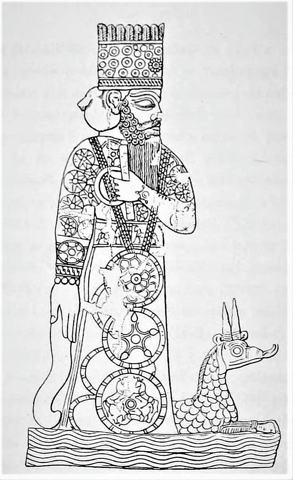
Champion of the gods — Babylon's patron, who killed the sea-dragon Tiamat, built heaven and earth out of her body, and was crowned king over all the gods.
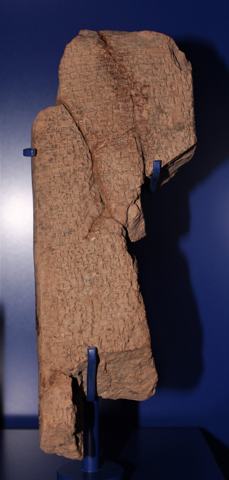
The Babylonian creation epic — seven tablets recited each New Year, telling how Marduk defeated Tiamat and became king of the gods.
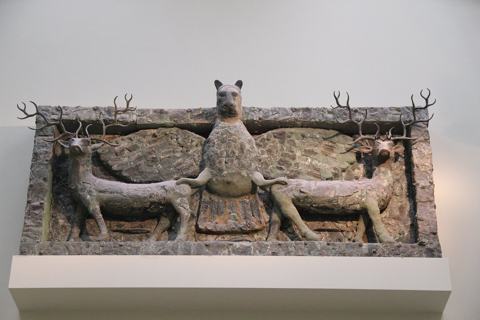
The cuneiform tablet that fixes the fates of gods and things — fought over by Marduk and Tiamat, stolen by the bird-demon Anzu, always worth a war.
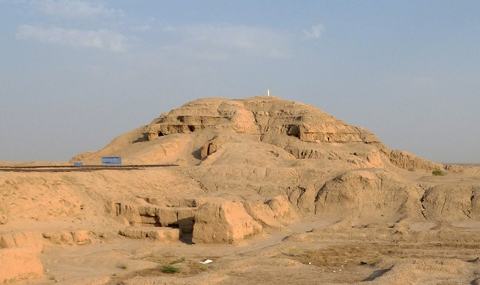
Father of the gods — the Mesopotamian sky, whose written sign meant "god" itself; the source of all authority, and almost never the one who uses it.
God of wisdom and the sweet water under the ground — the craftsman-trickster who made humankind, taught the crafts, and warned one man about the Flood.
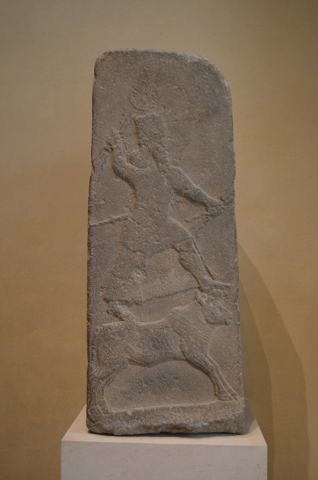
The Mesopotamian storm god who could drown the land in flood or bless it with rain, worshipped as Ishkur in Sumer and Adad across Babylonia and Assyria.
Also mentioned inMushussu (the Dragon of Marduk)
Sources & Further Reading
- 1.Enuma Elish (the Babylonian Epic of Creation), Standard Babylonian recension, Tablets I–V.
- 2.Berossus, Babyloniaca (c. 290 BCE), surviving in quotations by Alexander Polyhistor, Eusebius and Syncellus.
- 3.Lambert, Wilfred G. Babylonian Creation Myths. Mesopotamian Civilizations 16. Eisenbrauns, 2013.
- 4.Jacobsen, Thorkild. 'The Battle between Marduk and Tiamat.' Journal of the American Oriental Society 88.1 (1968), 104–108.
- 5.Dalley, Stephanie. Myths from Mesopotamia. Oxford University Press, revised edition 2000.
- 6.Black, Jeremy & Anthony Green. Gods, Demons and Symbols of Ancient Mesopotamia: An Illustrated Dictionary. British Museum Press, 1992.
Spot an error or have a source to suggest? Write to info@viseterna.com. We cite primary sources and modern scholarship, and we correct fast.