
The Ishtar Gate
Nebuchadnezzar II's glazed-brick gate to Ishtar, dug out of a Babylonian ruin mound and rebuilt whole in Berlin's Pergamon Museum.
Pergamon Museum Ishtar Gate from Babylon, first phase, detail (photograph by Dosseman, 2021) · CC BY-SA 4.0 · source
The Eighth Gate
Babylon's inner city wall was pierced by eight monumental gateways, each named for a god, and the grandest of them belonged to Ishtar, the Akkadian Queen of Heaven. An inscription of Nebuchadnezzar II, king of Babylon 605-562 BCE, records that he tore down a smaller predecessor gate and raised the structure known today in its place, dedicating it to the goddess by name and describing the gate and the processional street beyond it in the same breath as acts of devotion owed to her 1. The gate sat at the north end of the city, where the Processional Way ran from the royal palace to the Esagila temple complex and on toward the akitu, or New Year, festival house outside the walls, so that the goddess's threshold was also the route every crowned king had to walk 1,6.
Dragons, Bulls, and a Glaze No One Else Had
What survives is a double archway faced in fired brick, glazed a deep lapis blue and set with rows of animals modelled in low relief and picked out in ochre and white: the mushhushshu, a scaled, horned, serpent-necked dragon that was Marduk's own beast, alternating with straight-horned aurochs bulls associated with the storm god Adad, while lions, the beast of Ishtar herself, line the flanking walls of the Processional Way leading up to it 4,5. Wiggermann's study of Mesopotamian protective figures treats the mushhushshu less as folklore than as apotropaic technology, a guardian creature literally built into a threshold to keep hostile forces out, which is exactly the job this gate performs at the edge of the sacred city 4. The glazed-brick technique itself was a Neo-Babylonian specialty, colored glass paste fired onto brick faces molded in advance so that each animal could be assembled like a puzzle from a numbered set of blocks, a fact that mattered enormously once the gate had to be taken apart again three thousand years later 3,6.
Excavated Piece by Piece
Robert Koldewey led the German Oriental Society's excavation of Babylon from 1899, and by 1902 his teams had begun uncovering the gate's foundations beneath more than a decade of accumulated debris 3. Koldewey's own account describes years of patient work: extracting thousands of individual glazed and unglazed bricks, recording each animal figure's position, and packing the fragments for shipment down the Euphrates and on to Berlin, a process that consumed the bulk of the excavation's remaining seasons before the outbreak of the First World War forced the team to leave Mesopotamia in 1917 3. What came out of the ground was not a standing monument but a demolished one: only the lower courses of the gate remained in place, and everything above them had to be reconstructed from the sorted brick fragments and Koldewey's careful plans 3,6.
Two Gates, Not One
The gate now on display is in fact the second and more elaborate of two building phases from Nebuchadnezzar's reign. An earlier, plainer gate of unglazed relief brick preceded it on the same spot, and when the king rebuilt the city's defenses he raised the ground level, widened the passage, and refaced the whole structure in glazed color, a sequence Koldewey's stratigraphy was able to read directly in the layered brickwork 3,6. Seymour's study of Babylon's afterlife in scholarship and imagination stresses that this building history is easy to erase once fragments are reassembled behind museum glass: what looks like a single timeless monument was, on site, a structure the Babylonians themselves rebuilt and upgraded within one reign 6.
Rebuilt in Berlin, Left Behind in Iraq
Only the smaller, frontal section of the gate could be reassembled in the Vorderasiatisches Museum's hall in Berlin's Pergamon Museum, opened to the public in the 1930s; the larger rear structure remains in storage, and complete reconstruction was judged impossible for want of space, so what visitors see in Berlin is itself a partial monument 3,6. Fragments and duplicate bricks from the same excavation ended up scattered across other museum collections worldwide, while at the original site in Iraq, near modern Hillah, only the foundation stub survives; a full-scale replica gate, built from modern brick during Saddam Hussein's 1980s restoration campaign at Babylon, now stands roughly on the ancient location for visitors who cannot travel to Berlin 6. The gap between the two, one a real if partial ancient structure moved wholesale to Europe, the other a modern guess standing where the original once stood, is itself part of what makes Babylon's afterlife as contested as its history 6.
Legacy
The Ishtar Gate is routinely named among the wonders of the ancient Near East even though it never appeared on any classical list of Wonders, its glazed lions and dragons familiar today chiefly through museum reproduction rather than the ruined mound at Hillah 5,6. It remains the clearest surviving demonstration of how thoroughly Neo-Babylonian kings dressed political power in religious language: Nebuchadnezzar's inscription frames a defensive gate and a paved processional street as gifts to a goddess, and the Etemenanki ziggurat rising nearby within the same walls made the same claim on an even larger scale 1,2.
Continue Exploring
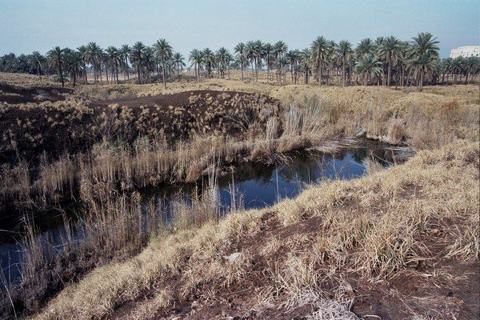
Babylon's great stepped temple tower to Marduk, rebuilt by Nebuchadnezzar II, ruined to a flooded pit, and read for centuries as the Tower of Babel.
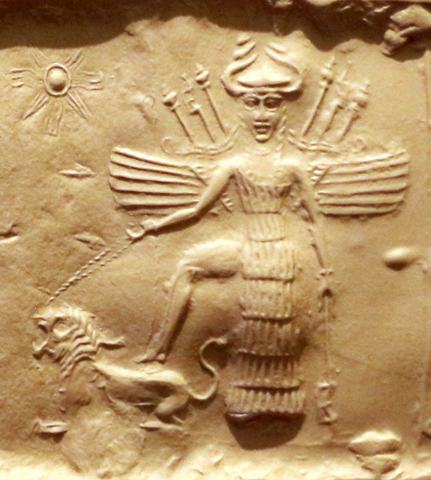
Queen of Heaven — Sumerian goddess of love, war, and the planet Venus, who walked into the land of the dead and was the only one to walk back out.
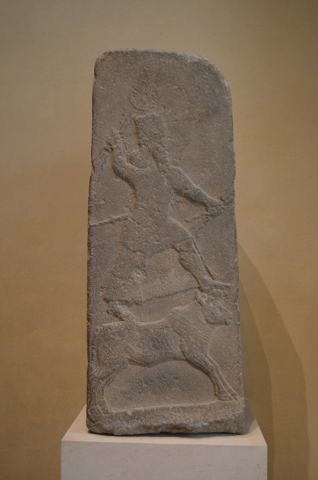
The Mesopotamian storm god who could drown the land in flood or bless it with rain, worshipped as Ishkur in Sumer and Adad across Babylonia and Assyria.
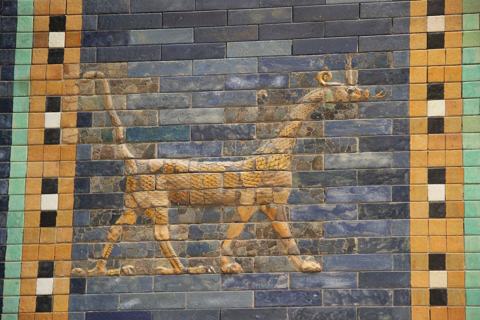
The scaled, horned dragon that once fought for Tiamat, was defeated by Marduk, and ended up as his tame guardian on the glazed brick of Babylon's Ishtar Gate.
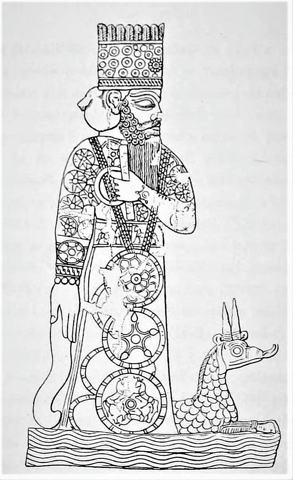
Champion of the gods — Babylon's patron, who killed the sea-dragon Tiamat, built heaven and earth out of her body, and was crowned king over all the gods.
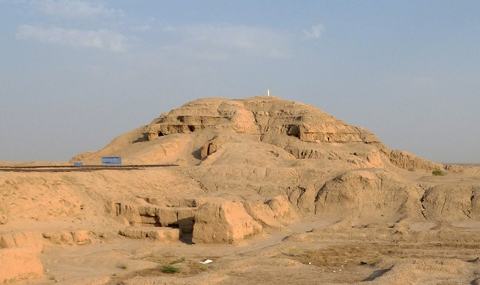
Father of the gods — the Mesopotamian sky, whose written sign meant "god" itself; the source of all authority, and almost never the one who uses it.
Sources & Further Reading
- 1.Nebuchadnezzar II, dedicatory inscription for the Ishtar Gate, translated in D. J. Wiseman, Nebuchadrezzar and Babylon (Schweich Lectures on Biblical Archaeology, 1985).
- 2.Herodotus, Histories 1.178-181 (5th century BCE).
- 3.Koldewey, Robert. The Excavations at Babylon. Translated by Agnes S. Johns. Macmillan and Co., 1914.
- 4.Wiggermann, F. A. M. Mesopotamian Protective Spirits: The Ritual Texts. Cuneiform Monographs 1. Styx & PP, 1992.
- 5.Black, Jeremy & Anthony Green. Gods, Demons and Symbols of Ancient Mesopotamia: An Illustrated Dictionary. British Museum Press, 1992.
- 6.Seymour, Michael. Babylon: Legend, History and the Ancient City. I.B. Tauris, 2014.
Spot an error or have a source to suggest? Write to info@viseterna.com. We cite primary sources and modern scholarship, and we correct fast.