
Apkallu (the Seven Sages)
Mesopotamia's seven antediluvian sages, half-fish or bird-headed, who brought civilization from the sea and were later buried as protective figurines.
Human-headed winged apkallu, alabaster relief from the Northwest Palace of Ashurnasirpal II, Nimrud, 883-859 BCE (Museum of the Ancient Orient, Istanbul) · CC BY-SA 4.0 · source
Seven Wise Ones Before the Flood
The apkallu — Akkadian for "sage" or "skilled one" — are the seven semi-divine wise beings Mesopotamian tradition credits with bringing the arts of civilization to humanity before the great Flood 4,6. A ritual incantation series known by its opening words, Bit Meseri, "House of the Sprinkling," preserves their names in sequence — Uanna, Uannedugga, Enmedugga, Enmegalamma, Enmebulugga, An-Enlilda, and Utuabzu — each paired in later tradition with the mythical king he served, so that the earliest rulers of Mesopotamia each have their own sage-advisor standing quietly behind the throne 5,6. They are servants of Ea (Enki), god of the fresh waters and of craft and wisdom, and their authority runs back to his domain, the Abzu, the sweet subterranean ocean below the earth 4,6.
Uan and the Coming of Civilization
The first and most important sage is Uanna, better known in the Greek-language tradition as Oannes. The Babylonian priest Berossus, writing a history of his country in Greek around 290 BCE, describes a creature with the full body of a fish but a human head beneath the fish head and human feet beneath the tail, who emerged each day from the Persian Gulf to teach the still-savage inhabitants of Babylonia writing, mathematics, agriculture, city-building, and law, then returned to the sea each evening, eating nothing on land 3. Berossus names further fish-men sages after him, matching the count and rough sequence of the cuneiform apkallu list, which makes his Greek account one of the clearest surviving bridges between native Mesopotamian tradition and the classical world's picture of it 3,5.
Adapa, the Sage Who Refused Immortality
Uanna appears in native Akkadian sources under the name Adapa, hero of his own myth, sometimes treated as identical with Uanna and sometimes kept distinct by modern scholars as a related but separate figure 5,6. In the Adapa story, the sage breaks the wing of the South Wind in anger and is summoned before the sky god Anu to answer for it. Ea, his patron, coaches him beforehand: refuse anything Anu offers you to eat or drink, since it will be poison. Anu, impressed rather than angry, instead orders the bread and water of eternal life brought out — and Adapa, following his god's advice to the letter, refuses them, and with that refusal loses humanity's one clear chance at immortality 1. The story reads, deliberately, as a companion piece to the Flood-survivor Utnapishtim's opposite fate: one man tricked out of eternal life by his own god's caution, the other granted it by divine reward 1.
Fish Cloaks and Bird Heads
Neo-Assyrian palace art gives the apkallu two distinct visual forms. Most common is a bearded man wearing a fish's skin as a cloak, its gaping head worn like a hood over his own, a costume that directly illustrates Berossus's description of Oannes centuries before the Greek text was written down 4,6. A second type dispenses with the human face altogether: a winged, bird-headed genie, usually shown with a raptor's beak, standing in the same ritual poses as his human-headed counterparts 4. Modern viewers often assume these are two different beings, but the ritual texts treat them as interchangeable members of the same apkallu class, distinguished by role and gesture rather than by species 4.
Figures Buried Under the Floor
The apkallu were not only mythic history; they were active ritual protection. Wiggermann's study of the incantation and ritual texts shows that Assyrian and Babylonian households and temples buried small clay, wood, or bronze figurines of fish-cloaked and bird-headed apkallu beneath thresholds, in wall niches, and at the corners of buildings, following prescribed instructions for their material, number, and placement, to guard the structure against disease-demons and misfortune 4. A figure carved on a palace wall in full public view and a figure quietly buried under a private floor were doing the same theological work at different scales 4.
Banished to the Apsu
The Erra Epic, a Standard Babylonian poem about the plague-god Erra's near-destruction of Babylon, supplies the apkallu's fall from grace. Marduk, recalling how he once banished the seven sages to the Apsu, the subterranean waters that are Ea's own realm, explains that he grew uneasy at how perfectly they had built his temple Esagila and feared their skill might be turned toward undoing it, so he sent them below the earth where their handiwork could no longer threaten the order they had helped create 2.
After the Flood: Human Sages and the King List
Once the Flood divides the mythic past from the historical one, the apkallu's role passes to human successors called ummanu, scholar-advisors rather than semi-divine sages, each still paired with a king in the tradition Lenzi traces through the Uruk List of Kings and Sages 5. That list eventually reaches Gilgamesh, whose own paired sage is remembered as the very scholar later credited with compiling the Standard Babylonian Epic of Gilgamesh itself — a closing loop in which the sages who taught Mesopotamia to write ended up, by tradition's own reckoning, writing down its greatest story 5.
Continue Exploring
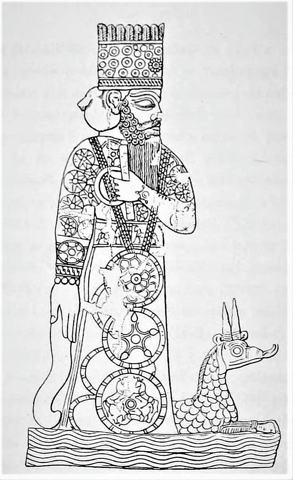
Champion of the gods — Babylon's patron, who killed the sea-dragon Tiamat, built heaven and earth out of her body, and was crowned king over all the gods.
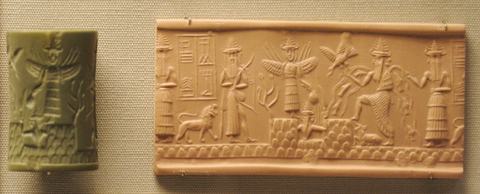
God of wisdom and the sweet water under the ground — the craftsman-trickster who made humankind, taught the crafts, and warned one man about the Flood.
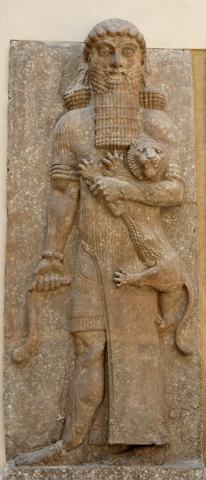
King of Uruk, two-thirds god and one-third man — the hero of the world's oldest surviving epic, who went to the ends of the earth to escape death.
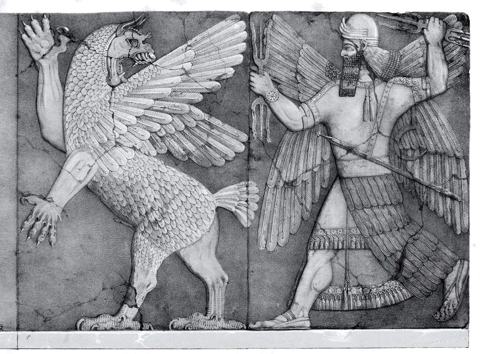
The primordial salt sea — the first mother of the gods, who turned on her children and whose split body became the sky and the earth above us.
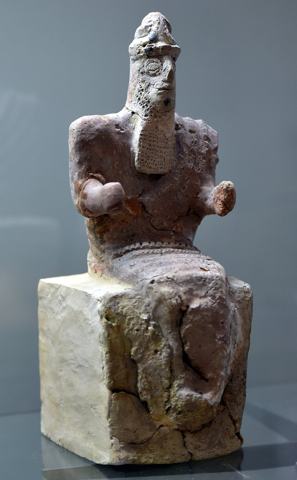
Lord of the moving air — the Sumerian executive of the gods, whose word carried out destinies, who split heaven from earth and sent the Flood.
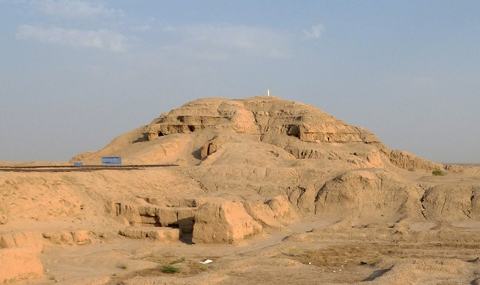
Father of the gods — the Mesopotamian sky, whose written sign meant "god" itself; the source of all authority, and almost never the one who uses it.
Sources & Further Reading
- 1.Adapa (the Adapa myth), Akkadian, Amarna and Nineveh recensions.
- 2.Erra and Ishum (the Erra Epic), Standard Babylonian.
- 3.Burstein, Stanley Mayer, trans. The Babyloniaca of Berossus. Sources from the Ancient Near East 1/5. Undena Publications, 1978.
- 4.Wiggermann, F.A.M. Mesopotamian Protective Spirits: The Ritual Texts. Cuneiform Monographs 1. Styx & PP, 1992.
- 5.Lenzi, Alan. 'The Uruk List of Kings and Sages and Late Mesopotamian Scholarship.' Journal of Ancient Near Eastern Religions 8, no. 2 (2008): 137-169.
- 6.Black, Jeremy & Anthony Green. Gods, Demons and Symbols of Ancient Mesopotamia: An Illustrated Dictionary. British Museum Press, 1992.
Spot an error or have a source to suggest? Write to info@viseterna.com. We cite primary sources and modern scholarship, and we correct fast.