
Mushussu (the Dragon of Marduk)
The scaled, horned dragon that once fought for Tiamat, was defeated by Marduk, and ended up as his tame guardian on the glazed brick of Babylon's Ishtar Gate.
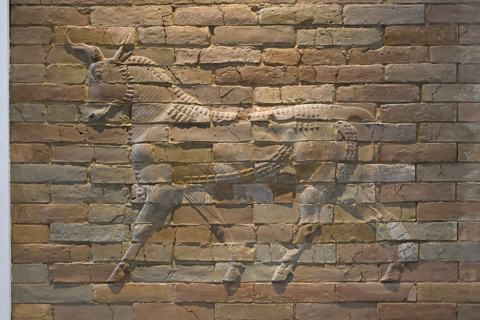
Mushussu dragon, glazed brick relief, Ishtar Gate of Babylon, reign of Nebuchadnezzar II, c. 575 BCE, reconstructed at the Pergamon Museum, Berlin · CC0 · source
A Composite Dragon
The mushussu (Akkadian mushhushshu, "fierce" or "reddish serpent") is a hybrid predator assembled, like most Mesopotamian monsters, out of the most dangerous parts of several real animals: a long, scaled serpent's body and neck, a horned, snake-like head with a forked tongue, the muscular forelegs of a lion, the taloned hind legs of an eagle of prey, and a crested tail 3,4. Unlike the winged bull lamassu, whose composite body signals dignity and protection from the start, the mushussu's design reads as pure danger — every borrowed part is a weapon 3.
One of Tiamat's Eleven
The dragon's earliest secure appearance in narrative is as an enemy, not a guardian. In the Enuma Elish, when the primordial sea Tiamat prepares for war against the younger gods, she gives birth to eleven monstrous warriors to serve under her commander Qingu, and the mushussu is named explicitly among them, listed alongside horned serpents, scorpion-men, and fish-men as one of Tiamat's terrifying brood 1. Marduk defeats the whole army along with Tiamat herself, and the poem specifies that rather than simply destroying the eleven, he binds them, tramples them underfoot, and later fashions their images to set up as a permanent memorial of his victory — which is the detail that explains why a creature born as one of the gods' worst enemies ends the story decorating divine architecture instead of haunting it 1,4,5.
Before Marduk: A Borrowed Beast
Before it became Marduk's personal emblem, the mushussu already had a long career serving other gods. Wiggermann's study of Mesopotamian protective-spirit texts traces the dragon's earliest strong association to Ningishzida, an underworld and vegetation god represented by entwined serpents, and then to Tishpak, the patron god of the city of Eshnunna, whose temple art gives the mushussu pride of place as his mount and symbol 2,3. When Babylon eclipsed Eshnunna's political importance in the eighteenth century BCE and Marduk absorbed much of the religious ground older city-gods had held, the mushussu transferred its loyalty from Tishpak to Marduk along with a great deal of the rest of that theological territory — a beast, like a title or a temple, that could change masters when a city's fortunes changed 2,3.
Marduk's Guardian, and His Son's
By the time of the Standard Babylonian Enuma Elish, the mushussu is thoroughly Marduk's own animal, depicted crouched at his feet or led on a leash in cylinder seals and kudurru boundary stones, the captured monster now doing loyal service for the god who beat it 1,4. The dragon extends its loyalty to Marduk's son Nabu, the god of writing and wisdom, whose own temple at Borsippa carried mushussu imagery as well — a family animal passed from father to son the way a crown or a weapon might be 4.
The Ishtar Gate
The mushussu's single most famous appearance is architectural rather than literary. Nebuchadnezzar II's building inscriptions describe, and the excavated remains of the Ishtar Gate confirm, that the northern processional gate of Babylon, dedicated to the goddess Ishtar but guarded by Marduk's and Adad's own emblem animals, was faced with glazed and moulded brick in vivid blue, showing rows of striding mushussu dragons alternating with the bulls sacred to Adad 4,6. Each dragon is rendered in profile, scaled body picked out in relief, walking in stately procession rather than attacking — a guardian on display for everyone entering the city, not a monster in combat 4.
Excavated and Reconstructed
The gate and its dragons lay buried until the German archaeologist Robert Koldewey excavated Babylon between 1899 and 1917, recovering tens of thousands of glazed brick fragments from the gate and the Processional Way leading to it 4. Reassembling the mushussu and bull panels from that fragmentary hoard took decades; the reconstructed gate now stands in Berlin's Pergamon Museum, built from a substantial proportion of the original excavated bricks supplemented with modern replacements, so that the dragon a visitor sees striding across the glaze today is largely, though not entirely, the same material fired in Nebuchadnezzar's kilns twenty-six centuries ago 4.
A Guardian That Was Once an Enemy
The mushussu's whole documented history is a demotion turned into a promotion. Born, in the one narrative that names its origin, as an instrument of Tiamat's rebellion against the younger gods, it survives its own side's total defeat, changes hands at least twice as political fortunes reshuffled the pantheon, and ends its career as the single most reproduced animal image in the archaeology of Babylon — proof that in Mesopotamian religion, a monster thoroughly beaten did not have to be a monster erased 1,2,4.
Continue Exploring
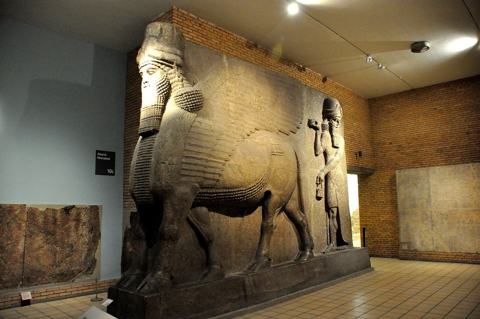
The human-headed winged bull that guarded Assyrian palace gates, sculpted with five legs so it reads correctly as both standing and walking.
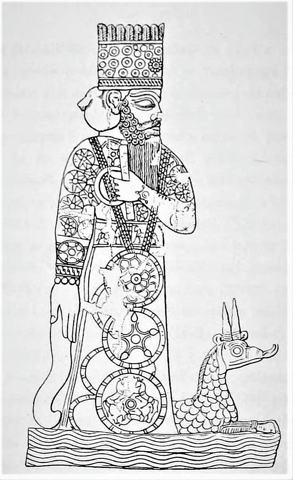
Champion of the gods — Babylon's patron, who killed the sea-dragon Tiamat, built heaven and earth out of her body, and was crowned king over all the gods.
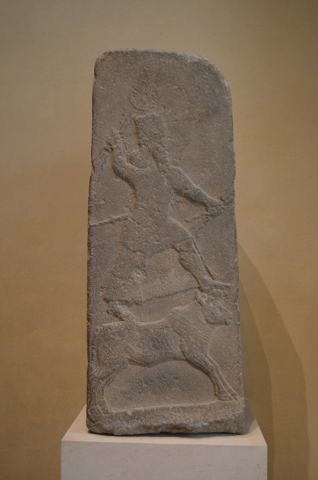
The Mesopotamian storm god who could drown the land in flood or bless it with rain, worshipped as Ishkur in Sumer and Adad across Babylonia and Assyria.
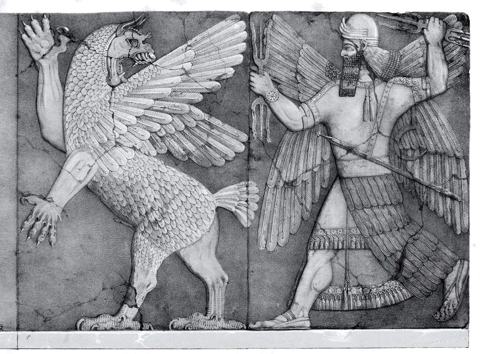
The primordial salt sea — the first mother of the gods, who turned on her children and whose split body became the sky and the earth above us.
Nebuchadnezzar II's glazed-brick gate to Ishtar, dug out of a Babylonian ruin mound and rebuilt whole in Berlin's Pergamon Museum.
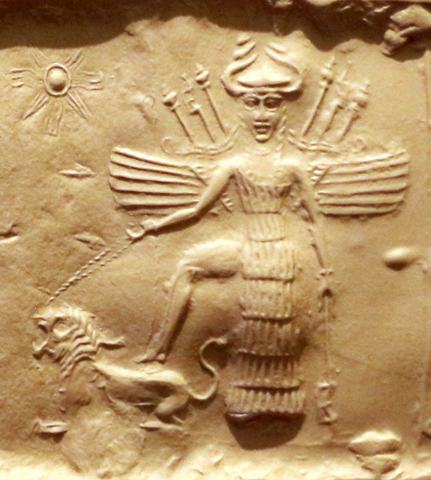
Queen of Heaven — Sumerian goddess of love, war, and the planet Venus, who walked into the land of the dead and was the only one to walk back out.
Sources & Further Reading
- 1.Enuma Elish (the Babylonian Epic of Creation), Standard Babylonian recension, Tablets I and V.
- 2.Wiggermann, F.A.M. Mesopotamian Protective Spirits: The Ritual Texts. Cuneiform Monographs 1. Styx & PP, 1992.
- 3.Bienkowski, Piotr & Alan Millard, eds. Dictionary of the Ancient Near East. British Museum Press, 2000.
- 4.Black, Jeremy & Anthony Green. Gods, Demons and Symbols of Ancient Mesopotamia: An Illustrated Dictionary. British Museum Press, 1992.
- 5.Dalley, Stephanie. Myths from Mesopotamia. Oxford University Press, revised edition 2000.
- 6.Inscriptions of Nebuchadnezzar II describing the building of the Ishtar Gate and Processional Way, Babylon (6th century BCE).
Spot an error or have a source to suggest? Write to info@viseterna.com. We cite primary sources and modern scholarship, and we correct fast.