
Dumuzi (Tammuz)
Inanna's shepherd husband, handed to the underworld in her place and mourned every summer across three thousand years of Near Eastern religion.
Tablet of the debate poem Dumuzid and Enkimdu, from Nippur, Iraq, 1st half of the 2nd millennium BCE (Ancient Orient Museum, Istanbul; photograph by Osama Shukir Muhammed Amin) · CC BY-SA 4.0 · source
The Shepherd Who Won Her
Dumuzi is a shepherd god, and the poems about him keep that occupation at the center of his identity rather than treating it as incidental 1,6. In the debate poem "Dumuzid and Enkimdu," he competes against a farmer for Inanna's hand, each suitor listing what he can offer her; her brother Utu argues for the shepherd, Dumuzi presses his own case directly, arguing that everything the farmer can give her, wool, milk, cream, a shepherd can give better, and Inanna chooses him, though the poem closes with the two rivals reconciled rather than one humiliated 3,6. A large body of separate love poetry, addressed between "the lady" and "the wild bull," celebrates the courtship and marriage that follows in frankly erotic pastoral imagery, milk and dates, fields and folded sheep, standing among the oldest love poetry in the world 3,6.
A Husband Who Would Not Mourn
The turn from wedding song to tragedy comes in "Inanna's Descent to the Netherworld." Inanna travels to the underworld ruled by her sister Ereshkigal, is killed there, and is revived only on condition that she send someone else to take her place 1. Returning to the world above escorted by demons under strict orders to seize whoever she names, she finds Dumuzi not in mourning but enthroned in her own city of Uruk, dressed in fine clothes and, by every account, not missing her at all 1. Enraged, she fixes the demons' eye on him, and he is dragged off in her stead, a punishment the poem frames not as random cruelty but as the direct consequence of a husband who failed the one duty owed a spouse believed dead 1,8.
Flight, Capture, and a Sister's Refusal
"Dumuzid's Dream" follows him after the sentence is passed. Terrified by a nightmare he cannot interpret, Dumuzi is warned by his sister Geshtinanna that the demons are coming, and he flees from hiding place to hiding place while she refuses, even under torture, to reveal where he is 2. His unnamed friend eventually betrays him; Utu, the sun god, briefly transforms Dumuzi into a gazelle so he can escape a second time, but the demons run him down again, and the poem's surviving text ends with his capture rather than a clean resolution 2,6. Geshtinanna's loyalty against Dumuzi's friend's betrayal is one of the sharpest character contrasts in Sumerian literature, and later texts reward her for it directly 2,8.
Splitting the Year
A separate composition, generally called "The Return of Dumuzid," resolves the story: Geshtinanna, Inanna, and Dumuzi's mother Sirtur search and lament until a fly agrees to reveal where he is hidden, and Inanna, having caused his death, now decrees a compromise rather than a full pardon, Dumuzi will spend half of each year in the underworld and half above, with Geshtinanna voluntarily taking his place below for the other half 1,6. Nineteenth- and early twentieth-century scholarship, following James Frazer's comparative reading in The Golden Bough, took this as a resurrection myth and filed Dumuzi among a supposed worldwide class of "dying-and-rising gods" 8. That reading rested on an incomplete Sumerian text; once the full tablets were recovered and translated in the mid-twentieth century, they showed Inanna's Descent itself ends in Dumuzi's death, not his rising, and that his return is a separate, later composition bound by an unbreakable condition, a substitute must always be found, rather than a triumph over death 8. Modern Assyriologists generally treat the older "dying-and-rising god" category with real caution for exactly this reason 8.
Weeping for Tammuz
Under his Akkadian name Tammuz, the god's summer death was marked by public mourning across Mesopotamia, women's laments in particular, timed to a month that still carries his name in the Jewish and Iraqi calendars 5,8. The rite reached the biblical world directly: Ezekiel, condemning practices he witnessed at the Jerusalem temple, describes "women weeping for Tammuz" at its north gate, the only mention of the god by name in the Hebrew Bible and a rare case of a foreign mourning cult recorded by a hostile eyewitness rather than by its own practitioners 5. In the Epic of Gilgamesh, Ishtar's proposal of marriage is rejected by Gilgamesh with a catalogue of her ruined former lovers, Tammuz named first, condemned to "wailing year after year," a bitter aside that assumes its Babylonian audience already knew exactly why he wails 4.
Adonis, and a Cult That Outlasted Babylon
Greek writers absorbed the same dying shepherd-consort figure as Adonis, the name itself borrowed from a Semitic word for "lord," with Sappho supplying the earliest surviving Greek reference and the summer Adonia festival, women planting fast-sprouting "gardens of Adonis" that withered within days, echoing the mourning rites of Tammuz's own cult almost exactly 7,8. The cult proved remarkably durable: the tenth-century writer al-Nadim reports Mesopotamian Sabians still weeping for Tammuz in his own day, and Jerome, writing around 395 CE, claimed the traditional site of Bethlehem had once stood in a grove sacred to Tammuz, a claim later Christian writers used, whether accurately or not, to explain uncomfortable overlaps between pagan mourning ritual and the new religion growing up around it 8. Few Mesopotamian deities can be traced continuously in cult practice for so long after the civilization that first sang about them had disappeared.
Continue Exploring
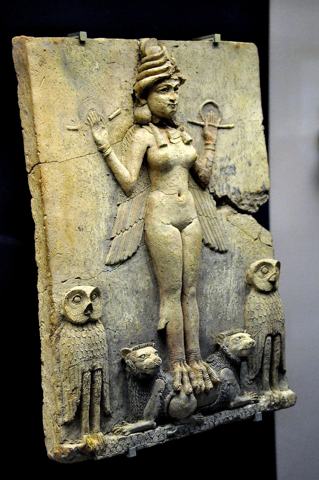
Lady of the Great Earth — the Mesopotamian queen of the dead, elder sister of Inanna, who rules the land of no return by rules even the gods obey.
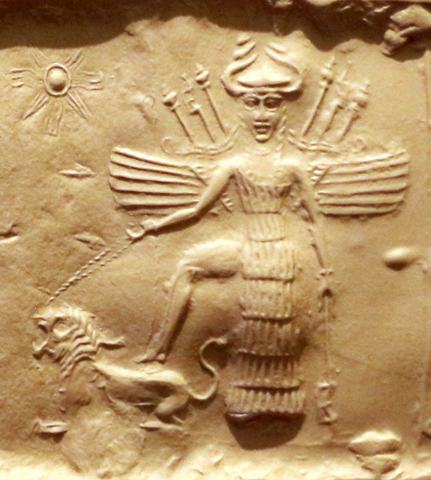
Queen of Heaven — Sumerian goddess of love, war, and the planet Venus, who walked into the land of the dead and was the only one to walk back out.
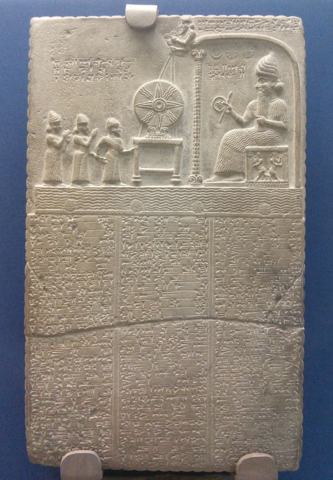
Sumerian Utu, Akkadian Shamash — the sun god who sees everything, judge of heaven and earth, patron of law, oaths, travellers and the diviner's art.
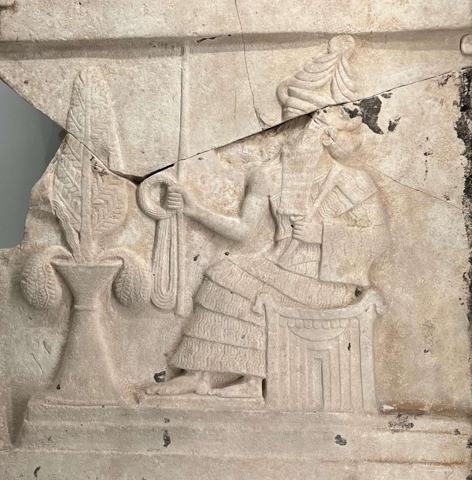
The Mesopotamian moon god of Ur's great ziggurat, father of the sun and Venus in most tellings, served by history's first named author, Enheduanna.
God of wisdom and the sweet water under the ground — the craftsman-trickster who made humankind, taught the crafts, and warned one man about the Flood.
Father of the gods — the Mesopotamian sky, whose written sign meant "god" itself; the source of all authority, and almost never the one who uses it.
Sources & Further Reading
- 1."Inanna's Descent to the Netherworld" (Sumerian composition, early 2nd millennium BCE).
- 2."Dumuzid's Dream" (Sumerian composition, early 2nd millennium BCE).
- 3."Dumuzid and Enkimdu" (Sumerian composition, early 2nd millennium BCE).
- 4.The Epic of Gilgamesh, Standard Babylonian version, Tablet VI.
- 5.Ezekiel 8:14 (Hebrew Bible).
- 6.Kramer, Samuel Noah. Sumerian Mythology. University of Pennsylvania Press, revised edition, 1961.
- 7.Jacobsen, Thorkild. Toward the Image of Tammuz and Other Essays on Mesopotamian History and Culture. Edited by William L. Moran. Harvard University Press, 1970.
- 8.Pryke, Louise M. Ishtar. Routledge, 2017.
Spot an error or have a source to suggest? Write to info@viseterna.com. We cite primary sources and modern scholarship, and we correct fast.