
The Burney Relief (Queen of the Night)
An Old Babylonian terracotta plaque of a winged, lion-footed goddess whose identity, Ishtar, Ereshkigal, or a demon, is still argued over.
The Queen of the Night (the Burney Relief), Old Babylonian period, c. 1800-1750 BCE (British Museum, photograph by Andres Rueda, 2012) · CC BY 2.0 · source
A Plaque With No Findspot
The Burney Relief is a fired terracotta panel just under half a meter tall, molded in high relief and originally painted: red ochre once covered the goddess's body and wings, black picked out her hair and the lions' manes, and white gypsum finished their bodies 4. The British Museum dates it to the Old Babylonian or Isin-Larsa period, roughly 1800-1750 BCE, on stylistic grounds, but no excavation record exists for it at all: the plaque surfaced on the antiquities market around 1933, reportedly from southern Iraq, and everything about where it actually came from and what building it stood in is lost 4. That absence of context is unusual for an object this important, and it is the reason its identity has never been settled by archaeology rather than argument alone 4,5.
From Dealer's Stock to the British Museum
The relief takes its common name from Sidney Burney, the London dealer who acquired it after the British Museum itself examined and declined to buy the piece in the 1930s 4. It passed afterward through the private collections of Norman Colville and the Japanese collector Goro Sakamoto before the British Museum finally purchased it in 2003 for 1.5 million pounds, seventy years after first turning it down, and renamed it "Queen of the Night" for display 4. Thermoluminescence testing carried out around the time of that purchase supported an ancient firing date, addressing, though not entirely silencing, decades of argument over whether the object was genuine at all 4.
What the Goddess Is Wearing
The figure stands nude and winged, her feet ending in bird talons rather than human toes, on the backs of two recumbent lions, flanked by a pair of owls, against a background originally painted black 4. She wears a four-tiered horned crown topped by a disk, a broad beaded necklace, and bracelets, and she holds a rod and ring in each raised hand, the standard Mesopotamian emblem of divine authority and measurement rather than a weapon 4. Every element of that costume, the horned crown especially, marks her as a major deity rather than a minor spirit: horns on a Mesopotamian headdress are a divinity marker with no lesser-being exception, a convention standard reference works on Mesopotamian iconography treat as effectively universal, which immediately complicated the relief's first proposed identification 3,4,6.
Demon, War Goddess, or Queen of the Dead
Emil Kraeling's first publication of the plaque in 1937 read the wings, taloned feet, and owls as marks of lilitu, a female demon of Mesopotamian folk belief later absorbed into the Hebrew Lilith tradition, and that identification stuck in popular writing for decades 1,4. It has not held up well under scrutiny: Cyril Gadd pointed out at the time that no other Babylonian image actually pairs lilitu with owls, and a demon seems an odd subject for an object this large and finely made 4. Thorkild Jacobsen's 1987 study argued instead for Inanna-Ishtar, on the grounds that the horned crown signals a major god, that the lions are her recognized animal, and that the necklace and rod-and-ring recur as her attributes in the text of Inanna's descent to the underworld 3,4. The British Museum's own current label prefers a third reading, Ereshkigal, Inanna's sister and queen of the dead, a case built by Edith Porada on the grounds that hanging, closed wings elsewhere mark underworld or demonic beings rather than the outspread wings typical of Ishtar in flight, and that the plaque's black-painted background suits a goddess of the underworld rather than the sky 4. Albenda's 2005 reassessment revives some of the earlier skepticism, arguing the composition still reads as an odd pastiche by comparison with securely provenanced Old Babylonian art, though she does not go as far as calling it a forgery outright 5. No consensus has formed, and the museum itself now presents the identification as an open question rather than a settled fact 4.
An Argument the Object Cannot Settle
What makes the Burney Relief difficult is exactly what makes it valuable: it is a first-rate, technically accomplished work from a period that has left few comparably large figural plaques, but it survives with no archaeological context, no inscription naming the figure, and no twin to compare it against 4,5. Frankfort's 1937 defense of its authenticity leaned on Old Babylonian parallels for individual motifs, the lions, the taloned feet, the rod-and-ring, even where no single parallel combines all of them the way this plaque does, and that argument still underlies the modern consensus that the object is genuine even as its subject remains contested 2,4. The most honest summary is Collon's: a real work of Old Babylonian religious art, almost certainly showing one of Mesopotamia's great goddesses, whose precise name scholars are still not agreed on 4.
Continue Exploring
Queen of Heaven — Sumerian goddess of love, war, and the planet Venus, who walked into the land of the dead and was the only one to walk back out.
Lady of the Great Earth — the Mesopotamian queen of the dead, elder sister of Inanna, who rules the land of no return by rules even the gods obey.
God of wisdom and the sweet water under the ground — the craftsman-trickster who made humankind, taught the crafts, and warned one man about the Flood.
Father of the gods — the Mesopotamian sky, whose written sign meant "god" itself; the source of all authority, and almost never the one who uses it.
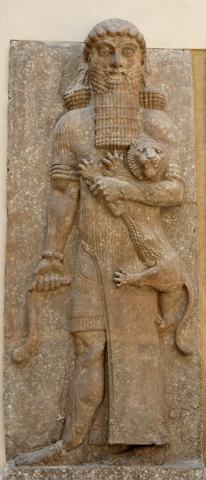
King of Uruk, two-thirds god and one-third man — the hero of the world's oldest surviving epic, who went to the ends of the earth to escape death.
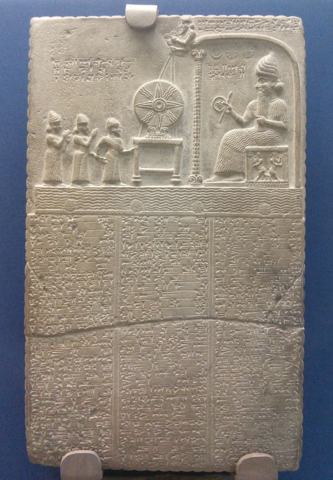
Sumerian Utu, Akkadian Shamash — the sun god who sees everything, judge of heaven and earth, patron of law, oaths, travellers and the diviner's art.
Sources & Further Reading
- 1.Kraeling, Emil G. "A Unique Babylonian Relief." Bulletin of the American Schools of Oriental Research 67 (1937), 16-18.
- 2.Frankfort, Henri. "The Burney Relief." Archiv fur Orientforschung 12 (1937), 128-135.
- 3.Jacobsen, Thorkild. "Pictures and Pictorial Language (the Burney Relief)." In Figurative Language in the Ancient Near East, edited by M. Mindlin, M. J. Geller & J. E. Wansbrough, 1-11. School of Oriental and African Studies, University of London, 1987.
- 4.Collon, Dominique. The Queen of the Night. British Museum Objects in Focus. British Museum Press, 2005.
- 5.Albenda, Pauline. "The 'Queen of the Night' Plaque: A Revisit." Journal of the American Oriental Society 125.2 (2005), 171-190.
- 6.Black, Jeremy & Anthony Green. Gods, Demons and Symbols of Ancient Mesopotamia: An Illustrated Dictionary. British Museum Press, 1992.
Spot an error or have a source to suggest? Write to info@viseterna.com. We cite primary sources and modern scholarship, and we correct fast.