
Irkalla
The land of no return — the dusty house below the earth where every Mesopotamian dead person went, ruled by Ereshkigal and locked behind seven gates.
Queen of the Night (Burney) Relief, Old Babylonian, c. 1800-1750 BCE (British Museum) · CC0 · source
Names for the Place Below
Irkalla is one of several names for the Mesopotamian underworld, used both for the realm and, by extension, for its queen 7. The Akkadian texts also call it erṣetu, "the earth," and Kurnugi, "the land of no return"; the Sumerian sources most often say Kur, a word that means mountain, foreign land, and underworld at once, or Ganzir, the name of its gate 6,7.
There is no Mesopotamian heaven for the dead. Sky belongs to the gods, and every human being, righteous or not, goes down: kings, priests, farmers, and infants alike 6,7. Katz's study of the Sumerian material emphasises how varied and locally inconsistent the picture is — the netherworld is a city, a house, a pit, a distant land across a river, sometimes several of these in the same composition — and warns against assembling the fragments into one tidy geography 6.
The Road and the Seven Gates
Getting there involves a journey, a river, and a ferryman in some traditions, and always a doorway 6,7. The best-described entrance is in the Descent narratives. When Inanna goes down, the gatekeeper Neti consults the queen and then admits her through seven gates, removing one item of clothing or regalia at each, so that she arrives in the throne room naked and powerless 1. The Akkadian Descent of Ishtar keeps the structure and states the rule of the place in its opening lines: the road whose journey has no return, the house whose entrants are deprived of light 2.
Ereshkigal's instruction to Neti is essentially a legal one. The visitor must be treated according to the ancient rites of the netherworld, which is why the stripping is not cruelty but procedure — nothing that signals power on earth is allowed past the threshold 1,6.
What the Dead Eat
Two texts give the same bleak description. In Enkidu's dream in Tablet VII of Gilgamesh, and again in the Descent of Ishtar, the dead live in the House of Darkness where dust is their food and clay their bread, they see no light, and they are clothed like birds in feathered garments 2,3. Former kings and high priests sit there as servants 3.
Conditions are not uniform, though, and Mesopotamian afterlife thinking is more practical than doctrinal. Tablet XII of Gilgamesh, translated from a Sumerian original, has the shade of Enkidu report on who fares well below: the man with many sons is comforted, the man who fell in battle is cared for by his parents, and the man with no one left to make offerings for him eats scraps thrown in the street 3,6. The stillborn play at a table of gold; the man burned to death has no ghost at all, because his smoke went up to the sky 3.
Ereshkigal's Court
The queen is Ereshkigal, "Lady of the Great Earth," elder sister of Inanna 1,7. Her vizier is Namtar, whose name means "fate" and who is also the demon of plague; the gatekeeper is Neti; and the seven Anunnaki sit as judges, fixing the dead with the eye of death 1,7. Various other figures serve as scribes and officials, because the underworld is imagined as a functioning administrative household, with a palace, staff, and paperwork 6,7.
Its rules bind even gods. When Inanna is killed and hung on a hook, the gods above have no jurisdiction; her rescue depends on Enki inventing two sexless beings the underworld's regulations do not cover, and even then she is released only on condition that she supply a living substitute 1,6. The demons who escort her up to collect it are described as knowing neither food, drink, nor gifts, and refusing bribes 1.
Nergal Comes to Stay
The poem Nergal and Ereshkigal explains how the underworld acquired a king. The gods above hold a banquet Ereshkigal cannot attend, since she may not come up and they will not come down; she sends Namtar as her deputy, and one god fails to rise for him 4,8. Summoned below to answer for the discourtesy, Nergal is advised to refuse the chair, the bread, the meat, the beer, and the bathing — and does refuse them all, and then does not refuse Ereshkigal herself 4.
He slips away after six days; she threatens the gods above with the standard formula — she will raise the dead and they will outnumber the living — and he is sent back, in the fuller version seizing her by the hair and pulling her from the throne before the confrontation resolves into marriage 4,8. Nergal, a plague and war god, rules there afterwards alongside her 7.
Feeding the Ghosts
Practical religion took the underworld extremely seriously. The kispu was a regular offering of food and poured water made to dead family members by name, and the obligation ran with the household and the property; a lineage that stopped performing it left its ancestors hungry 7. A neglected or improperly buried ghost, the etemmu, could come back and cause illness, and a substantial body of exorcistic texts exists to identify which ghost was responsible and to send it back down with an escort of gifts 7.
The dead were not worshipped and they had no power to bless. They had only the capacity to be a nuisance, which was reason enough 6,7.
Seeing It and Surviving
One Assyrian text describes an actual guided tour. In The Underworld Vision of an Assyrian Prince, a man named Kummaya prays to see the netherworld, and does: he wakes among fifteen composite monsters — figures with the heads of lions, birds, and goats and the hands of men — before Nergal on his throne, who seizes him by the hair and threatens him, then spares him and sends him back to proclaim what he has seen 5,8. The text has been read as political writing aimed at a specific reign, which does not make its imagery less startling 5,8.
It remains the closest thing Mesopotamia produced to a guided vision of hell, and it does not offer reward, punishment, or judgement of the soul — only rank, dust, and an audience with a king who might have killed the visitor and chose not to 5,6.
Continue Exploring
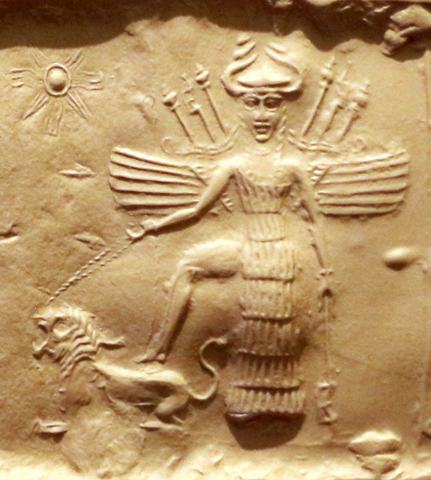
Queen of Heaven — Sumerian goddess of love, war, and the planet Venus, who walked into the land of the dead and was the only one to walk back out.
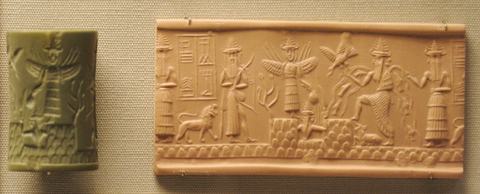
God of wisdom and the sweet water under the ground — the craftsman-trickster who made humankind, taught the crafts, and warned one man about the Flood.
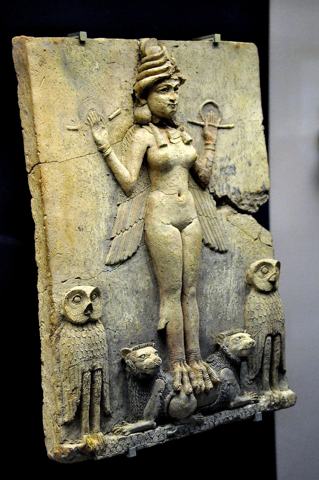
Lady of the Great Earth — the Mesopotamian queen of the dead, elder sister of Inanna, who rules the land of no return by rules even the gods obey.
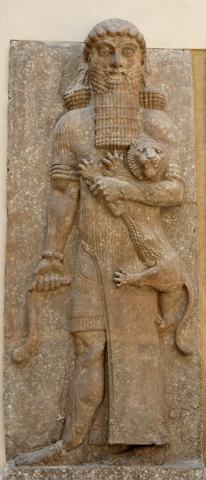
King of Uruk, two-thirds god and one-third man — the hero of the world's oldest surviving epic, who went to the ends of the earth to escape death.
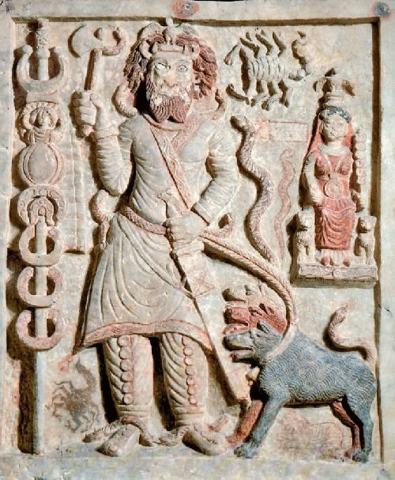
Mesopotamian god of plague, war and the scorching sun — the violent power of inflicted death, who talked his way into the underworld and stayed as its king.
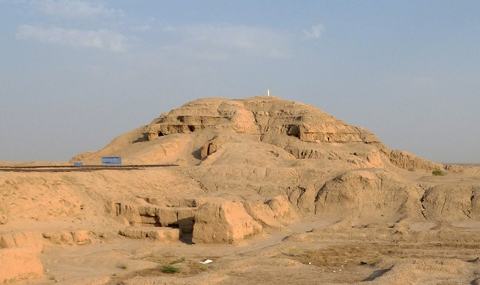
Father of the gods — the Mesopotamian sky, whose written sign meant "god" itself; the source of all authority, and almost never the one who uses it.
Sources & Further Reading
- 1.Inanna's Descent to the Netherworld (Sumerian, early 2nd millennium BCE).
- 2.The Descent of Ishtar to the Netherworld (Standard Babylonian version).
- 3.The Epic of Gilgamesh, Standard Babylonian version, Tablets VII and XII.
- 4.Nergal and Ereshkigal (Amarna and Sultantepe/Nineveh versions).
- 5.The Underworld Vision of an Assyrian Prince (7th century BCE).
- 6.Katz, Dina. The Image of the Netherworld in the Sumerian Sources. CDL Press, 2003.
- 7.Black, Jeremy & Anthony Green. Gods, Demons and Symbols of Ancient Mesopotamia: An Illustrated Dictionary. British Museum Press, 1992.
- 8.Dalley, Stephanie. Myths from Mesopotamia. Oxford University Press, revised edition 2000.
Spot an error or have a source to suggest? Write to info@viseterna.com. We cite primary sources and modern scholarship, and we correct fast.