
The Celtic Otherworld and the Sidhe
Not an afterlife but a parallel country — the sid mounds, the islands west of the sea, and the aos si who kept Ireland after they lost it.
A Spirit or Sidhe in a Landscape, George William Russell (AE), early 20th century (National Gallery of Ireland) · CC BY 4.0 · source
Not an Afterlife
The Irish Otherworld is one of the most misdescribed ideas in popular mythology, because English has no word for it that does not imply death. It is not a land of the dead, not a heaven, and not a hell. It is a second Ireland — running alongside the visible one, occupying the same coordinates, entered by accident or invitation, and inhabited by beings who are neither ghosts nor gods in the classical sense 7,8.
The clearest medieval statement of that geography is in Immram Brain. Manannan drives his chariot across what Bran perceives as open sea, and tells him that where Bran sees waves, he sees a flowering plain; where Bran sees salmon leaping, he sees calves and lambs. Neither man is wrong. The same space carries two descriptions at once, and which one you get depends on what you are 1,7. John Carey has argued that this doubled perception is a genuine feature of early Irish religious thought rather than a poetic flourish, and it is the most useful single key to the material 7.
The Names It Goes By
The texts do not settle on one name, and the names are not synonyms so much as different angles on the same idea 8.
Sid (plural side, modern si) is the oldest and most important. The word means both the mound — the prehistoric tumuli and cairns that stud the Irish landscape — and the Otherworld state itself, and it is also glossed as "peace." Brug na Boinne, Aengus's house on the Boyne, is a sid; so is Cruachan in Connacht, whose cave was reckoned an entrance 5,8. Mag Mell, "the plain of delights," and Mag Mor, "the great plain," name it as level, cultivated country. Tir Tairngiri, "the Land of Promise," and Emain Ablach, "Emain of the apples," place it out at sea. And Tir na nOg, "the Land of the Young," which is now the most famous term of all, is in fact late — it belongs to the Early Modern Irish Oisin material rather than the Old Irish corpus 3,8.
The variety is not sloppiness. Under the ground and over the western sea are two different routes to the same condition, and individual tales pick one and stay with it 1,3,8.
Getting In, and What It Costs
Two tale-types organise the journeys. An echtrae, "adventure," takes a hero into the Otherworld, usually after an invitation. An immram, "rowing about," is a sea voyage among islands, and the surviving examples are already partly Christianised — the voyage of Saint Brendan is the same form with a monastic crew 1,8.
The invitation is nearly always issued by a woman, and nearly always in verse. In Echtra Condla a woman no one else can see calls Connla away, and he leaves in a glass boat while his father's druid chants against her and fails 2,8. In Immram Brain a branch of silver with white blossom appears in Bran's hall, and the singer who claims it lists the wonders of the island she comes from 1. In Serglige Con Culainn the Otherworld reaches inward instead: Cu Chulainn is beaten by two women in a vision and lies sick for a year before being brought to Mag Mell 4,8.
Time is the tax. The Otherworld runs on a different clock, and the direction of the difference varies: a night in the sid can cover a year outside, or centuries pass at home during what felt like a season away. The consequence is the same in almost every tale — returning travellers must not touch Irish ground, and when they do, the accumulated years arrive at once and reduce them to dust or to sudden age 1,3,8. It is one of the most stable motifs in the whole tradition, and it makes the Otherworld's hospitality into a trap that nobody sets deliberately.
The Aos Si
The population has a pseudo-history. Lebor Gabala Erenn and the tales attached to it record that when the Milesians took Ireland from the Tuatha De Danann, the two sides divided the country: the incomers took the surface, and the defeated gods took everything beneath it. Manannan is credited in the later tradition with allotting the mounds among them and providing the mist that hides them, the feast that keeps them from ageing, and the swine that can be eaten and killed again 5,8.
From that settlement come the aes side or aos si, "the people of the mounds" — the fairies of later Irish and Scottish folklore. Continuity between the medieval Tuatha De and the modern si is real but not simple: the diminished, dangerous, capricious fairy of nineteenth-century tradition is not a straightforward memory of a worshipped god, and the shift in scale and dignity took a thousand years and a great deal of Christian pressure to happen 6,8. What did survive intact was the etiquette. You do not name them directly — they are na daoine maithe, "the good people," or "the gentry." You do not build on their paths or cut their thorn trees. You leave food out, and you do not thank them 6,8.
The banshee, bean si, "woman of the mound," is the best known survival, and her name is literally an Otherworld address rather than a description of what she does 6,8.
Where the Doors Are
The tradition is specific about entrances. Sid mounds, most famously Brug na Boinne and Cnoc Meadha; the Cave of Cruachan in Roscommon, called in the texts the door of Ireland's hell after Christianisation; lakes and wells; and the sea to the west, where islands appear on the horizon at intervals and vanish when approached 5,6,8.
The calendar has doors too. Samhain, the turn from summer to winter, is when the boundary is thinnest, and a striking proportion of Irish tales are dated to it precisely because it is the night when the sid stands open — Aengus finds Caer among the swans at Samhain, and the second battle of Mag Tuired against the Fomorians is fought then 5,8. Bealtaine, the opposite hinge, does similar work at the other end of the year 6,8.
W. Y. Evans-Wentz's 1911 survey of living fairy belief across the six Celtic countries remains the fullest record of the folk system at the point it began to break up, though his own theorising about the origins of the faith belongs firmly to his period and is not shared by current scholarship 6,8.
Continue Exploring
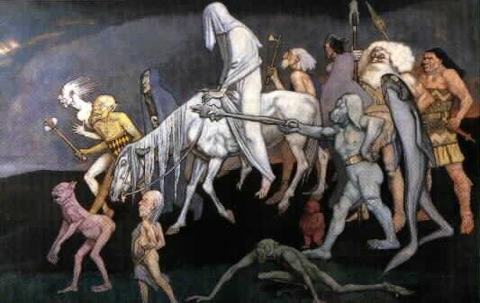
Ireland's monstrous sea-people — raiders, tribute-takers and kin to the gods they fight, led by Balor of the destroying eye.
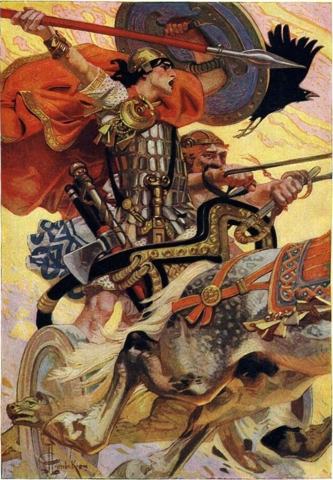
The Hound of Ulster — a boy-hero who holds an entire army at a ford, warps into a monster when he fights, and dies standing up, tied to a stone.
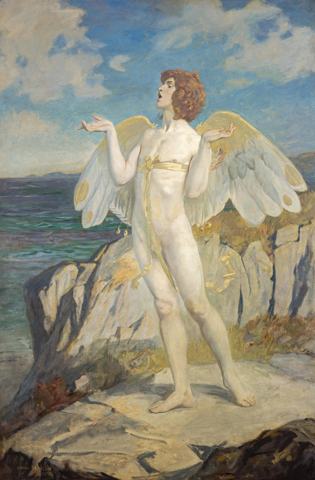
The young god of Brú na Bóinne — conceived in a stolen day, owner of a house won by a pun, and the lover who followed a dream into a lake of swans.
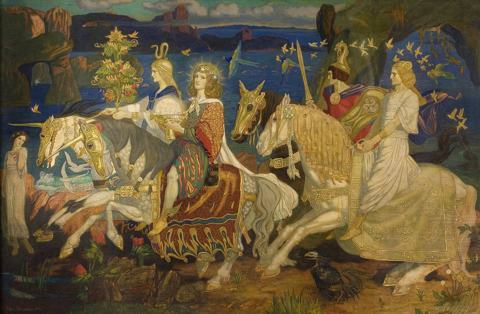
The land of the young — the Irish otherworld across the western sea where no one ages, and where a year away can cost a returning traveller three centuries.
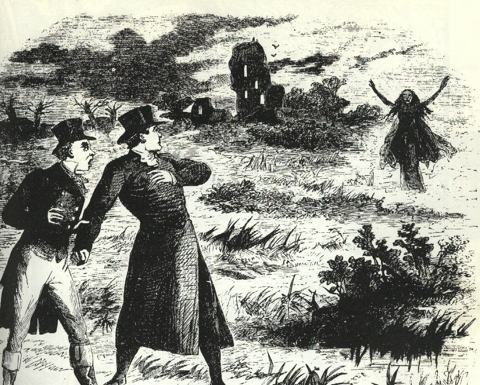
Herald of death — the "woman of the mound," heard rather than seen, whose keening outside a house announces that someone of the family is about to die.
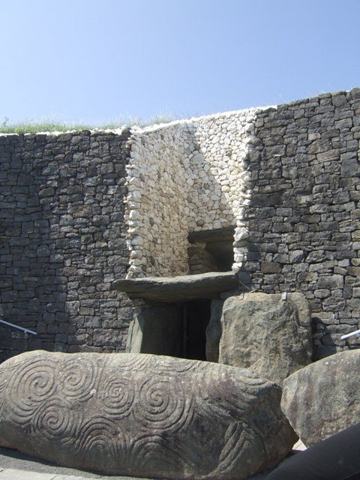
A 5,000-year-old passage tomb on the Boyne, built for the winter solstice centuries before the Celts arrived — later remembered as the Dagda's own hall.
Also mentioned inBrigid (Brigit, Brighid)DanuFinn McCool (Fionn mac Cumhaill)Lebor Gabala Erenn (The Book of Invasions)Manannan mac LirSamhainSelkie (Seal Folk)The Gundestrup CauldronThe Salmon of KnowledgeTuatha De Danann
Sources & Further Reading
- 1.Immram Brain maic Febail (The Voyage of Bran), ed. and trans. Kuno Meyer with Alfred Nutt, The Voyage of Bran. David Nutt, 1895-1897.
- 2.Echtra Condla (The Adventure of Connla), Old Irish; ed. and trans. in Eriu.
- 3.Echtra Cormaic i Tir Tairngiri (The Adventure of Cormac in the Land of Promise), Middle Irish; ed. Whitley Stokes, Irische Texte III, 1891.
- 4.Serglige Con Culainn (The Wasting Sickness of Cu Chulainn), ed. Myles Dillon. Irish Texts Society, 1953.
- 5.Lebor Gabala Erenn (The Book of the Taking of Ireland), ed. R. A. S. Macalister. Irish Texts Society, 1938-1956.
- 6.Evans-Wentz, W. Y. The Fairy-Faith in Celtic Countries. Oxford University Press, 1911.
- 7.Carey, John. A Single Ray of the Sun: Religious Speculation in Early Ireland. Celtic Studies Publications, 1999.
- 8.MacKillop, James. Dictionary of Celtic Mythology. Oxford University Press, 1998.
Spot an error or have a source to suggest? Write to info@viseterna.com. We cite primary sources and modern scholarship, and we correct fast.