
Finn McCool (Fionn mac Cumhaill)
Warrior-poet, leader of the Fianna, and the hero who burned his thumb on the Salmon of Knowledge — Ireland's most widely told legend.
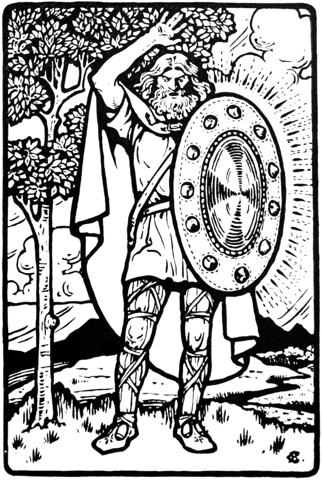
Finn McCool Comes to Aid the Fianna, Stephen Reid, 1932 · Public domain · source
The Biggest Story in Ireland
Fionn mac Cumhaill — anglicised Finn McCool or Finn MacCool — is the warrior-seer at the centre of the Fenian or Ossianic Cycle, which is by a wide margin the largest body of narrative in Gaelic tradition. Material about him runs from eighth-century poems through the twelfth-century Acallam na Senorach and the ballad collections of the Duanaire Finn to oral tales still being recorded from storytellers in Ireland and Scotland in the twentieth century 6,7,8.
That longevity matters for how the entry should be read. Where Cu Chulainn belongs to a comparatively fixed set of medieval sagas, Fionn belongs to a tradition that never stopped being retold, and there is consequently no authoritative version of most of his stories 6,8.
His name means "fair" or "bright," and one strand of scholarship holds that Find was originally an epithet — a title of a seer-figure whose personal name was something else, later reinterpreted as a name. The father's name, Cumhall, gives the patronymic 7,8.
The Boyhood Deeds
Macgnimartha Finn, "The Boyhood Deeds of Finn," is the key early text and supplies the origin. Cumhall, leader of the Fianna, is killed at the battle of Cnucha by Goll mac Morna, and his son is born after his death and reared secretly in the forest by two foster-mothers, a druidess and a woman warrior — an upbringing outside society that Joseph Nagy has argued is the structural heart of the whole cycle. Fionn is a figure of the margins who is repeatedly let back in, and his wisdom is the kind you can only acquire outside the settlement 1,6.
The famous episode is the salmon. Apprenticed to the poet Finn Eces (Finnegas) on the Boyne, the boy is set to cook the Salmon of Knowledge, which the poet has hunted for seven years and which will grant all knowledge to whoever eats it first. Fionn burns his thumb on the hot skin, puts it in his mouth, and the wisdom is his. Finn Eces sees it at once and gives him the whole fish 1,7. Thereafter, when he chews or sucks that thumb, knowledge comes.
The text is more precise than the popular retelling. It names the arts Fionn acquires as teinm laida, imbas forosna and dichetal di chennaib — three techniques of poetic divination that appear elsewhere in Irish law and glossary material as the professional equipment of the fili, the trained poet. Fionn is not simply "wise"; he is credentialed 1,6,7. Later tradition sometimes replaces the salmon with a thumb caught in the door of a sid mound, which points the same way: knowledge taken from the Otherworld, slightly by accident and slightly by theft 1,6.
The Fianna
The Fianna are a fian: a roving warrior band of young men living outside the settled kin-based society, hunting and fighting for hire, and the medieval texts are strikingly clear that this was a recognisable social institution rather than a purely literary invention. The tests of entry given in the tales — mastering twelve books of poetry, standing in a pit to the waist and defending against nine spears, running the forest without breaking a branch or waking a stag, drawing a thorn from the foot at full speed — read as heroic exaggeration of a real initiation 2,6,8.
Fionn's household is well populated. His son Oisin is the poet of the cycle and the voice of the Acallam; his grandson Oscar is its best fighter; Caoilte mac Ronain is the runner and the other great survivor; Diarmuid ua Duibhne is the young champion with the love-spot; Goll mac Morna, who killed Fionn's father, becomes his most powerful and least reliable ally; and his hounds Bran and Sceolang are his own nephews, born to a sister transformed into a hound 2,3,7.
Diarmuid, Grainne, and the Turn
The single most-told Fenian tale is Toruigheacht Dhiarmada agus Ghrainne. The ageing Fionn is betrothed to Grainne, daughter of the high king Cormac mac Airt; at the wedding feast she puts the company to sleep and lays a geis on Diarmuid to take her away. The pursuit lasts sixteen years across Ireland, and the dolmens of the country are still called "the beds of Diarmuid and Grainne" in local tradition, which is a good illustration of how the cycle attached itself to landscape 3,7.
Fionn's part in the ending is what makes the tale unusual: after a reconciliation, Diarmuid is gored by an enchanted boar at Ben Bulben, and Fionn, who can heal with water carried in his hands, twice lets it run through his fingers before finally going too slowly. The hero is allowed to be small 3,7. The Fenian cycle generally is more comfortable than the Ulster material with a leader who is jealous, calculating and occasionally mean 6,8.
Death, the Giant, and the Return
There is no single death. Some texts kill Fionn at the ford of Ath Brea on the Boyne; the ballad tradition after the disastrous battle of Gabhra, where the Fianna destroy themselves, generally leaves him already gone 4,5,7. A widespread and much later belief has him sleeping in a cave with the Fianna, to wake when Ireland needs him — a motif shared with Arthur and with a long list of European sleeping kings, and one that scholars treat as a migratory legend attached to Fionn rather than as native Fenian material 7,8.
The giant Finn McCool of the Giant's Causeway is later still. Folk tradition in Ulster and Scotland made him a builder of causeways and an outwitter of the giant Benandonner, most famously in the version where his wife disguises him as a baby and the rival giant flees at the thought of the father — a comic tale first written down in the nineteenth century and now the version most visitors to Antrim hear 7,8.
Acallam na Senorach, composed around 1200, is the cycle's masterpiece and its own commentary. Oisin and Caoilte have outlived the Fianna by centuries and travel Ireland with Saint Patrick, naming places and telling the stories attached to them while a scribe writes them down. It is a frame narrative about the transmission of pagan memory into a Christian record, and it is the reason so much of the Fenian material survives at all 2,6.
Continue Exploring
An ordinary salmon that eats hazelnuts of wisdom from an otherworldly well and passes all knowledge on by accident, to the boy Fionn mac Cumhaill.
The Hound of Ulster — a boy-hero who holds an entire army at a ford, warps into a monster when he fights, and dies standing up, tied to a stone.
Not an afterlife but a parallel country — the sid mounds, the islands west of the sea, and the aos si who kept Ireland after they lost it.
The young god of Brú na Bóinne — conceived in a stolen day, owner of a house won by a pun, and the lover who followed a dream into a lake of swans.
The Irish sea god — ferryman between worlds, master of illusion and the mist of invisibility, and the presiding figure of the Otherworld voyages.
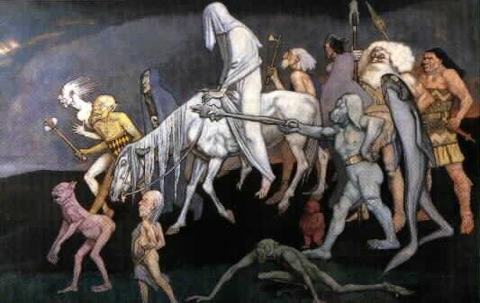
Ireland's monstrous sea-people — raiders, tribute-takers and kin to the gods they fight, led by Balor of the destroying eye.
Sources & Further Reading
- 1.Macgnimartha Finn (The Boyhood Deeds of Finn), Middle Irish; ed. and trans. Kuno Meyer, Revue Celtique 5, 1882.
- 2.Acallam na Senorach (The Colloquy of the Ancients), c. 1200; trans. Ann Dooley and Harry Roe, Tales of the Elders of Ireland. Oxford University Press, 1999.
- 3.Toruigheacht Dhiarmada agus Ghrainne (The Pursuit of Diarmuid and Grainne), Early Modern Irish.
- 4.Duanaire Finn: The Book of the Lays of Fionn, ed. Eoin MacNeill and Gerard Murphy. Irish Texts Society, 1908-1953.
- 5.Cath Gabhra (The Battle of Gabhra) and related Fenian ballads.
- 6.Nagy, Joseph Falaky. The Wisdom of the Outlaw: The Boyhood Deeds of Finn in Gaelic Narrative Tradition. University of California Press, 1985.
- 7.MacKillop, James. Dictionary of Celtic Mythology. Oxford University Press, 1998.
- 8.Koch, John T. (ed.). Celtic Culture: A Historical Encyclopedia. ABC-CLIO, 2006.
Spot an error or have a source to suggest? Write to info@viseterna.com. We cite primary sources and modern scholarship, and we correct fast.