
Tir na nOg
The land of the young — the Irish otherworld across the western sea where no one ages, and where a year away can cost a returning traveller three centuries.
The Riders of the Sidhe, John Duncan, 1911 (McManus Galleries, Dundee) · Public domain · source
A Late Name for an Old Idea
Tir na nOg — in Irish orthography Tír na nÓg, "the land of the young" — is the best known name for the Irish otherworld, and it is not the oldest one 5. The medieval literature is full of otherworld places under other names: Mag Mell, "the plain of delights"; Tir Tairngire, "the land of promise"; Tir na mBeo, "the land of the living"; Emain Ablach, the apple-abounding Emain, a probable ancestor of Arthurian Avalon; and simply the síd, the mounds 5,6.
These are not a systematic geography. Different texts place the otherworld across the western sea, under the water of a lake, inside a hill, or in no stated direction at all, and the same story can shift between models without apology 5,6. What is consistent is the character of the place: no sickness, no ageing, no want, music and feasting that never stop, and a population of beautiful people who are usually understood to be the Tuatha De Danann after their defeat and withdrawal into the mounds 5,6. In Serglige Con Culainn, Cu Chulainn is summoned to Mag Mell by an otherworld woman and sends his charioteer ahead to inspect it before going himself 3.
The Voyage of Bran
The earliest substantial description is in Immram Brain, an Old Irish text of roughly the eighth century 1. A woman in strange clothing appears in Bran's hall and sings of an island supported on four pillars of gold, where there is a distant plain on which hosts play games, where colour and music are everywhere and no grief or treachery is known, and where "there is nothing rough or harsh" 1. Then she leaves with her silver branch, and Bran sails to find it 1.
At sea he meets Manannan mac Lir driving a chariot across what to Bran is water and to Manannan is a flowering plain — the same space perceived two ways, one of the most striking images in early Irish writing 1,5. Bran reaches the Land of Women, stays what feels like a year, and sails home; when his crew make landfall, people on shore have never heard of him except in old stories, and the first man to jump ashore crumbles to dust the moment he touches Irish ground 1.
Connla and the Woman from the Sid
Echtra Condla runs the same idea as a shorter, sharper story. A woman invisible to everyone but Connla appears beside him at Uisnech and invites him to a land without death, sin, or transgression, where there is feasting without labour 2. His father the king calls in a druid, whose chanting drives her off, but she leaves Connla an apple that sustains him for a month without diminishing while he refuses all other food and pines 2.
She returns, and this time Connla steps into her crystal boat and is never seen again 2. The text is often read as containing a Christian overlay — the woman's land is described in language a monastic scribe could have applied to paradise, and the druid's failure has been taken as a comment on the impotence of the old religion 2,6. Whatever its theology, its structure is the canonical shape: an invitation from a woman, a refusal by the community, a departure with no return 5.
Oisin and Niamh
The story most people mean by "Tir na nOg" is considerably later than the medieval material. Laoi Oisin ar Thir na nOg was composed around 1750 by Micheal Coimin, a County Clare poet, in the Fenian ballad tradition 4. In it, Niamh of the golden hair rides out of the sea on a white horse, takes the hero Oisin back with her, and they live in the land of youth; he fights a giant, they have children, and after what he believes is three years he asks to visit Ireland 4.
Niamh lends him the horse on one condition: he must not set foot on Irish soil 4. He arrives to find the Fianna long gone and three hundred years passed; stopping to help men struggling with a stone, his saddle girth breaks, he touches the ground, and he becomes instantly and enormously old 4. In later versions, including the frame used in earlier Fenian literature, he survives long enough to be questioned by Saint Patrick about the vanished world he came from 4,5.
The poem was translated into English by Bryan O'Looney in the 1850s and rewritten by W. B. Yeats as The Wanderings of Oisin in 1889, which is how an eighteenth-century Clare ballad became the standard "ancient Irish myth" of the modern imagination 4,5.
Time That Runs Wrong
The recurring mechanic across all of these texts is temporal. Time in the otherworld runs slower, or does not run, and the discrepancy is only discovered on return — usually fatally 5,6. The prohibition on touching the ground is the narrative device that enforces it: the traveller's accumulated years are held in suspension and land on him all at once 4,5.
This is not unique to Ireland. Comparable time-slip stories occur in Welsh, Breton, Japanese, and later European folklore, and folklorists classify the pattern as an international tale type rather than a Celtic peculiarity 5,6. What the Irish versions add is the specific poignancy of the returning hero as the last survivor of a vanished order, talking to a world that has replaced him 4,5.
Where It Is, and What It Was For
Attempts to fix Tir na nOg on a map are beside the point, but the western sea location has a plausible logic: Ireland's western horizon is the edge of the known world, and the Atlantic mirages occasionally visible from the coast supplied the folklore of Hy-Brasil, the island said to appear once every seven years 5,6. Green notes the general Celtic pattern of otherworlds located at boundaries — water, mounds, mist, the west — places where one kind of space visibly gives out 7.
The name itself has outlived the literature. Tir na nOg is now a fixture of Irish cultural vocabulary and of every derivative fantasy setting that wants a deathless elf-country over the water, and the version behind that borrowing is almost always Coimin's poem by way of Yeats rather than Immram Brain 4,5. That is worth knowing, because the medieval otherworld is stranger and less sentimental than the Victorian one: in Immram Brain nobody is punished for leaving, and the horror at the end is simply that the world did not wait 1.
Continue Exploring
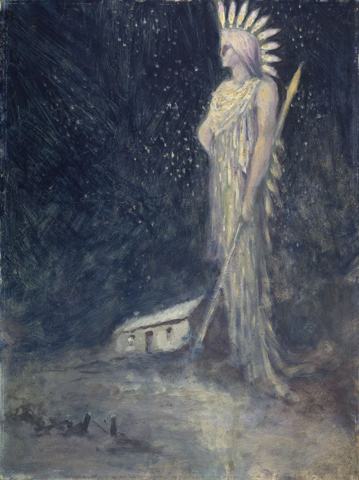
Not an afterlife but a parallel country — the sid mounds, the islands west of the sea, and the aos si who kept Ireland after they lost it.
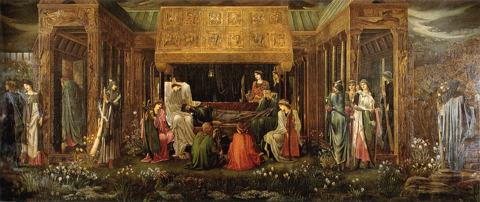
The isle of apples: the healing island where Excalibur was forged and where the wounded Arthur was carried, neither dead nor returned.
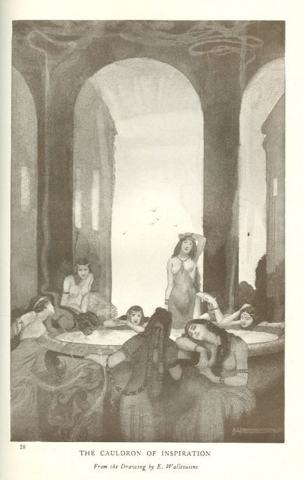
Wales's Otherworld — a rival kingdom ruled by Arawn, raided by Arthur for a magic cauldron, and only later flattened by Christian Welsh into a word for hell.
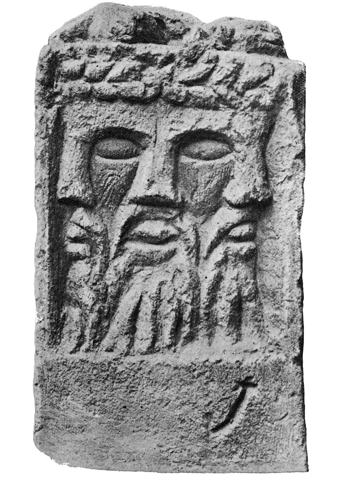
Master of every skill — the young god admitted to Tara because he alone could do all the crafts at once, and who killed his own grandfather Balor.
The good god — not morally good but good at everything: the club-bearing, cauldron-owning father figure of the Tuatha De Danann, and their crudest comedian.
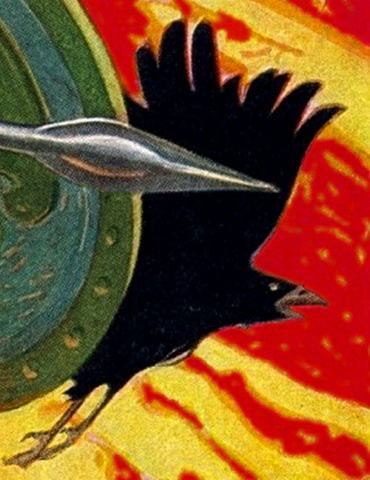
The great queen of war and fate — a shape-shifting Irish goddess who takes crow form above the battlefield and decides its outcome before it is fought.
Sources & Further Reading
- 1.Immram Brain (The Voyage of Bran son of Febal), Old Irish, c. 8th century.
- 2.Echtra Condla (The Adventure of Connla), Old Irish.
- 3.Serglige Con Culainn (The Wasting Sickness of Cu Chulainn), Middle Irish.
- 4.Micheal Coimin, Laoi Oisin ar Thir na nOg (The Lay of Oisin in the Land of the Young), c. 1750.
- 5.MacKillop, James. Dictionary of Celtic Mythology. Oxford University Press, 1998.
- 6.Koch, John T. (ed.). Celtic Culture: A Historical Encyclopedia. ABC-CLIO, 2006.
- 7.Green, Miranda J. Dictionary of Celtic Myth and Legend. Thames & Hudson, 1992.
Spot an error or have a source to suggest? Write to info@viseterna.com. We cite primary sources and modern scholarship, and we correct fast.