
The Fomorians (Fomoire)
Ireland's monstrous sea-people — raiders, tribute-takers and kin to the gods they fight, led by Balor of the destroying eye.
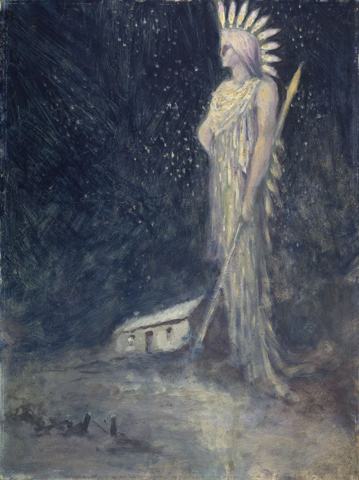
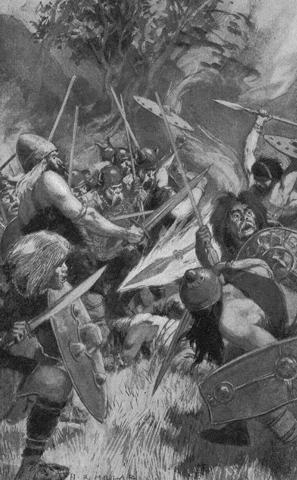
The Fomorians, John Duncan, 1912 · Public domain · source
What Their Name Means, and Does Not
The Fomorians — Old Irish Fomoire, modern Fomhoraigh — are the hostile supernatural race of medieval Irish literature, opposed in turn to every people who take Ireland in the pseudo-historical scheme. The name's meaning is genuinely uncertain, and the uncertainty is worth stating up front because the popular version is almost certainly wrong 5,6.
The familiar gloss reads fo-muire, "under the sea," which fits their association with the ocean and with the northern islands, and was accepted by earlier writers. Most current philology prefers a different second element: fo plus a root mor meaning something like "phantom," "terror" or "spectre" — the same element that sits in English nightmare and in Old Norse mara. On that reading they are "under-demons" or "nether phantoms," beings of the underneath rather than specifically of the water, and the sea-associations are an accretion the texts themselves may have built from the folk etymology 5,6. Neither derivation is settled, and both are still cited.
Their traditional description is monstrous — one-eyed, one-armed and one-legged in some late accounts, goat-headed in others — but the earliest and most important text does not describe them that way at all 1,6,7.
Kin, Not Aliens
Cath Maige Tuired, the central saga for the Fomorians, is emphatic on a point that most retellings drop: the Fomorians and the Tuatha De Danann are related by marriage and blood at nearly every level. Bres, the king the Tuatha De elect, is the son of the Fomorian Elatha and the Tuatha De woman Eriu. Lugh, the champion who destroys them, is himself the grandson of the Fomorian king Balor through his mother Ethniu. The Dagda sleeps with a Fomorian woman who then turns her own arts against her people 1,4,7.
This makes the second battle of Mag Tuired a civil war rather than an invasion, and it is why readings that cast the Fomorians as pure chaos opposed to pure order tend to fall apart on contact with the text. Marie-Louise Sjoestedt's influential formulation — the gods of the tribe against the powers outside the tribe — captures something real, but Cath Maige Tuired keeps blurring the line, and John Carey's work on the pseudo-histories argues that these genealogies are doing deliberate theological and political work for their monastic compilers rather than preserving a clean pagan dualism 4,7.
Tribute and Tyranny
Their function in the story is extraction. In Lebor Gabala Erenn the Fomorians harass each successive settlement of Ireland: they overcome the people of Partholon, and they impose on the people of Nemed a tribute of two-thirds of their corn, their milk and their children, collected every Samhain at Mag Cetne — the demand that provokes the assault on Conand's tower on Tory Island, in which the Nemedians destroy the tower and are themselves nearly annihilated 2,6.
The tyranny in Cath Maige Tuired is subtler and, as literature, far better. Bres, half-Fomorian, becomes king of the Tuatha De after Nuada loses his arm and with it his fitness to rule. Bres is beautiful and useless: he lets Fomorian tribute fall on Ireland, sets the Dagda to digging ditches and Ogma to hauling firewood, and — the sin the text lingers on — keeps no hospitality, so that the knives of his household are never greased and his ale-horns never wet. It is a satire by the poet Cairbre on exactly that failure that raises blisters on his face and ends his reign, the first satire made in Ireland 1,5.
Balor of the Baleful Eye
Their king in the second battle is Balor, Balor Birugderc, "Balor of the piercing eye," whose single eye is opened by four men lifting its lid with a polished handle and whose gaze destroys whatever it falls on. The text explains it as an accident of exposure to his father's druids' poisonous brew 1,6.
A prophecy that his grandson will kill him leads Balor to shut his daughter Ethniu in a tower; the standard folk versions have her reached anyway by Cian of the Tuatha De, and Lugh is the result. At Mag Tuired the grandson puts a sling-stone through the opening eye and drives it out the back of the skull, so that the destroying gaze falls on the Fomorian host behind him 1,6. The motif — the prophesied grandson, the tower, the eye — is one of the most widely collected in modern Irish and Scottish oral tradition, where Balor appears as Balor of the Evil Eye and is often localised to Tory Island 3,6,8.
Other named Fomorians include Elatha, Indech mac De Domnann, Tethra, Conand, and Cichol Gricenchos, "the footless," who leads them against Partholon in the earliest of the invasions 2,6.
Reading the Fomorians
Nineteenth-century writers liked to make them a memory of a displaced aboriginal population, or of Viking raiders — the sea, the northern islands, the tribute, the tower. Neither reading holds up. The Fomorian material is older than the Viking Age in its essentials, and the "aboriginal race" theory belongs to a period of scholarship that read invasion myths as garbled ethnography; current work treats Lebor Gabala as a learned construction assembled to give Ireland a place in biblical world-history, in which the Fomorians are one of the pieces the compilers had to fit 4,5,6.
What they are within the literature is clearer. They are the counter-power: the necessary opposite that gives the Tuatha De something to be sovereign against, and — because the two races keep intermarrying — a permanent reminder that the boundary is porous. When the Tuatha De themselves are defeated by the Milesians and withdraw into the Otherworld, they take up a position not entirely unlike the one the Fomorians held 1,2,7.
Continue Exploring
Not an afterlife but a parallel country — the sid mounds, the islands west of the sea, and the aos si who kept Ireland after they lost it.
A medieval synthetic history of Ireland: six waves of settlers, the Tuatha De Danann, and the Gaelic Milesians, engineered to answer to the Bible.
The Gaelic quarter day that opened winter and the Otherworld alike in medieval Irish literature — not, despite a popular myth, the name of a god of the dead.
The mother goddess of the Tuatha De Danann — and the most famous Irish deity who may never have existed under that name.
Ireland's race of gods — arriving with four treasures from four lost cities, winning Ireland twice, then losing it once and withdrawing into the mounds.
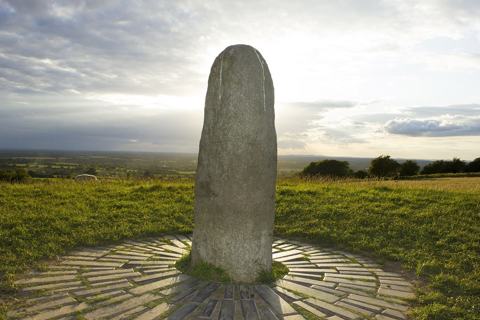
Four wonder-objects the Tuatha De Danann brought to Ireland: a screaming stone, an unstoppable spear, an inescapable sword, and a cauldron that never runs dry.
Also mentioned inBalor of the Evil EyeBrigid (Brigit, Brighid)Nuada (Nuada Airgetlam)Ogma
Sources & Further Reading
- 1.Cath Maige Tuired: The Second Battle of Mag Tuired, ed. and trans. Elizabeth A. Gray. Irish Texts Society vol. 52, 1982 (CELT edition).
- 2.Lebor Gabala Erenn (The Book of the Taking of Ireland), ed. R. A. S. Macalister. Irish Texts Society, 1938-1956.
- 3.The Metrical Dindshenchas, ed. and trans. Edward Gwynn. Royal Irish Academy, 1903-1935.
- 4.Carey, John. The Irish National Origin-Legend: Synthetic Pseudohistory. Department of Anglo-Saxon, Norse and Celtic, University of Cambridge, 1994.
- 5.Koch, John T. (ed.). Celtic Culture: A Historical Encyclopedia. ABC-CLIO, 2006.
- 6.MacKillop, James. Dictionary of Celtic Mythology. Oxford University Press, 1998.
- 7.Sjoestedt, Marie-Louise. Gods and Heroes of the Celts. Trans. Myles Dillon. Methuen, 1949.
- 8.Green, Miranda J. Dictionary of Celtic Myth and Legend. Thames & Hudson, 1992.
Spot an error or have a source to suggest? Write to info@viseterna.com. We cite primary sources and modern scholarship, and we correct fast.