
Aengus (Oengus, Angus Og)
The young god of Brú na Bóinne — conceived in a stolen day, owner of a house won by a pun, and the lover who followed a dream into a lake of swans.
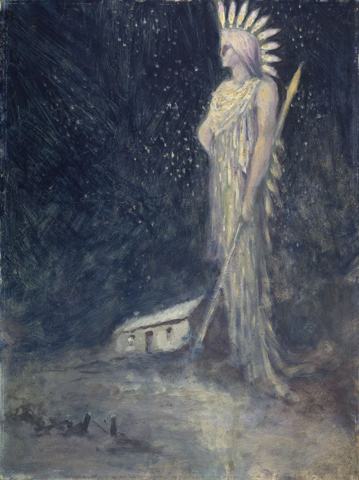
Angus Og, God of Love and Courtesy, Putting a Spell of Summer Calm on the Sea, John Duncan, 1908 (National Galleries Scotland) · Public domain · source
Conceived in a Day That Did Not Happen
Aengus — Old Irish Oengus, also Oengus Mac ind Oc or Aengus Og, "the young son" — is the Irish god of love, youth and poetic inspiration, and one of the Tuatha De Danann. He is the son of The Dagda and Boand, the goddess of the river Boyne, and the circumstances of his conception are the tradition's first joke at his expense 1,5,6.
Tochmarc Etaine tells it directly. Boand is the wife of Elcmar, and the Dagda sends Elcmar away on an errand while holding the sun still, so that nine months pass in what Elcmar experiences as a single day; Aengus is conceived, carried and born inside it, and the husband never knows 1,6. The epithet Mac ind Oc is explained in the text as "son of the young ones," because, in the phrase the story gives Boand, young is the mother and young the father — a gloss that scholars generally read as the tale accounting for a title it had inherited rather than inventing one 1,6,8.
He is fostered by Midir of Bri Leith, and it is Midir's household that raises him, which matters later: much of what Aengus does in the sagas is done on someone else's behalf 1,6.
Winning Brú na Bóinne
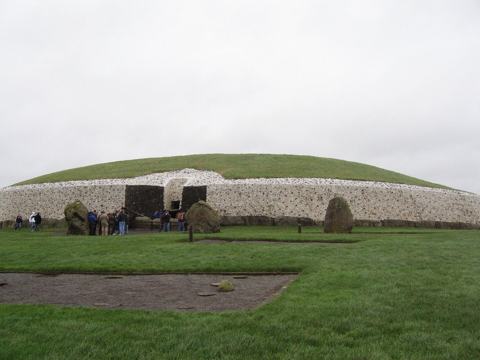
Aengus's house is the great Neolithic passage-tomb complex on the Boyne — Brug na Boinne, the Brug of the Boyne, identified in the tradition with the monuments at Newgrange, Knowth and Dowth. How he gets it is the tradition's best-known verbal trick 1,3,6.
Told to ask for the Brug for a day and a night, Aengus does so, and when the owner returns to claim it back he refuses to leave: it is days and nights that make up all of time, and the loan was therefore permanent. Which owner he outwits varies. In Tochmarc Etaine the dispossessed party is Elcmar, and the Dagda coaches his son through the manoeuvre; in other versions Aengus plays the trick on the Dagda himself, after the father has parcelled out the sid-mounds to all the other Tuatha De and left his son with nothing 1,3,6. The variation is a good example of how Irish material reassembles the same motif around different pairs of characters, and no version is more "original" than the others in the surviving evidence 6,7.
The identification of the Brug with the Boyne monuments is one of the few places where Irish myth and Irish archaeology sit on the same ground. Newgrange was built roughly three thousand years before the earliest of these texts, and the medieval writers plainly knew the mounds were older and stranger than anything in their own history; the Dindshenchas treats the whole valley as a landscape of the Otherworld 3,6,7.
The Dream
Aislinge Oenguso, "The Dream of Oengus," is a short Old Irish tale and the piece of literature most responsible for his reputation. Aengus is visited nightly by a woman he cannot reach, and he wastes away with love-sickness for a person he has only dreamed. The Tuatha De search Ireland for a year to find her 2,6.
She is Caer Ibormeith, "yew berry," daughter of Ethal Anbuail of a Connacht sid. Aengus finds her at a lake with a great company of girls, each pair chained with silver — and learns the condition: Caer takes the form of a swan every second year at Samhain, and he may have her only if he can pick her out of the flock and only in her bird shape. He goes to the lake at Samhain, names her, and takes swan form himself; they circle the lake three times and fly away, and their singing puts everyone who hears it asleep for three days and nights 2,6,8.
The story is unusual in the corpus for having no battle, no death and no trick played on anyone, and for turning entirely on recognition. It also gave modern Irish poetry one of its most reused images — Yeats's "The Song of Wandering Aengus" is a reception of it rather than a version of it, and the wandering, the silver apples and the glimmering girl are Yeats's, not the medieval tale's 6,7.
Protector, Mourner, Intervener
Aengus's other appearances are almost all interventions on behalf of lovers. In Tochmarc Etaine he helps his foster-father Midir win Etain, shelters her when Midir's jealous first wife transforms her, and builds her a sunlit bower of glass that he carries with him 1,6. In Toruigheacht Dhiarmada agus Ghrainne he is the foster-father and protector of Diarmuid ua Duibhne, repeatedly spiriting the eloping couple out from under the pursuit of Finn McCool; when Diarmuid is finally killed by the boar at Ben Bulben and Finn withholds the healing water, Aengus carries the body back to the Brug and puts a soul into it so that he can speak with him each day 4,6.
That last detail is characteristic. Where other Irish gods win or lose, Aengus preserves — a house, a lover, a foster-son, a voice after death. Scholars have noted that the youthful divine son who acquires a dwelling by cleverness has analogues elsewhere in Indo-European material, though the Irish evidence is literary and late enough that any reconstruction stays speculative 6,7,8.
Names and Afterlife
He accumulates titles: Mac ind Oc, Aengus Og, and in Scottish Gaelic tradition Angus Og, where he shades into a general figure of youth and summer 6,7. The Scottish Celtic Revival painters, John Duncan chief among them, made him a standard subject, and Duncan's 1908 canvas of Angus Og calming the sea with birds circling his head is the image most people now carry — a nineteenth-century idea of the god, built from the medieval texts but not found in them, and worth labelling as such 6,7.
What the medieval material actually gives is narrower and better: a god associated with a specific place on a specific river, whose stories are about wanting something badly enough to take an unusual route to it 1,2,3,6.
Continue Exploring
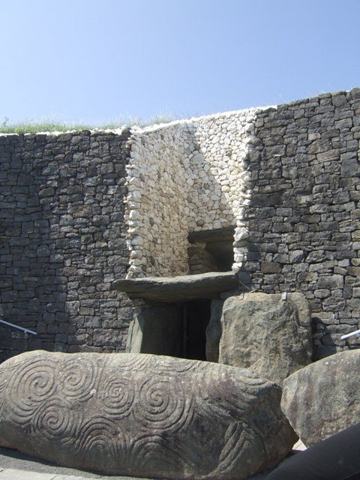
A 5,000-year-old passage tomb on the Boyne, built for the winter solstice centuries before the Celts arrived — later remembered as the Dagda's own hall.
Not an afterlife but a parallel country — the sid mounds, the islands west of the sea, and the aos si who kept Ireland after they lost it.
The good god — not morally good but good at everything: the club-bearing, cauldron-owning father figure of the Tuatha De Danann, and their crudest comedian.
Warrior-poet, leader of the Fianna, and the hero who burned his thumb on the Salmon of Knowledge — Ireland's most widely told legend.
The Irish sea god — ferryman between worlds, master of illusion and the mist of invisibility, and the presiding figure of the Otherworld voyages.
The mother goddess of the Tuatha De Danann — and the most famous Irish deity who may never have existed under that name.
Sources & Further Reading
- 1.Tochmarc Etaine (The Wooing of Etain), ed. and trans. Osborn Bergin and R. I. Best, Eriu 12, 1938 (CELT edition).
- 2.Aislinge Oenguso (The Dream of Oengus), ed. Francis Shaw. Browne & Nolan, 1934.
- 3.The Metrical Dindshenchas, ed. and trans. Edward Gwynn. Royal Irish Academy, 1903-1935.
- 4.Toruigheacht Dhiarmada agus Ghrainne (The Pursuit of Diarmuid and Grainne), Early Modern Irish.
- 5.Lebor Gabala Erenn (The Book of the Taking of Ireland), ed. R. A. S. Macalister. Irish Texts Society, 1938-1956.
- 6.MacKillop, James. Dictionary of Celtic Mythology. Oxford University Press, 1998.
- 7.Koch, John T. (ed.). Celtic Culture: A Historical Encyclopedia. ABC-CLIO, 2006.
- 8.O Cathasaigh, Tomas. Coire Sois: The Cauldron of Knowledge. University of Notre Dame Press, 2014.
Spot an error or have a source to suggest? Write to info@viseterna.com. We cite primary sources and modern scholarship, and we correct fast.